How Insurance Closed the Strait of Hormuz
No navy blocked the Strait. No mines were laid. The world's most important energy chokepoint was closed by an actuarial judgment. A sourced analysis of JWLA-033, the $20B DFC facility, and the insurance mechanism that commercially closed Hormuz.
The Mechanism
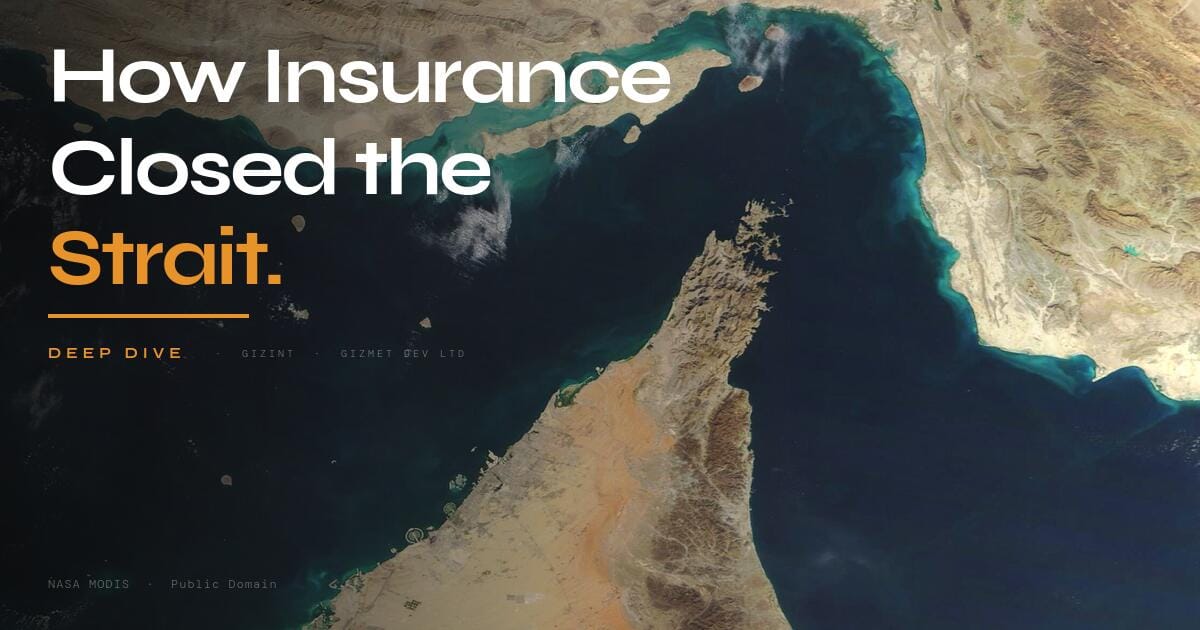
On 3 March 2026 — four days after the US-led campaign against Iran began — the Lloyd's Market Association Joint War Committee issued Circular JWLA-033. The circular expanded the JWC's Listed Areas to include the entire Persian Gulf, Gulf of Oman, Strait of Hormuz, Arabian Sea, Gulf of Aden, and Southern Red Sea.
Five non-belligerent states — Bahrain, Djibouti, Kuwait, Oman, and Qatar — were added to the listed area. None are participants in the conflict. All are victims of it.
The circular took effect at 0001Z on 9 March 2026.
Any vessel entering a JWC-listed area requires additional war-risk insurance cover at punitive rates — currently 1-3% of hull value per transit, escalating to 2.5-7.5% by mid-March (Lloyd's List, 3 and 11 March 2026). For a $100M Very Large Crude Carrier, that is $1M to $3M per voyage at early-March rates. US-, UK-, and Israeli-flagged vessels face approximately 3x the standard war-risk markup (Lloyd's List, 3 March 2026).
Between 1 and 5 March, seven P&I clubs — Gard, Skuld, NorthStandard, London P&I Club, the American Club, Steamship Mutual, and The Swedish Club — issued cancellation notices for charterers' liability war-risk extensions, effective 5 March 2026. Japan P&I Club followed with a separate notice the next day. The cancellations were triggered by reinsurers exercising 72-hour exit clauses on these non-poolable, fixed-premium products. Mutual P&I cover and hull war cover through the London market technically survived — all twelve International Group clubs subsequently arranged buybacks at 0.04-0.06% of limit purchased — but the practical effect was devastating: replacement coverage at those rates made Gulf operations economically unviable for most operators.
The strait was closed by three interlocking mechanisms, not one. The JWC listing imposed punitive hull premiums. The P&I cancellations removed charterers' liability cover. And the physical threat — IRGC transit warnings, active hostilities — ensured that no insurer's willingness to price risk could substitute for the risk itself.
How It Happened: Ten Days
The insurance withdrawal did not occur in a single event. It operated as a ratchet across a ten-day window.
| Date | Day | Event |
|---|---|---|
| 28 Feb | 0 | US-led campaign against Iran begins |
| 1-2 Mar | 1-2 | Reinsurers invoke 72-hour cancellation clauses on P&I war-risk extensions. VLCC charter rates spike to $423,736/day — a 94% increase from the 27 February close of $218,154 (Baltic Exchange TD3C MEG-China). Hormuz transits begin declining. |
| 3 Mar | 3 | JWLA-033 issued. Five non-belligerent states added to listed area. Daily transits fall to ~13 (CSIS, via Starboard Maritime AIS). |
| 5 Mar | 5 | Seven P&I club cancellations take effect. Daily transits decline further toward single digits. |
| 6 Mar | 6 | VLCC Kalamos fixed at $770,000/day by Bharat Petroleum (Yanbu to India west coast, Baltic Exchange via Tankers International). DFC announces $20B reinsurance facility. |
| 7 Mar | 7 | WTI crude posts 35.6% weekly gain — the largest since the contract's inception in 1983 (LSEG, via CNBC, 7 March 2026). |
| 9 Mar | 10 | JWLA-033 takes effect at 0001Z. Daily transits collapse to approximately 2 — both Iranian-flagged (Windward, 9 March 2026). Non-Iranian commercial transit effectively ceases. |