GIZINT — The Daily Brief | Issue 005
Day 14: The Iran campaign has no identifiable ceasefire mechanism and is escalating. We assess the week of 17-23 March presents the highest convergence of military and financial risk since the campaign began.
AT A GLANCE
- The US-Israeli campaign escalated on Day 14 with the "highest volume of strikes" of the war, while three contradictory Iranian leadership signals in 12 hours reveal there may be no credible interlocutor for ceasefire negotiations.
- The Iran campaign is producing opposite effects on the Ukraine conflict: the OFAC waiver hands Moscow a $10 billion revenue windfall while Russian force redeployments to counter Iranian threats enable Ukraine's first net territorial gains since 2023.
- The 16-22 March Ukraine trilateral has no agreed baseline after Peskov abandoned Istanbul, no Ukrainian participation in the Miami preparatory meeting, and a political figure replacing a GRU officer as Russian delegation head — the diplomatic conditions for a productive outcome do not exist.
I. PRINCIPAL ITEMS
PI-1: Iran Campaign Day 14 — Highest-Volume Strikes as Three Iranian Leadership Signals Contradict Within Hours
Changed from prior assessment: Ceasefire pathway via Oman/Egypt/Turkey assessed as possible. Now: all three channels assessed as non-functional. Mojtaba proof-of-life photographs confirmed AI-generated.
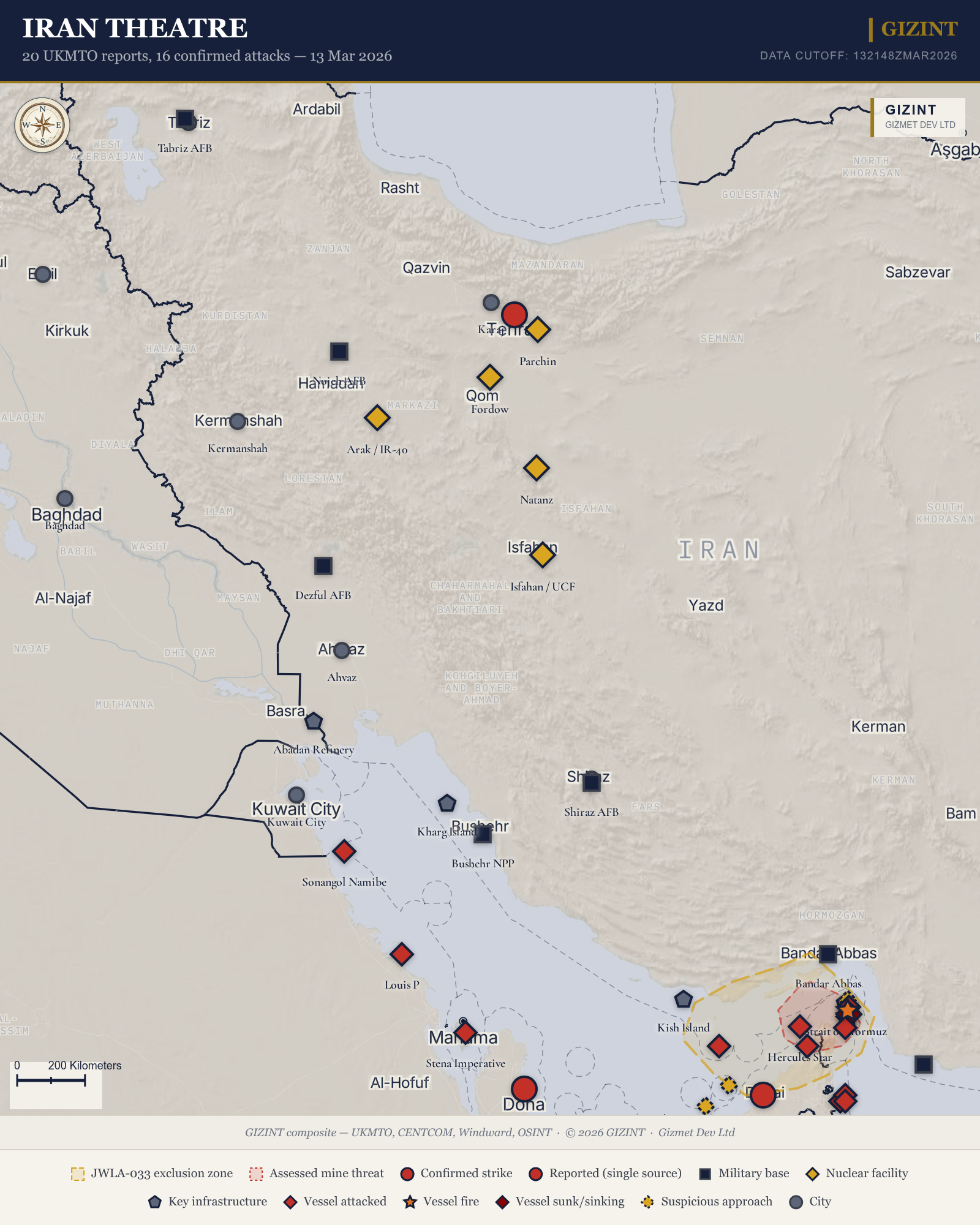
Hegseth declared 13 March the highest-volume strike day of the campaign, while three Iranian institutional voices issued mutually contradictory positions within hours — leaving no identifiable interlocutor for ceasefire negotiations.
CTP-ISW reported the combined force struck multiple internal security sites in Khuzestan Province overnight, including LEC Headquarters in Ahvaz, an IRGC Ground Forces headquarters, and the Artesh 292nd Armored Brigade (CTP-ISW Morning, 13 March). LEC systematic degradation across six provinces signals objectives extending beyond military capability into regime stability.
Over 15,000 enemy targets struck since 28 February (Hegseth/Gen Caine, 13 March). Alma Center: 160-190 ballistic missile launchers destroyed, ~200 blocked/disabled, ~150 active remaining (Alma Center, 13 March). Iranian drone attacks down 95 percent, ballistic missiles down 90 percent (CENTCOM/Hegseth, 13 March). We assess the loss of 11 MQ-9 Reapers and $4 billion in interceptor expenditure establishes a cost trajectory unsustainable without allied resupply. SM-3 Block IIA stockpile exhaustion within 4-6 weeks at current rates; PAC-3 MSE faces similar constraints with production at ~500/year against consumption in hundreds per week (CSIS; SOF News, 13 March). All effectiveness claims sourced from belligerent militaries; Planet Labs/Vantor 14-day satellite imagery embargo renders independent BDA unavailable until ~27 March.
US WIA reached approximately 200, up from 140 — an increase of 60 in 24-48 hours (DefenseScoop/Gen Caine, 13 March). Total US fatalities: 13 KIA plus 6 KC-135 non-hostile. France sustained its first combat death — Chief Warrant Officer Arnaud Frion, killed by a Shahed drone near Erbil (French MoD, 13 March). An Iraqi militia, Ashab Ahl al-Kahf, subsequently issued a 500-metre standoff warning against French interests — the specificity suggests operational planning rather than generic rhetoric.
The diplomatic picture fractured visibly. Trump told G7 leaders Iran is "about to surrender," then added "nobody knows who is the leader, so there is no one that can announce surrender" — an internal contradiction identifying the structural barrier to de-escalation (Axios, 13 March). Pezeshkian issued three-condition ceasefire terms via social media because no diplomatic channel exists. FM Araghchi stated categorically: "We are not asking for a ceasefire." Mojtaba Khamenei's first statement — written, read by another individual — endorsed permanent Hormuz closure and "additional fronts." BBC Verify confirmed the accompanying photographs were AI-generated (BBC Verify, 13 March). CTP-ISW notes the Houthis have not attacked since 28 February.
Trump announced CENTCOM "totally obliterated every MILITARY target in Iran's crown jewel, Kharg Island" — stating he had "chosen NOT to wipe out the Oil Infrastructure" but adding: "should Iran, or anyone else, do anything to interfere with the Free and Safe Passage of Ships through the Strait of Hormuz, I will immediately reconsider this decision" (Truth Social, 13 March, 18:54 ET). We assess this as the most consequential conditional escalation threat of the campaign: Kharg handles ~7 million bpd and its destruction would remove Iran's primary revenue stream permanently. The threat converts the Hormuz blockade from a cost Iran is imposing into leverage Washington holds. ISIS confirmed Israeli bunker-busters penetrated Parchin's Taleghan 2 site (ISIS, 12 March). Three Iranian missile entries into Turkish airspace have now occurred, including interceptions above Incirlik — which hosts ~50 US B61-12 nuclear gravity bombs (Alma Center, 13 March; FAS Nuclear Notebook). Turkey continues bilateral management, but three incursions create a threshold a fourth may exceed.
What changes if this assessment is wrong: If Iran's three contradictory signals represent a coordinated dual-channel strategy rather than institutional fracture, a ceasefire pathway may be closer than the surface signals suggest. The indicator: a single authoritative Iranian statement delivered through a recognised intermediary rather than social media, within 72 hours.
PI-2: Cross-Theatre — Iran Campaign Reshaping Ukraine as Russia Gains Revenue, Loses Territory, Enters Talks With No Baseline
Changed from prior assessment: OFAC waiver and trilateral treated as separate developments. Now: assessed as a single cross-theatre system — the Iran campaign is simultaneously funding Russia and creating the conditions for Ukrainian advances.
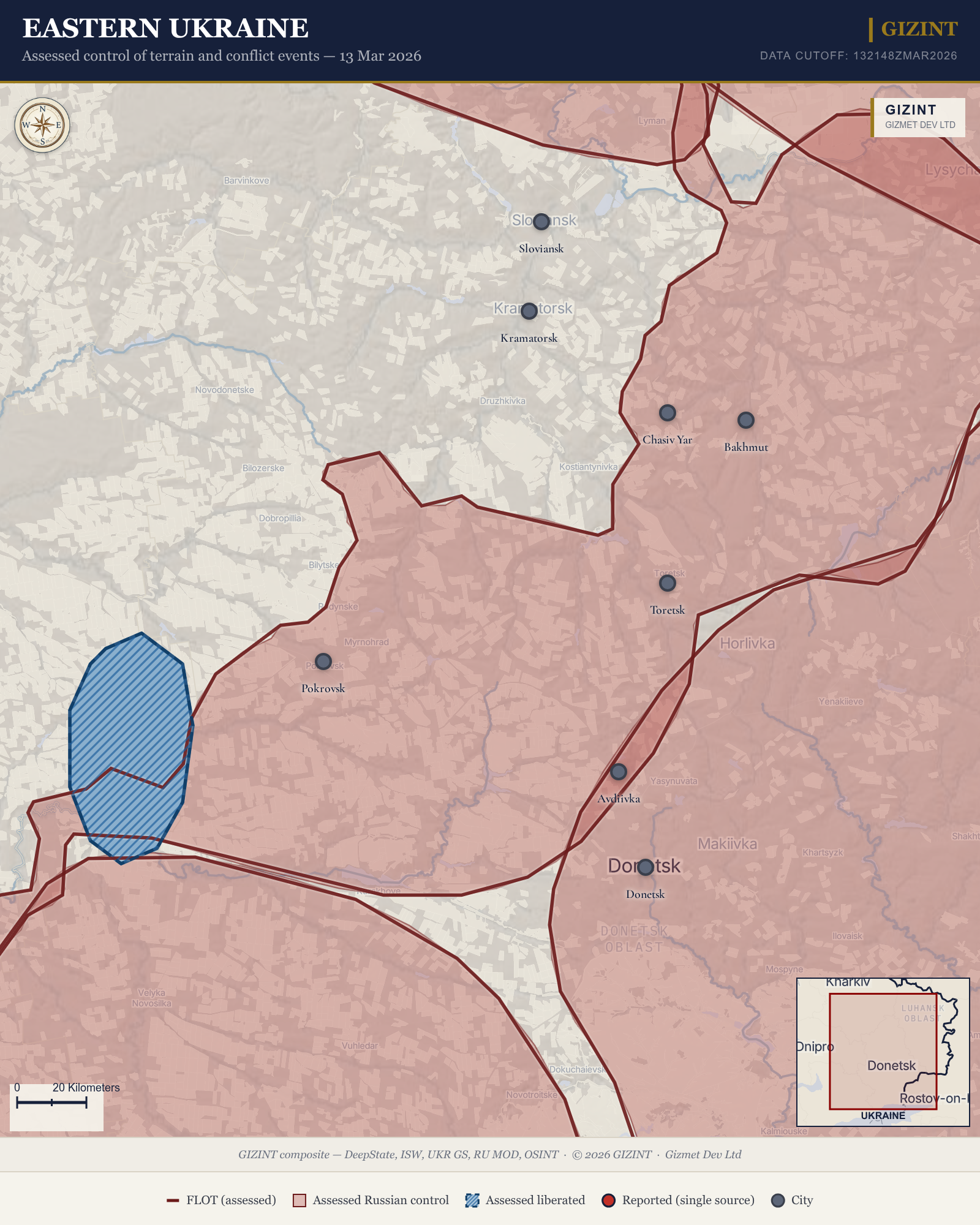
The Iran campaign is producing opposite effects on the same conflict: the OFAC waiver hands Moscow revenue without a reciprocal commitment, while the force management crisis it creates is enabling Ukraine's first net territorial gains since 2023.
The 30-day OFAC GL-134 waiver (12 March) permits delivery of Russian crude — including shadow fleet vessels Washington spent three years sanctioning — because the conventional tanker market cannot replace Hormuz-transiting capacity. Urals crude now commands a $1.50/bbl premium at Shandong delivery, up from $0.44 in February (Argus Media, March). The licence carries no reporting requirements and covers both Rosneft and Lukoil designations (OFAC, 12 March). Zelensky assessed the waiver delivers a $10 billion windfall to the Russian war effort; EU officials pushed back within hours (Euronews, 13 March).
On the battlefield, the 76th Guards VDV Division and 68th Army Corps have redeployed from Pokrovsk and Donetsk to Zaporizhia — forces intended for Russia's Spring-Summer 2026 offensive consumed as emergency reinforcements (ISW, 12 March). Ukrainian forces recorded approximately 460 square kilometres of territorial gains, roughly 10 percent of 2025 losses. February 2026 was the first month since the Kursk incursion where Ukraine captured more territory than it lost. Peskov abandoned the Istanbul 2022 framework — "the whole reality has changed" — the first public discarding of the document (TASS, 11 March). The Miami meeting (Witkoff/Kushner/Dmitriev, 11 March) produced no readout and no Ukrainian participation. Medinsky is replacing Kostyukov as Russian delegation head. The Swiss Federal Supreme Court rejected Gazprom's final appeal on the $1.4 billion Naftogaz judgment — enforceable with no further recourse, landing four days before talks where frozen Russian assets are a core issue (Swiss Federal Supreme Court, 13 March).
What changes if this assessment is wrong: If the OFAC waiver does not translate into measurable Russian revenue gains, or if the Miami meeting produced an undisclosed Ukrainian concession, the cross-theatre linkage weakens. The indicator: Russian compliance with any ceasefire commitment before the 30-day waiver expires on 11 April.
II. NARINT
Information environment assessment · State media monitored as IO terrain, not editorial source NOTE: Derived from state media monitoring, open-source cross-referencing, and static corpus pattern-matching.
NARRATIVE STATUS Iranian Leadership Coherence — FRACTURING
Three Iranian officials issued three incompatible positions within hours — conditions for ending the war, categorical rejection of ceasefire, and defiant escalation — with no visible coordination. Iranian domestic media carried only the unity message; defiance and rejection appeared exclusively on international channels. The gap is deliberate. The absence of proof-of-life from the senior leadership figure makes this operationally significant — if the defiance statements are institutionally authored rather than individually directed, the diplomatic question collapses to which institutional body holds negotiating authority.
Russia as Sanctions Beneficiary — STRUCTURAL (standing condition)
The OFAC waiver formalised what was already observable. Russian state media frames it exclusively as transatlantic fracture, omitting the revenue dimension — amplifying the US-EU split while suppressing the beneficiary narrative.
"Surrender" vs. "No Interlocutor" — EMERGING (contradictory)
Senior US officials simultaneously claimed Iran is "about to surrender" and that "nobody knows who the leader is." Multiple contradictory framings circulate with no dominant explanation, consistent with high-volume flooding patterns. The absence of a credible interlocutor is the operational reality.
PRC Force Posture Recalibration — DEVELOPING
PLAAF activity near Taiwan dropped to lowest since mid-2024 while allied Indo-Pacific restructuring accelerated. Chinese state media maintains diplomatic neutrality on Iran while commercial outlets convey energy anxiety. The restraint is strategic positioning ahead of the planned bilateral summit.
GLOBAL FRAMING MATRIX
| Ecosystem | Lead framing | Key language |
|---|---|---|
| Chinese state (Global Times, 13 Mar) | Technical/analytical — Hormuz capability, economic concern | "consequences beyond global energy markets" |
| Russian state (TASS, 13 Mar) | Transatlantic fracture — waiver as US concession | "global market cannot remain stable without Russian oil" |
| Turkish state (Anadolu, 13 Mar) | Factual-minimal — airspace incursion reported neutrally | "sirens heard" |
| Gulf media (Al Jazeera / Al Arabiya, 12 Mar) | Convergent condemnation, divergent framing | "big sense of betrayal" / IRGC direct command |
| Iranian state (PressTV, 12 Mar) | Unity and continuity — no coverage of ceasefire rejection | "Parliament hails election, pledges allegiance" |
| Western institutional (multiple, 13 Mar) | Contradictory — surrender alongside interlocutor absence | "about to surrender" / "nobody knows" |
WATCH
1. Turkish state media tone shift. Three airspace incursions reported neutrally. A shift to condemnatory framing would signal posture change from bilateral management toward collective response.
2. Iranian proof-of-life. Absence of visual confirmation forces all diplomatic signals through institutional proxies whose authority is unverifiable. Any confirmed appearance — or confirmed absence beyond the current window — restructures the ceasefire question.
III. REGIONAL ASSESSMENTS
Iran / Middle East — Day 14
Core operational and diplomatic assessment in PI-1. Additional PMESII elements below. Military: Hezbollah attack tempo reached 29 waves on 12 March (354 cumulative since 2 March), shifting toward domestic drone production as rocket/missile stockpiles deplete (CTP-ISW Evening, 12 March). IDF eliminated Abu Ali Rayyan, Radwan Force Commander for southern Lebanon (IDF/CTP-ISW, 12 March). Italy withdrew 100 troops from Camp Singara following an 11 March drone strike — the first European withdrawal from Iraq triggered by militia action (Italian MoD/La Repubblica, 12 March). Iranian-aligned proxies are pursuing a deliberate strategy to fracture the non-US coalition. Economic: Six vessels attacked near Basra in two days; Iraqi production collapsed 70 percent from 4.3 to 1.3 million bpd (OPEC/Platts, 12 March). JWC JWLA-033 expanded listed areas to include Bahrain, Kuwait, Oman, Qatar — the insurance market closed the Gulf before any government did. The US decommissioned all four Avenger-class minesweepers from Bahrain in 2025; replacements are three untested LCS MCM packages against an Iranian mine inventory of approximately 2,000 (ONI; CSIS, March 2026). Social: Iran: 1,444 killed, 18,551 wounded, 3.2 million displaced (Iran Health Ministry/UNHCR, 12-13 March). Lebanon: 687 killed including 98 children, 800,000 displaced (Lebanese MoH, 13 March). Both sides striking freshwater infrastructure — over 100 million Gulf residents depend on desalination; a Jebel Ali strike landed 12 miles from a 43-unit complex (OCHA, 12-13 March). Watch: Houthi activation or neutrality statement within 72 hours — simultaneous Hormuz and Bab el-Mandeb closure would push Brent well above $114. What changes if wrong: If Turkey absorbs further airspace violations without invoking consultation mechanisms, Iranian missile transit through NATO airspace becomes precedent.
Ukraine
Military: Ukrainian forces advanced near Kupyansk, western Zaporizhia, and southern Kostyantynivka — total gains approximately 460 square kilometres (ISW, 12 March). The 51st CAA reduced offensive intensity at Pokrovsk due to heavy losses. Starlink blocking continues generating decisive effects: 90 percent drone supply drop failure, Russian shift to fixed-wing reconnaissance they cannot produce at scale. Seven Storm Shadow missiles struck the Kremniy El microelectronics plant — Russia's second-largest, producing 1,200+ components for Iskander, air defence, and ICBM systems. SBU drones struck Tikhoretsk oil pumping station — the only supply branch delivering petroleum to Novorossiysk (SBU, 12 March). Political: Duma legislation (10 March) grants extraterritorial military authority to "protect Russian citizens abroad" — a statutory framework for intervention in states with Russian-speaking minorities, timed during maximum Western distraction (see Section V). Germany committed EUR 200 million additional air defence; Romania signed a strategic partnership including joint drone production (11-12 March). Watch: Whether 51st CAA's reduced tempo becomes sustained operational pause — if sustained, Starlink blocking and counterattacks are forcing strategic-level trade-offs unresolvable without fresh mobilisation. What changes if wrong: If Russia sustains eastern pressure despite redeployments, the counteroffensive window closes without operational-level disruption.
Indo-Pacific
Military: PLAAF flew 147 sorties into Taiwan's ADIZ in February — the lowest since President Lai took office, with zero incursions on 13 of 28 days (ISW-AEI, 6 March). Japan deploys upgraded Type 12 missiles (range ~1,000 km) at Camp Kengun on 31 March — one year ahead of schedule (Japan Times, 9 March). Taiwan approved LOA for M109A7, Javelin, TOW 2B, and HIMARS on 12 March (Focus Taiwan). Two Type 055 destroyers commissioned to the Eastern Theater Command — the first Type 055s in the ETC, each with 112 VLS cells (Global Times, 9 March). Information: Chinese firm Jingan Technology claims AI interception of B-2 Spirit radio signals during Iran strike operations (SCMP, 12 March). Requires verification. If confirmed: PRC extracting US operational methodology from an active combat theatre in real time. PRC HUMINT campaigns continue: Philippine DND/Navy arrests (4 March) and UK MP spouse arrest under the National Security Act 2023 (4 March) confirm systematic LinkedIn-based recruitment targeting junior personnel. Cross-theatre: 2,200 US Marines deploying from Okinawa to the Middle East (US DoD, 13 March), directly reducing Indo-Pacific force posture. Watch: PLA ADIZ sortie resumption above 300/month. If activity returns to pre-February levels in the Trump-Xi summit window (31 March-2 April), Beijing is using military pressure to frame negotiations. What changes if wrong: If PLAAF cessation is seasonal, Beijing retains full coercive capacity on short notice.
IV. FINANCIAL & ECONOMIC
| Indicator | Level | Delta | Source |
|---|---|---|---|
| Brent (ICE, May) | $103.14/bbl | +$2.68 (+2.67%) | ICE, 13 Mar |
| Gold (COMEX, Apr) | $5,066.03/oz | -3.0% from prior cycle | CME/COMEX, 13 Mar |
| VIX (CBOE) | ~27 | +~2.8 pts | CBOE, 12-13 Mar |
| 10Y UST | 4.285% | — | Fed H.15, 13 Mar |
| DXY | ~100.0 | Highest since Nov 2025 | ICE, 13 Mar |
BEA's second estimate revised Q4 2025 GDP from 1.4 to 0.7 percent — halving the advance figure before Hormuz (BEA 26-15, 13 March). Core PCE at 3.1 percent, Brent above $103, CME FedWatch pricing 94-96 percent hold. The combination is a stagflationary condition constraining conventional monetary policy. Four central banks decide within 72 hours starting 17 March — the FOMC dot plot is the primary intelligence.
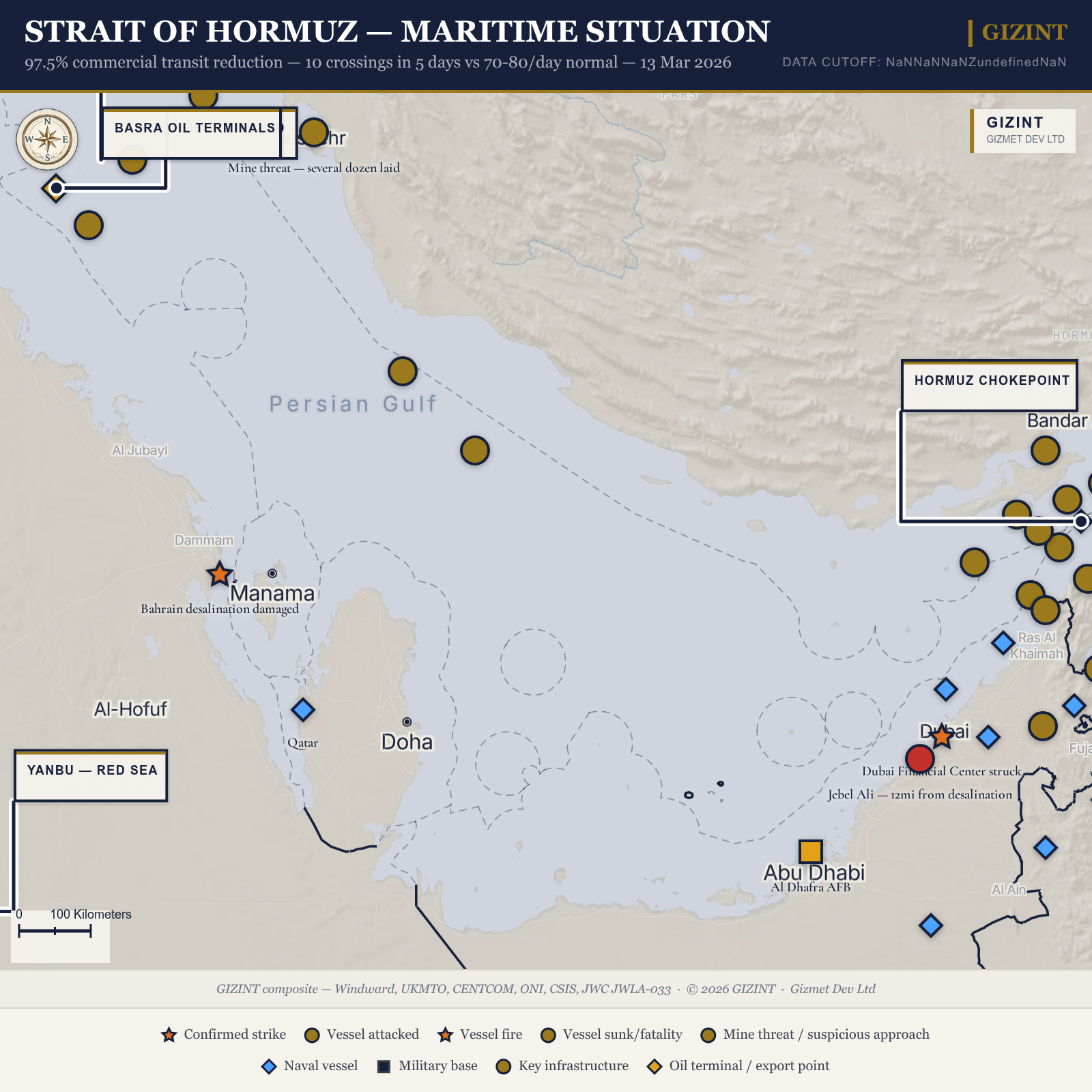
Commercial Hormuz transit has collapsed to 10 crossings in five days versus 70-80 per day normal — a 97.5 percent reduction (Windward, 13 March). Over 1,650 vessels GPS/AIS jammed; 36 broadcasting defensive nationality signals — unprecedented wartime adaptation. The IEA's record 400 million barrel release has not suppressed prices — strategic reserves address inventory, not transit. Trump's Kharg strikes — military targets only, oil infrastructure explicitly spared — convert the Hormuz blockade from a cost Iran is imposing into leverage Washington holds over Iran's remaining revenue. Physical SPR delivery begins next week; if the first tranche fails to move Brent below $100, the crisis premium is structural.
IEEPA tariff refund: the Supreme Court's 6-3 ruling struck down IEEPA tariff authority. CIT ordered reliquidation of $166 billion to 330,000+ importers (~$175 billion total liability per Penn Wharton). CBP system at 40-70 percent; interest accrues ~$23 million/day. Trump pivoted to Section 122 (Trade Act 1974), already challenged in Burlap and Barrel v. Trump (CIT, 9 March).
Watch: FOMC dot plot on 18 March. Fewer than two projected 2026 cuts would confirm the stagflationary policy trap. The IRGC "two defining weeks" window closing ~23 March overlaps with post-cluster market vulnerability — maximum financial risk if Tehran escalates.
V. LEGAL & REGULATORY
US constraints lead. War Powers 60-day clock at Day 14 — expires approximately 29 April. Both chambers rejected constraints on party-line votes (House 219-212, Senate 53-47). The appropriations track is remaining leverage: $11.3 billion spent in six days makes a supplemental mathematically certain. The Minab school strike (28 February — 168+ killed, predominantly girls aged 7-12) remains what we assess as the most consequential legal event of the campaign: a US Tomahawk struck using outdated DIA intelligence — a systemic targeting failure. Near-full Democratic Senate caucus letter to Hegseth; he vowed a "thorough probe" on 13 March but no independent investigation ordered (HRW, 12 March). OFAC contradiction: Washington simultaneously issues GL-134 permitting Russian crude sales, pursues DOJ forfeiture of $15.3 million from a dual-purpose Iranian-Russian oil network (DOJ, 6 March), and enters trilateral talks where sanctions are core leverage. Bessent's response to the Gallego-Liccardo 14-question letter is due 14 March. International. Naftogaz v. Gazprom: Swiss Federal Supreme Court rejected Gazprom's final appeal — $1.4 billion enforceable with immediate forced collection (13 March). Duma legislation (10 March) grants extraterritorial military authority to "protect Russian citizens abroad" — timed during maximum Western distraction (ISW, 10 March). ICJ Case 192: 20+ state interventions filed; Netherlands, Iceland, Namibia against Israel; US and Hungary in defence.
VI. TECHNOLOGY & CYBER
Offensive. CYBERCOM executed offensive operations against Iranian air defence and C2 networks within four hours of kinetic strikes on 28 February — the first confirmed US cyber-kinetic sequencing against a state adversary (Nextgov/FCW; Lawfare, March 2026). The 15,000+ target tempo is enabled by Palantir's Maven Smart System with AI-driven target processing, compressing kill chains from hours to seconds. The Minab strike demonstrates the systemic risk: AI-accelerated targeting with stale intelligence produces wrong targets at machine speed. Retaliatory. Iran's Electronic Operations Room claimed Stryker Corporation and Verifone simultaneously. Handala Hack exploited Stryker's Microsoft Intune MDM console — no custom malware, just remote wipe commands from a trusted management plane — wiping 200,000+ endpoints across 79 countries (Krebs on Security, 12 March; Stryker SEC 8-K). The template is now public: credential compromise + Global Admin = mass destruction via any MDM platform (400,000+ Intune-managed organisations globally). Unit 42 documented 60+ hacktivist groups conducting 149 attacks across 16 countries in 72 hours (Unit 42, 2 March). Pre-positioned. MuddyWater (MOIS) maintains Deno-based "Dindoor" backdoor access on a US bank, airport, Canadian non-profit, and defence-aerospace supplier — pre-positioned weeks before kinetic operations (Symantec, ~5 March; Unit 42, ~10 March). IOCONTROL malware remains dormant on 75+ US industrial control systems in fuel and water infrastructure, with 40,000+ internet-exposed devices matching the target profile (Claroty/Team82; CISA AA23-335A). Historical pattern: MOIS activated pre-positioned access 45-90 days after the Soleimani killing. We assess peak activation window at 14-28 March. The MuddyWater position on a defence-aerospace supplier during SM-3/PAC-3 stockpile crisis is the highest-consequence single pre-positioned access. Cross-theatre hardware. Russian Krasukha-4 and Murmansk-BN EW systems delivered to Iran by Il-76 (Defence Security Asia; Raksha Anirveda, March 2026). Kometa-M GNSS anti-jamming receivers confirmed in Shahed-136 production (DroneXL, 8 March). We assess this bidirectional hardware pipeline explains how Iran's Gulf GPS/AIS jamming (1,650+ vessels) exceeded indigenous capability. Ukraine front. Sandworm (APT44) deployed DynoWiper against Poland's power grid in January — the first confirmed destructive operation against a NATO member's critical infrastructure (ESET, January 2026). Ukrzaliznytsia struck by custom malware designated "act of terrorism" — targeting Ukraine's logistics backbone. Russia deployed TSPU deep packet inspection at ISP level, blocking 469 VPN services (HRW, 12 March). Google TAG assesses the defence industrial base is under "constant, multi-vector siege" from four state adversaries — targeting converges on interceptor production, the campaign's binding constraint.
VII. SIGNALS
1. Iran — No Ceasefire Interlocutor as IRGC Window Converges with Central Bank Cluster — Three contradictory leadership signals, AI-fabricated proof-of-life, no identifiable counterpart. The IRGC "two defining weeks" window closes ~23 March when four constrained central banks create maximum post-decision market vulnerability. Pezeshkian 72-hour window closing ~15 March will confirm whether any channel exists. (Defence / Financial) — Axios 13 Mar; CTP-ISW Evening 12 Mar; BEA 13 Mar; CME FedWatch 13 Mar
2. Indo-Pacific Restructures Under Iran Distraction — Taiwan approved $11.1 billion in US arms. Japan deploys Type 12 missiles one year early. PLAAF at lowest ADIZ sorties since May 2024. Meanwhile 2,200 US Marines deploy from Okinawa to the Middle East. Beijing's restraint is strategic — the campaign stretches US force posture without requiring PLA action. (Defence / Diplomacy) — Focus Taiwan 12 Mar; Japan Times 9 Mar; ISW-AEI 6 Mar; US DoD 13 Mar
3. OFAC Waiver and Naftogaz Create Opposing Financial Pressures for Trilateral — GL-134 expires 11 April with no reporting requirements; renewal becomes default if Hormuz remains closed. The Swiss court's rejection of Gazprom's final appeal makes $1.4 billion enforceable with immediate forced collection — precedent for sovereign-adjacent asset seizure four days before talks where frozen Russian assets are core. Moscow gains revenue from one conflict while losing assets from the other. (Financial / Legal) — OFAC 12 Mar; Swiss Federal Supreme Court 13 Mar
4. IAEA — No Safeguards Updates Since Campaign Inception — Six updates during the 12-Day War (June 2025). Zero during a larger conflict involving the same facilities, with E3 flagging Isfahan IFEP as possibly operational and bunker-busters confirmed at Parchin. Safeguards regime at its worst since DPRK withdrawal. (Legal / Defence) — IAEA 2-6 Mar; E3 Board statement 4 Mar; ISIS 12 Mar
STANDING ASSESSMENTS (Carried — mature signals requiring new evidence to upgrade)
- China parallel energy order — 11.7 million barrels shipped since 28 February, bilateral transit terms hardening. Structural condition.
- DFC reinsurance facility failure — Zero meaningful transit resumption. Insurance market has priced Hormuz closure as indefinite.
- CISA capacity gap — 38 percent operational (888/2,341), DHS shutdown Week 5. Stryker demonstrates the destructive template MuddyWater's pre-positioned access could execute.
- Russia concurrent vulnerabilities — Duma extraterritorial legislation, forced VDV/68th AC redeployment, Starlink blocking at 90 percent drone failure. Carried until new mobilisation or Pokrovsk resumption.
VIII. PIR / WATCH LIST
Status key: CRITICAL = active crisis, daily monitoring. ESCALATING = worsening, approaching threshold. STABLE = no significant change. DE-ESCALATING = improving. COLLAPSED = framework non-functional. RESOLVED = closed.
| # | PIR | Status | Key EEI |
|---|---|---|---|
| 1 | Iran campaign — ceasefire mechanism and operational trajectory | CRITICAL | Mojtaba proof-of-life; CENTCOM tempo reduction; IAEA access; Pezeshkian response |
| 2 | Strait of Hormuz — mine warfare and commercial reopening | CRITICAL | First mine detonation; DFC uptake (zero confirmed); Mojtaba statement effect on insurance |
| 3 | Russia-Ukraine — southern counteroffensive and force dilemma | ESCALATING | 51st CAA reconstitution; Ukrainian culmination; spring offensive disruption |
| 4 | GCC escalation threshold | CRITICAL | Saudi Enayati recall; emergency summit; any GCC state crossing to active strikes |
| 5 | Iranian cyber — OT targeting and CISA capacity gap | ESCALATING | Second destructive operation; Dindoor activation; CISA surge capacity |
| 6 | Cross-theatre linkage — OFAC waiver and Ukraine talks | CRITICAL | Russian crude deliveries at scale; EU objection; trilateral outcome; Naftogaz enforcement |
| 7 | Central bank cluster 17-19 March | ESCALATING | FOMC dots <2 cuts; ECB transitory vs structural; BoJ intervention trigger; IRGC window overlap |
IX. CORRECTIONS
Issue 002: Brent, gold, VIX, DXY corrected from stale data to 13 March settlements. US WIA updated to ~200 per DefenseScoop/Gen Caine 13 March briefing. All seven corrections sourced and reasoned. Corrections to date: 7 factual corrections across 5 issues.
X. SCHEDULE
14 March `PRIORITY` — Bessent response deadline: Gallego-Liccardo letter on OFAC waiver 15-16 March `PRIORITY` — Bessent-He Lifeng-Greer meeting, Paris; Pezeshkian 72-hour ceasefire window threshold 16-22 March `PRIORITY` — Ukraine-US-Russia trilateral talks; no confirmed date/venue; no agreed baseline 17-18 March `PRIORITY` — FOMC decision + SEP + dot plot (94-96% hold; dot plot is the intelligence) 18-19 March `ROUTINE` — ECB decision; BoE MPC decision 19 March `PRIORITY` — BoJ decision (USD/JPY 156-158 approaching 160 intervention trigger) ~23 March `PRIORITY` — IRGC "two defining weeks" window closes ~27 March `PRIORITY` — Planet Labs/Vantor satellite imagery embargo lifts — first independent BDA 26 March `ROUTINE` — HIMARS LOA expiry (Taiwan) 31 Mar - 2 Apr `PRIORITY` — Trump-Xi Beijing summit 29 April `ROUTINE` — War Powers 60-day clock expires Late April `ROUTINE` — CBP CAPE system delivery ($166B tariff refund; $23M/day interest)
XI. SOURCE INDEX
Section I — CTP-ISW Morning 13 Mar; CTP-ISW Evening 12 Mar; DefenseScoop 13 Mar; CENTCOM 12 Mar; Alma Center 13 Mar; SOF News 13 Mar; French MoD 13 Mar; IDF 12-13 Mar; Axios 13 Mar; ISIS 12 Mar; BBC Verify 13 Mar; CSIS; Planet Labs/Vantor; FAS Nuclear Notebook; Truth Social 13 Mar; OFAC GL-134 12 Mar; Argus Media Mar 2026; ISW 12 Mar; Swiss Federal Supreme Court 13 Mar; TASS 11 Mar; Zelensky 12 Mar; Euronews 13 Mar. Section II — State media OSINT: PressTV, TASS, Global Times, Anadolu, Al Jazeera, Al Arabiya (8-13 Mar). Section III — ISW Ukraine 12 Mar; ISW-AEI 6 Mar; China MFA 8-12 Mar; UNHCR 12 Mar; Lebanese MoH 13 Mar; Focus Taiwan 12 Mar; Japan Times 9 Mar; Global Times 9 Mar; SCMP 12 Mar; SBU 12 Mar; Ukrainian Air Force 13 Mar; Italian MoD/La Repubblica 12 Mar; OCHA 12-13 Mar; ONI; OPEC/Platts 12 Mar; Windward 13 Mar. Section IV — ICE 13 Mar; CME/COMEX 13 Mar; CBOE 13 Mar; Fed H.15 13 Mar; BEA 26-15 13 Mar; CME FedWatch 13 Mar; IEA 11 Mar; OFAC 12 Mar; CIT 12 Mar; Penn Wharton. Section V — Congress.gov; HRW 12 Mar; DOJ 6 Mar; Swiss Federal Supreme Court 13 Mar; ISW 10 Mar; ICJ 11-12 Mar; Liccardo 9 Mar. Section VI — Nextgov/FCW Mar 2026; Lawfare Mar 2026; Krebs on Security 12 Mar; Stryker SEC 8-K 12 Mar; Unit 42 2 Mar; Symantec ~5 Mar; Unit 42 ~10 Mar; Claroty/Team82; CISA AA23-335A; Defence Security Asia Mar 2026; DroneXL 8 Mar; ESET Jan 2026; HRW 12 Mar; Google TAG/Mandiant Feb 2026.
For informational purposes only. No editorial line. No advocacy. Assessment only. AI-assisted collection and drafting; all analytical assessments are human-directed. Errors: corrections@gizmet.dev Analytical register: "we assess" = high-confidence analytical judgment. "Available reporting suggests" = single-source or preliminary. "Reporting indicates" = multiple sources converging, not yet confirmed. AI Disclosure: This brief was produced with AI-assisted collection, synthesis, and drafting. All source selection, analytical judgments, confidence calibration, and editorial decisions are human-directed. The analytical methodology, source hierarchy, and assessment framework are proprietary to Gizmet Dev Ltd.