GIZINT — The Daily Brief | Issue 011
The IRGC has struck four of five announced energy targets and begun monetising the Hormuz blockade through a $2M-per-vessel toll corridor, while the Pentagon deployed 5,000 Marines with "ground option" language toward a war Congress has not authorised.
The IRGC has struck four of five announced energy targets and begun monetising the Hormuz blockade through a $2M-per-vessel toll corridor, while the Pentagon deployed 5,000 Marines with "ground option" language toward a war Congress has not authorised and cannot fund. We assess the conflict has entered an institutionalisation phase — both the blockade and the constitutional gap are hardening into durable conditions rather than crisis states.
- Toll corridor emerges: The IRGC is charging $2M per vessel for Strait of Hormuz transit while five nations negotiate terms and 21 signatories to a freedom-of-navigation statement commit zero warships.
- Ground option signals: The Pentagon deployed a dual-MEU force (~5,000 Marines) toward the Gulf with "ground option" language, three weeks ahead of schedule, while the Gottheimer War Powers Resolution can be forced to the House floor this week.
- Invisible leadership: Supreme Leader Mojtaba Khamenei and Quds Force commander Qaani issued written-only Nowruz statements — Day 21 with no physical appearance — while state media released an undated video and the Armed Forces separately threatened tourist sites worldwide.
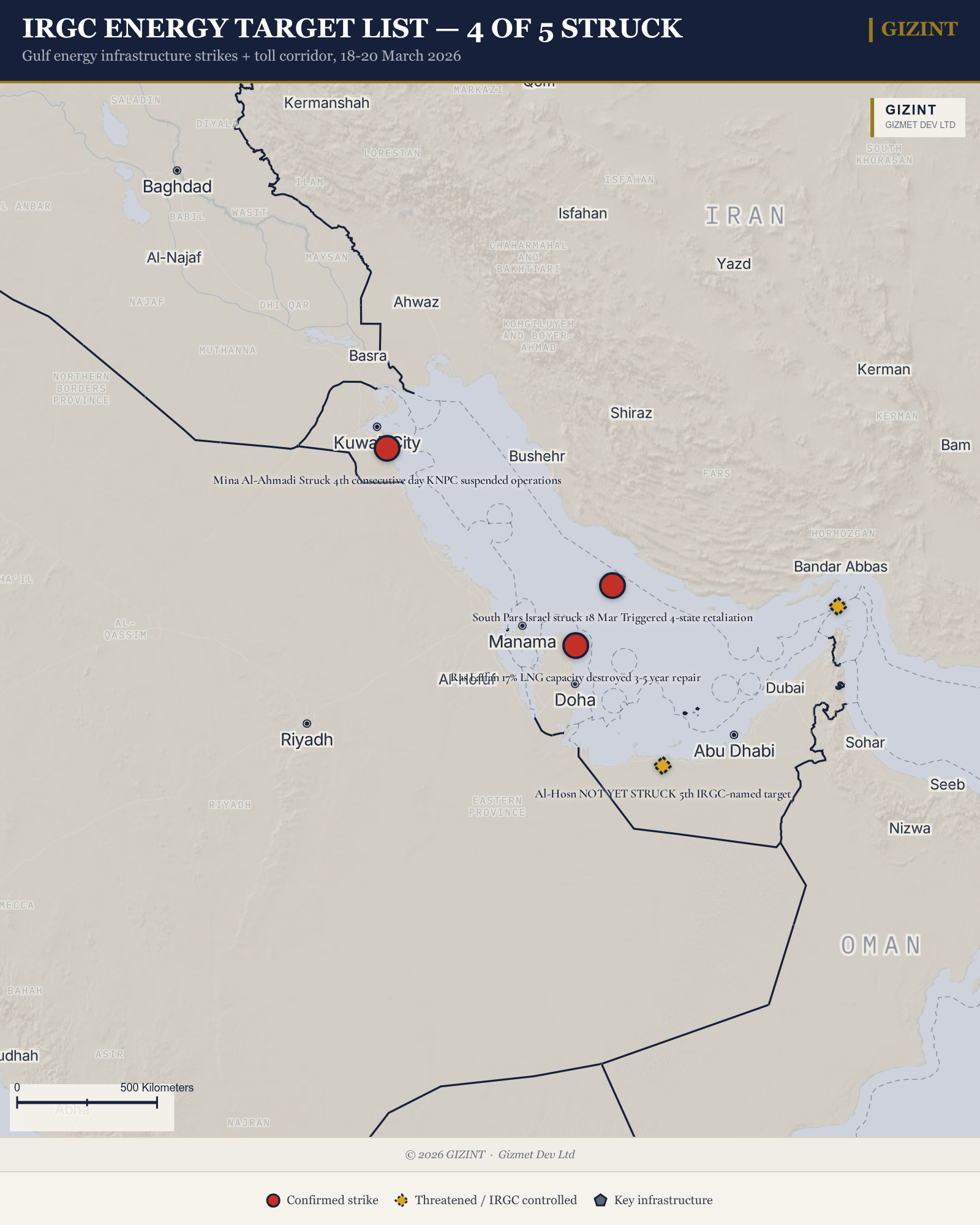
IRGC Energy Target List — Four of Five Hit, Blockade Monetised
The IRGC struck SAMREF on 19 March — the fourth of five announced energy targets — and established a toll corridor through the Strait that monetises the blockade at $2M per vessel.
Changed from prior assessment: SAMREF was the next expected target. Now: struck, and the blockade has acquired a commercial dimension with no modern precedent.
Iranian regime media named SAMREF as a target on 18 March; the strike followed within 24 hours (Saudi Defence Ministry; Critical Threats Project / Institute for the Study of War (CTP-ISW), 19 Mar). SAMREF, an Aramco-ExxonMobil joint venture processing 400,000 bpd, sits on Saudi Arabia's Red Sea coast — the last functioning export route bypassing the Strait. Crude loadings at Yanbu Port halted briefly before resuming (Reuters, 19 Mar). Mina Al-Ahmadi in Kuwait was struck again overnight 19-20 March — the fourth consecutive day of attacks on the facility — forcing Kuwait National Petroleum Company to suspend operations in several units (WSJ, 20 Mar). Only al-Hosn in Abu Dhabi remains from the IRGC's announced list.
The more consequential development is structural. Lloyd's List confirmed (20 Mar) that the IRGC has established a managed transit corridor through the Strait, charging approximately $2M per vessel. Ships must submit detailed ownership and cargo data through IRGC-linked intermediaries. Nine vessels have transited — two Indian LPG tankers, six bulk carriers, one Pakistani oil tanker — and India, Pakistan, Iraq, Malaysia, and China are negotiating formal access (CTP-ISW, 19 Mar; Lloyd's List, 20 Mar). IMO C/ES.36 confirmed 3,200 vessels carrying approximately 20,000 seafarers are confined west of the Strait; the Council proposed an evacuation framework — not a transit framework (IMO, 19 Mar). Traffic through the Strait has collapsed 97% below pre-conflict levels to 2.4 crossings per day (Windward, 18 Mar). *Update:* Parliament Speaker Ghalibaf stated on 17 March that "the Strait of Hormuz situation won't return to its pre-war status" — the most senior Iranian confirmation that the blockade is intended as a permanent condition, not a wartime measure (CTP-ISW Evening, 20 Mar).
Iraq compounded the supply shock on 20 March by declaring force majeure on all foreign-operated oilfields, citing security concerns (Reuters, 20 Mar). Production fell from 4.3M bpd to approximately 1.4M bpd for domestic refining. BP withdrew 1,700 staff from Rumaila; TotalEnergies pulled approximately 1,000 (MarketScreener, 20 Mar). We estimate combined Gulf supply under disruption or formal force majeure now approaches 18M bpd — two-thirds of OPEC+ production. Saudi officials have signalled prices could exceed $180/bbl if disruption persists through late April (WSJ, 19 Mar).
What changes if this assessment is wrong: If the IRGC toll corridor fails to formalise — if participating states face US secondary sanctions or if CENTCOM enforces free passage — the blockade reverts to pure denial and the monetisation precedent collapses. The oil price ceiling then depends on duration rather than mechanism.