GIZINT — The Daily Brief | Issue 012
We assess the Iran campaign's most consequential development is not the air war but the toll corridor — 90 vessels in 15 days, yuan payment, a G7 ally participating, and Iranian parliament legislating permanence.
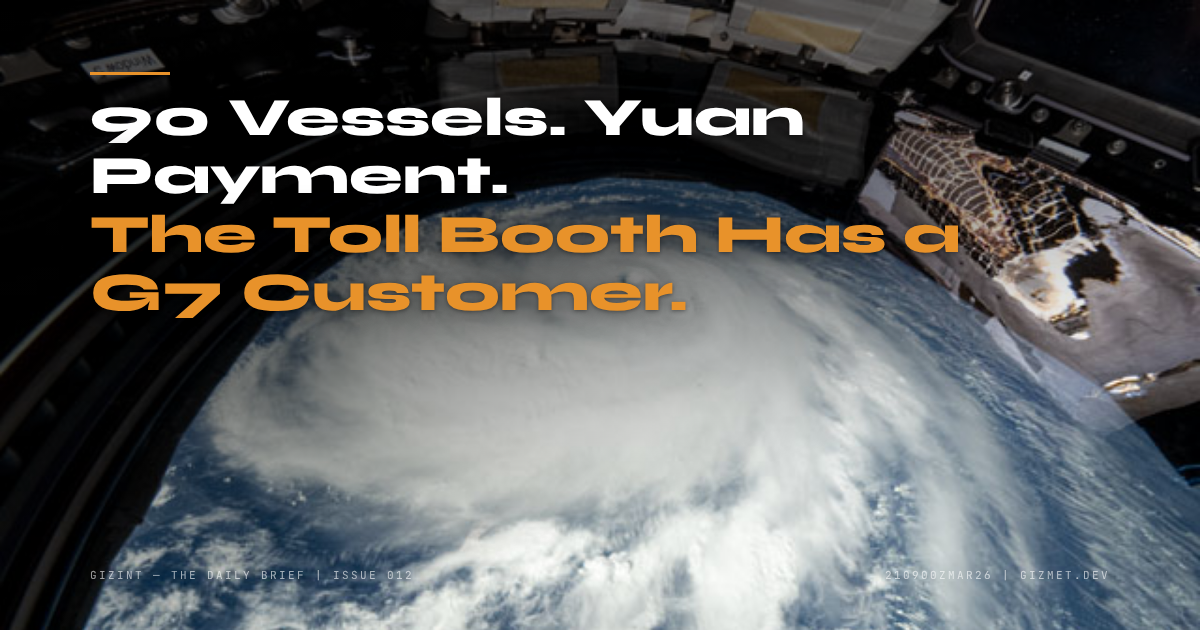
We assess the Iran campaign's most consequential development is not the air war but the toll corridor — 90 vessels in 15 days, yuan payment, a G7 ally participating, and Iranian parliament legislating permanence. The military campaign, the sanctions relief, the ground-force deployment, and the Hormuz windfall funding Russia's spring offensive are running simultaneously with no coordinating strategy visible on the public record.
- Toll corridor industrialised: Lloyd's List data reveals 89-90 vessels transited under IRGC clearance in the first 15 days — an order of magnitude above prior reporting — with Japan now paying in yuan, parliament drafting legislation, and senior officials declaring the regime permanent.
- Six-way policy divergence: The administration is fighting Iran, waiving Iranian oil sanctions, deploying Marines and the 82nd Airborne without an AUMF, facing a 30 March War Powers deadline, requesting a $200B supplemental that lacks votes — while its own ally's chief of staff says the campaign is only halfway done.
- Spring offensive enters ground phase: Russian mechanised assaults across multiple sectors since 17 March, battlefield air interdiction of Ukrainian logistics, and a central bank rate cut funded by EUR 510M/day in windfall revenues signal an offensive enabled by the Hormuz revenue surge.
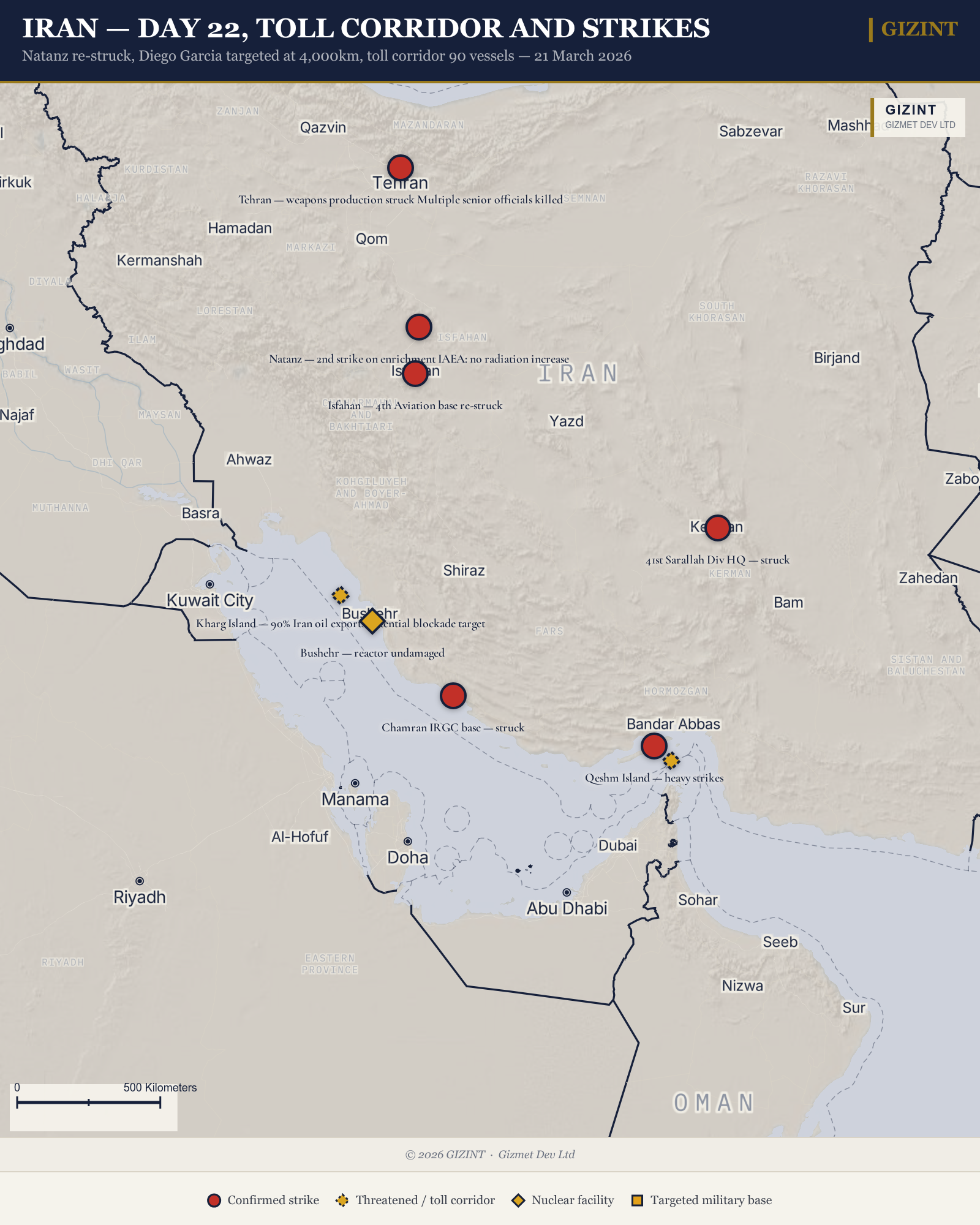
Toll Corridor Replaces International Order — 90 Vessels, Yuan Payment, G7 Acceptance
Lloyd's List Intelligence data covering 1-15 March shows approximately six vessels per day transiting the Strait of Hormuz under IRGC clearance at $2M per vessel — generating an estimated $180M in the first half of March alone (Lloyd's List, 18 Mar).
Three developments in the past 48 hours confirm the corridor is no longer improvised. First, Iran FM Araghchi announced on 21 March that Japanese-related vessels may transit the Strait, with reporting indicating yuan-denominated payment (Japan Times, 21 Mar; SCMP, 21 Mar). Japan sources 93% of its imported crude through Hormuz. A G7 treaty ally has accepted IRGC maritime authority and a non-dollar payment mechanism to access its primary energy supply. Second, Parliament Speaker Ghalibaf stated the "Strait of Hormuz situation won't return to its pre-war status" (X, 17 Mar), and Expediency Council member Mokhber described a "new regime for the Strait" (19 Mar). Parliament is drafting formal fee legislation. Third, six nations are now confirmed in the corridor — India, Pakistan, Iraq, Malaysia, China, and Japan — while the CENTCOM safe corridor and DFC reinsurance facility have attracted zero commercial uptake through Day 22 (CENTCOM, 21 Mar; DFC).
The corridor succeeds because it is cheaper than the alternative. JWC Circular 033 listed the entire Persian Gulf basin on 3 March, withdrawing commercial insurance cover (Lloyd's Market Association). War-risk premiums for a VLCC now run $3.6M-$6M per voyage — 1.5-3% of hull value, levels not seen since the 1980s Tanker War (S&P Global; Kennedys Law). The IRGC charges $2M. The market made a rational choice. Kpler data extending to 19 March shows 116 commodity crossings, up from 89-90 in the first 15 days (Kpler via AFP, 19 Mar). Araghchi's framing is precise: "the strait is open... closed only to ships belonging to our enemies" (21 Mar). This is selective enforcement that fragments any collective response by negotiating bilaterally with each transit state.
The yuan payment dimension extends well beyond energy logistics — if formalised, it establishes a precedent for non-dollar maritime commerce enforced by military coercion. Chinese state media is actively hedging the narrative, a signal that Beijing does not want ownership of a de-dollarisation mechanism enforced by military coercion.
The IRGC simultaneously escalated energy targeting. Mina al-Ahmadi refinery was struck on 20 March with fire at multiple units — the biggest single GCC energy facility hit of the campaign. The IRGC then published an evacuation map for Ras al-Khaimah (UAE) and warned of "crushing blows" — a sixth named target beyond the original five, indicating the target list is expanding rather than approaching completion.
Changed from prior assessment: Issue 011 tracked 9 individually reported transits, assessed as ad hoc. Lloyd's List data now reveals these were a fraction of a far larger operation running at scale from Day 1 — 89-90 vessels in 15 days, parliamentary legislation, permanent-regime rhetoric, G7 acceptance.
What changes if this assessment is wrong: If the corridor remains ad hoc rather than structural — if Japan's transit is a one-off emergency measure, parliament does not legislate, and volume collapses when the military campaign ends — then the post-war Hormuz order reverts to status quo ante.