GIZINT — The Daily Brief | Issue 013
We assess the 48-hour Hormuz ultimatum — deadline ~23:44 UTC 23 March — creates a binary fork in which neither path de-escalates: compliance is inconsistent with every statement from Tehran, and infrastructure strikes would trigger full Hormuz closure, retaliatory Gulf energy attacks, and explicitly
We assess the 48-hour Hormuz ultimatum — deadline ~23:44 UTC 23 March — creates a binary fork in which neither path de-escalates: compliance is inconsistent with every statement from Tehran, and infrastructure strikes would trigger full Hormuz closure, retaliatory Gulf energy attacks, and explicitly threatened cyber operations against US financial systems.
- Ultimatum expires 23 March: Trump's 48-hour deadline for Hormuz reopening lapses ~23:44 UTC 23 March; Iran's triple-institutional response — IRGC, Parliament, Army — rejected compliance and counter-threatened regional energy, desalination, and IT infrastructure destruction.
- Four war aims, none aligned: IDF Chief Zamir's "halfway" assessment implies three more weeks — directly contradicting Trump's "winding down" rhetoric and his ultimatum framework.
- Cyber retaliation authorised: Iran's Khatam al-Anbiya named "information technology" as a retaliation target for the first time — Iranian state cyber pre-positioning implants reach peak activation 28 Mar per published reporting.
Power Plant Ultimatum Expires 23 March — Neither Path De-Escalates
Trump's 48-hour demand for Hormuz reopening expires ~23:44 UTC 23 March, but the administration's own Treasury Secretary contradicted the premise four times in five days — and Iran's triple-institutional response has foreclosed compliance.
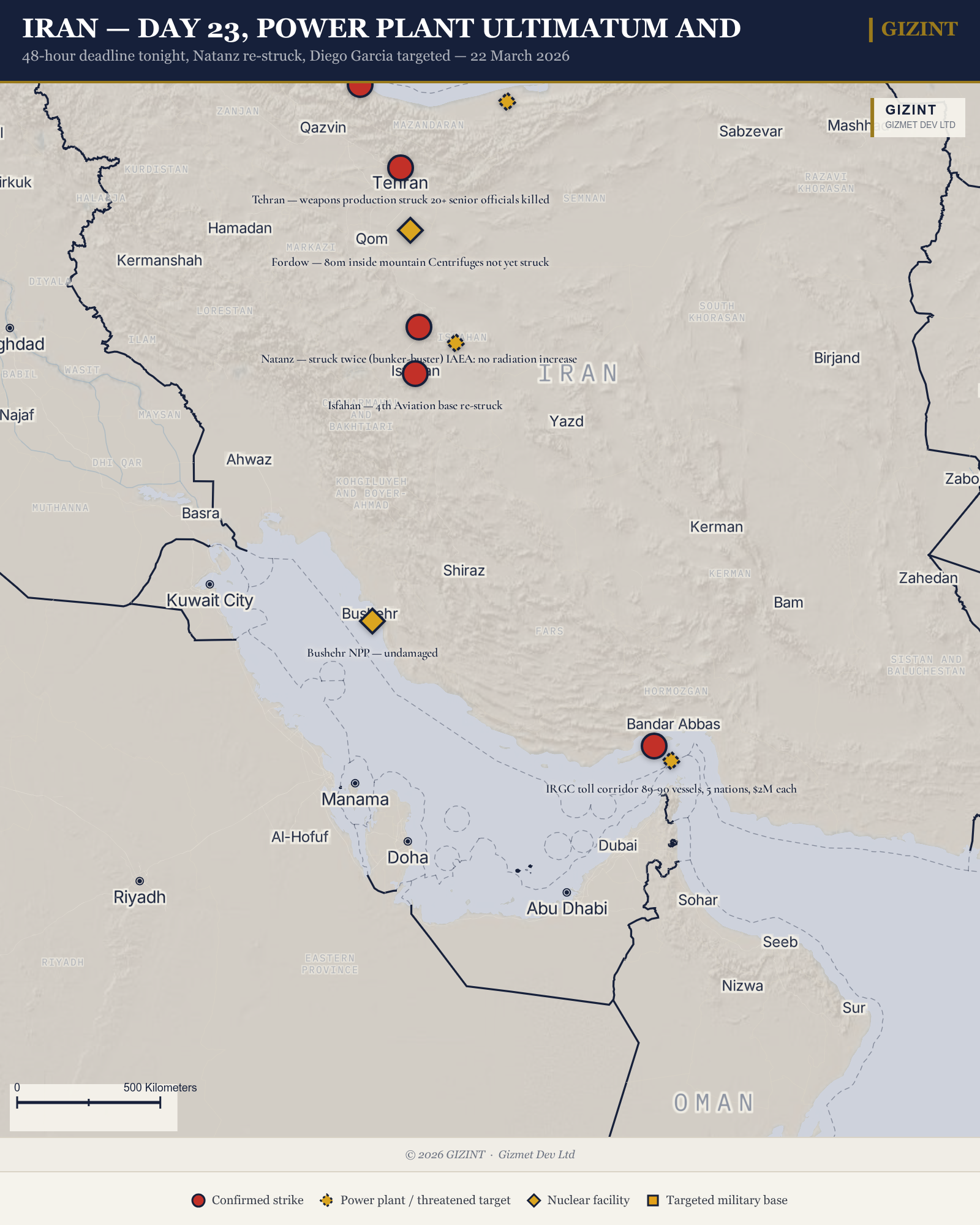
The ultimatum, posted on Truth Social at 19:44 ET on 21 March, demands Iran "fully open, without threat" the Strait of Hormuz or face strikes on its power plants "starting with the biggest one first." Three Iranian institutions responded within hours. The IRGC stated the strait will be "completely closed" if power plants are attacked — a step beyond the current toll corridor model (Al Jazeera, PBS, 22 Mar). Parliament Speaker Ghalibaf declared regional energy and oil infrastructure will be "considered legitimate targets and will be irreversibly destroyed" (NPR, Al Jazeera, 22 Mar). The Khatam al-Anbiya Central Headquarters threatened regional energy, desalination, and IT infrastructure (see Section VII).
The analytical significance lies in what the ultimatum contradicts. Bessent accepted Iranian transits on 16 March (CNBC), announced 140M barrel release on 19 March (Fox Business), and OFAC formalised GL-U on 20 March. Trump stated he was "getting very close" to winding down the same day. On 22 March Bessent defended both positions simultaneously on Meet the Press — strikes as "the only language the Iranians understand" and GL-U as "jiu-jitsuing the Iranians" (NBC, 22 Mar). Five positions in six days.
We assess the policy contradictions are mutually reinforcing: striking Iran while funding Iran through GL-U ($15.7B in crude authorised); deploying 5,000 Marines without AUMF; zero new Iran SDN designations since 28 February — last action 25 Feb pre-dated strikes (ofac.treasury.gov); claiming "winding down" while threatening infrastructure escalation; and a $200B supplemental request lacking bipartisan support.
The toll corridor continues: 116+ commodity crossings through 19 March (Kpler via AFP, 19 Mar), five nations, $2M each. CENTCOM's safe corridor and DFC reinsurance: zero uptake through Day 23.
Changed from prior assessment: Issue 012 assessed the toll corridor as the dominant development. Now: the ultimatum has subordinated the corridor question to a binary infrastructure escalation fork that expires 23 March.
What changes if this assessment is wrong: What changes if wrong: If Trump does not follow through — consistent with prior patterns — the ultimatum framework is exposed as non-credible, reducing future coercive leverage. Markets would correct sharply. The corridor's evolution into a permanent order would accelerate without opposition.