GIZINT — The Daily Brief | Issue 014
Trump postponed power plant strikes for five days. Iran denied all talks. Israel struck Tehran the same day. Five deadlines converge on one week — with Congress in recess.
We assess Trump's five-day postponement of power plant strikes — announced hours before his own 48-hour ultimatum expired — has not resolved the crisis but synchronised five institutional clocks onto one week: the new strike deadline (~28 March), a concurrent cyber pre-positioning window, Easter recess, and the 30-day War Powers deadline all converge with Congress unable to vote.
- Third path emerges: Trump claimed "productive conversations" with Iran and postponed power plant strikes for five days; Iran denied any talks while its Foreign Ministry acknowledged "messages received through friendly countries" — the gap between these descriptions is the diplomatic space.
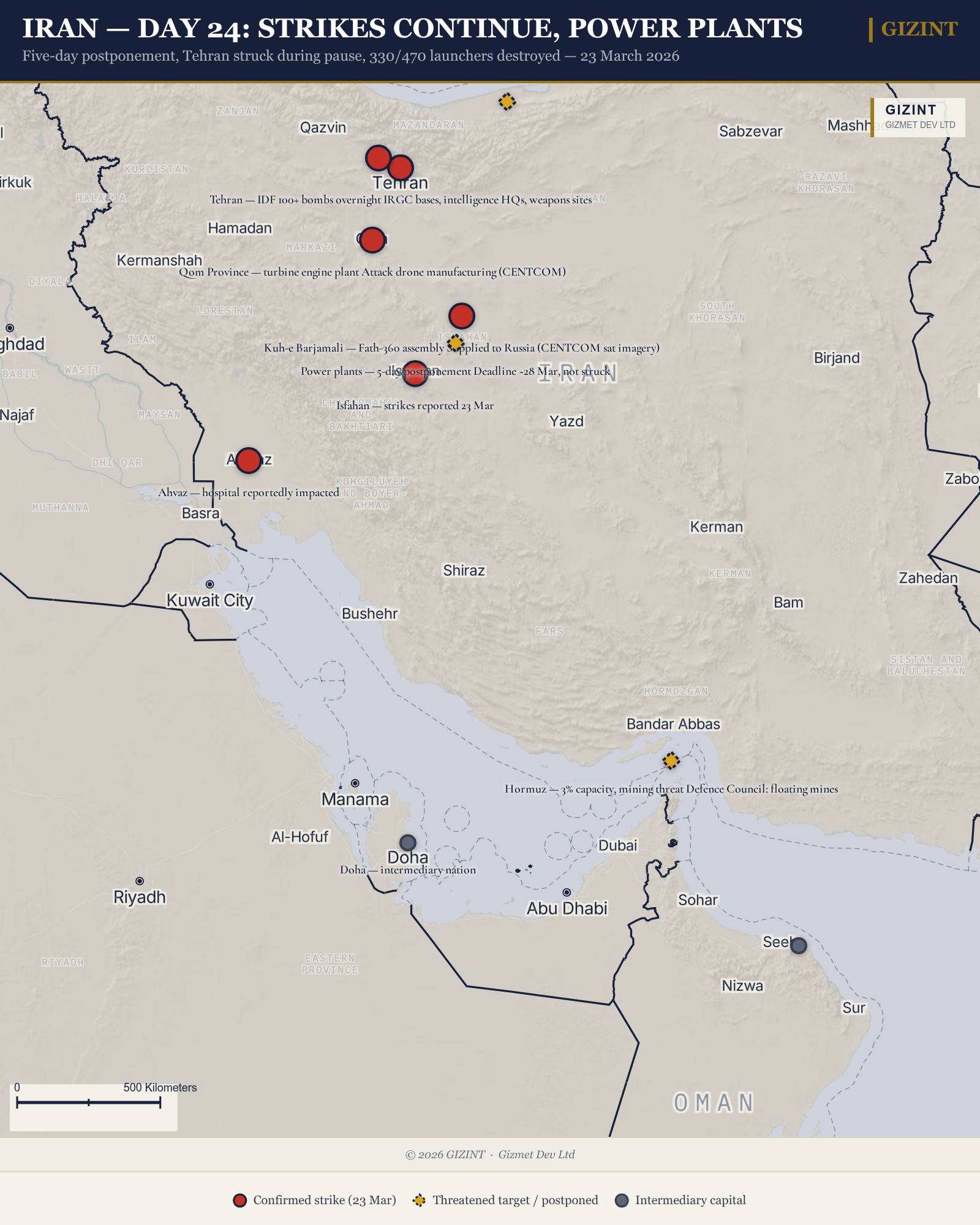
- Israel struck anyway: IDF launched "unprecedented" Tehran strikes hours after the postponement, destroyed 330 of 470 missile launchers, and issued zero political endorsement of the diplomatic track — the widest US-Israel divergence of the campaign.
- Markets split on timing: Asian equities crashed on the ultimatum (KOSPI circuit breaker, Shanghai -3.6%) before the postponement; US equities rallied afterward — Brent swung from $113 to below $92 intraday before steadying around $101 — still 33% above pre-war levels.
Five-Day Postponement — The Third Path Nobody Predicted
Trump created a third option where Issue 013 assessed only two: the 48-hour ultimatum expired without compliance and without strikes, replaced by a five-day pause on power plant targeting that preserves the threat while claiming diplomatic progress through intermediaries Iran simultaneously denies and enables.
Trump posted on Truth Social (23 Mar) that he had instructed the "Department of War" to postpone strikes on power plants and energy infrastructure for five days, citing "very good and productive conversations" with Iran. He named Witkoff and Kushner as negotiators, described the Iranian interlocutor as "the most respected" leader — explicitly not Mojtaba Khamenei — and stated: "We don't know if he's living" (CNBC, 23 Mar). Conditions: Iran must reopen Hormuz AND surrender enriched uranium stockpiles.
Iran's response was coordinated across three institutional pillars — and internally contradictory. The Foreign Ministry's Baqaei denied "any dialogue between Tehran and Washington" while acknowledging "messages were delivered through certain friendly countries indicating that the US sought negotiations" (IRNA, 23 Mar). Ghalibaf denied negotiations on X. A senior security official stated there was "no contact, direct or indirect" with Trump. The FM's careful language preserves the channel its security establishment denies.
Five intermediary nations are confirmed active: Oman, Egypt, Pakistan, Turkey, and Qatar. Pakistani officials are attempting to convene a face-to-face meeting in Islamabad this week (Axios, Haaretz, FT, 23 Mar). Iran's Supreme National Security Council had not decided whether to accept as of collection cutoff (Reuters, 23 Mar).
The analytical significance: Trump is characterising message-passing as negotiations; Iran is denying negotiations while leaving the intermediary channel open. Neither is lying. Both are framing. The five-day deadline (expiring ~28 Mar) replaces the 48-hour deadline and preserves escalation authority.
The institutional silence is itself a signal. No statement from Secretary of State Rubio — his last state.gov transcript is dated 3 March. No statement from Secretary Hegseth or CENTCOM confirming the operational pause. We assess the most significant diplomatic development of the campaign was announced by one person via social media with no institutional endorsement, no executive order, and no formal congressional notification.
Changed from prior assessment: Issue 013 assessed a binary fork — compliance (near-zero) versus power plant strikes. Neither materialised. The postponement created a third path that delays the binary fork by five days while five institutional clocks converge on one week: new strike deadline (~28 Mar), cyber pre-positioning window (~28 Mar), House Easter recess (27 Mar), 30-day WPR deadline (30 Mar), and FISA 702 expiry (20 Apr). The fork has not resolved; it has shifted.
What changes if this assessment is wrong: If the postponement reflects genuine private progress toward a ceasefire framework — and the intermediary channel has produced substantive Iranian concessions rather than procedural messages — the five-day clock is a genuine off-ramp. Available reporting does not support this reading.