GIZINT — The Daily Brief | Issue 009
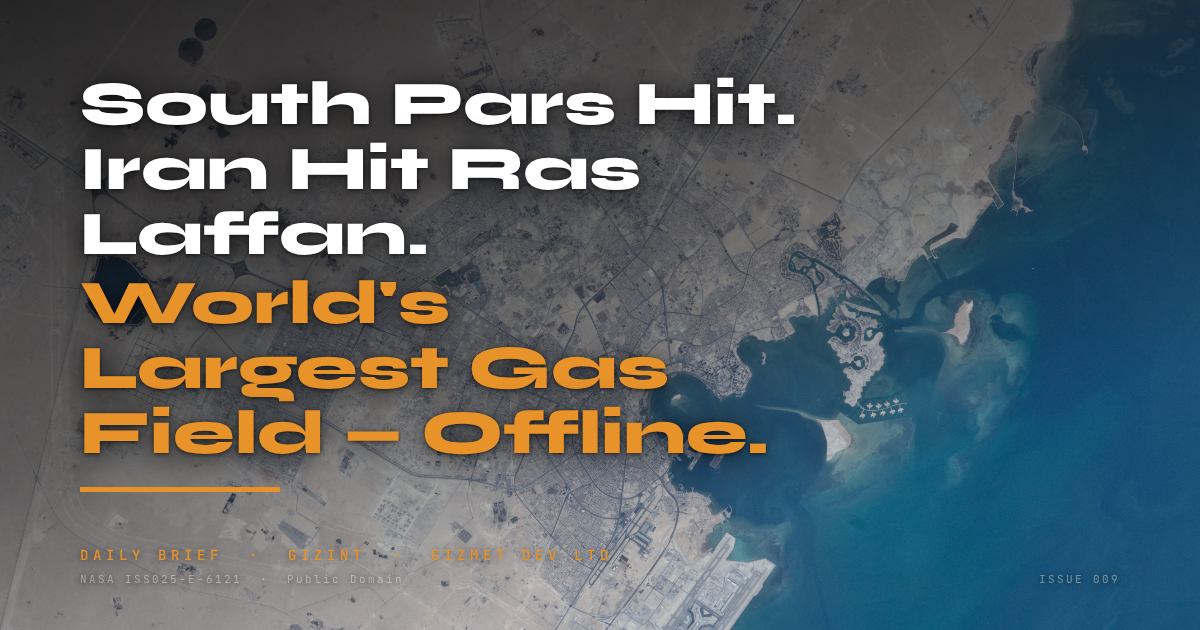
Israel struck South Pars on 18 March; hours later, Iran struck Ras Laffan causing extensive damage — both sides of the world's largest gas field are now offline.
BOTTOM LINE
Israel struck South Pars on 18 March; hours later, Iran struck Ras Laffan causing "extensive damage" (QatarEnergy) — both sides of the world's largest gas field are now offline. The triple decapitation of Larijani, Soleimani, and Intelligence Minister Khatib within 24 hours eliminates the remaining officials inclined toward restraint, consolidating power around Mojtaba's IRGC war cabinet at the moment the campaign demands a diplomatic off-ramp that no longer exists.
AT A GLANCE
- Energy infrastructure war: South Pars struck, Iran retaliated on Ras Laffan causing "extensive damage" (QatarEnergy), Fujairah loading halted — both the strait and its bypass are now inoperable, concentrating all Gulf crude exports into Saudi Yanbu as a single point of failure.
- Triple decapitation: Larijani (SNSC), Soleimani (Basij), and Khatib (MOIS) killed in 24 hours; the MOIS cyber command chain has been systematically decapitated at both levels — Panjaki in the opening strikes, Khatib on Day 19 — while pre-positioned implants on a US bank operate autonomously during FOMC week.
- Central bank cluster: FOMC held rates, raised inflation forecast to 2.7%, retained one-cut median but markets sold off and priced no further cuts for 2026; the energy-to-inflation transmission channel is confirmed live.
I. PRINCIPAL ITEMS
South Pars Struck, Ras Laffan Hit Back — Energy Infrastructure War Goes Bilateral
Israeli strikes hit gas-processing units, storage tanks, and petrochemical facilities at Asaluyeh, the onshore hub of South Pars — the world's largest gas field (Iran Ministry of Petroleum via Bloomberg, 18 Mar). South Pars is geologically continuous with Qatar's North Field. Qatar's FM spokesperson al-Ansari condemned the strike as "dangerous and irresponsible." Israel conducted the strike with reported US consent; neither government has formally confirmed. Iran halted gas exports to Iraq, removing approximately 4,000-4,500MW from the Iraqi power grid — 16-22% of total generation capacity heading into peak summer demand (The National, 18 Mar).
The IRGC responded by issuing formal evacuation warnings to five named GCC energy facilities: SAMREF refinery and Jubail petrochemical complex (Saudi Arabia), Al Hosn gas field (UAE), Ras Laffan refinery and Mesaieed petrochemical complex (Qatar). Attacks were described as coming "in the coming hours" (Middle East Eye, 18 Mar). Saudi Aramco evacuated SAMREF personnel. This is the first time Iran has explicitly threatened named civilian energy infrastructure during this conflict. The GCC Extraordinary Ministerial Council invoked Article 51 collective self-defence — creating the legal framework for potential GCC military response that did not exist before 18 March.
CENTCOM deployed GBU-72 5,000-lb bunker busters against hardened anti-ship cruise missile sites along the Hormuz coastline — the weapon's first combat use against Iranian targets (CENTCOM, 18 Mar). B-1B Lancers from RAF Fairford likely delivered the munitions (The Aviationist, 18 Mar). Fujairah oil loading berths halted as of 18 March morning after a third consecutive strike on the export terminal (Bloomberg, 18 Mar). Both the strait and the primary bypass are now inoperable. Saudi Yanbu remains the only functioning Gulf crude export path.