


























100 Missiles a Month vs 7 Interceptors — Why CENTCOM Shifted to Factories
On 2 March, Secretary of State Marco Rubio stated publicly what no other official had quantified: Iran is producing "by some estimates, over 100 of these missiles a month. Compare that to the six or seven interceptors that can be built a month."


On 2 March, Secretary of State Marco Rubio stated publicly what no other official had quantified: Iran is producing "by some estimates, over 100 of these missiles a month. Compare that to the six or seven interceptors that can be built a month."
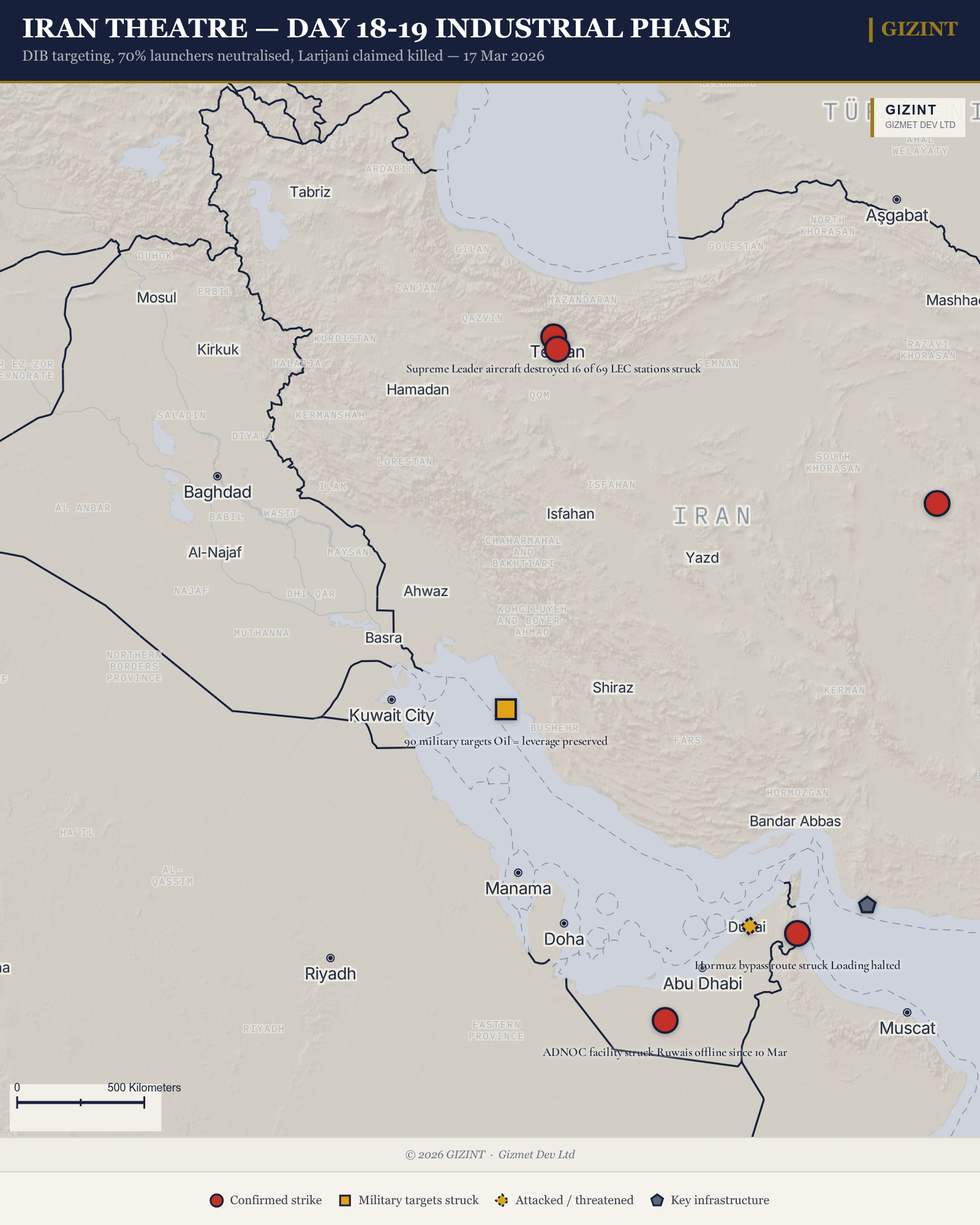
On 16 March, CENTCOM Admiral Brad Cooper confirmed strikes had shifted from "neutralizing immediate missile and drone threats" to Iran's "wider manufacturing apparatus." The counterforce phase — shooting at launchers — was over. The industrial-destruction phase had begun.
These two statements, two weeks apart, describe the same problem.
Iran's missile production outpaces interceptor replacement by roughly 15 to 1. The IDF assessed 70% of Iran's 410–440 missile launchers neutralised as of 16 March, with 85% of air defence capabilities destroyed. Over 6,000 US combat flights and 7,600 Israeli strikes — 15,000 combined targets — in 18 days. And Iran is still launching. Six barrages hit Israel on 15–16 March alone, including cluster munitions impacting central Israel.
The launchers are a renewable resource. Iran's dispersed production facilities rebuild what the strikes destroy. The only way to stop the incoming is to destroy the factories producing the missiles — not the trucks firing them.
Israel's emergency response: NIS 2.6 billion ($826 million) transferred to the Defence Ministry by phone vote on a Saturday night for "urgent and essential defence procurement." Semafor reported, citing US officials, that Israel had informed Washington it was running "critically low" on ballistic missile interceptors. An IDF official disputed the characterisation — "as of now."
The arithmetic drove the strategy. CENTCOM did not choose to enter the industrial phase. The production differential forced it. And the industrial phase — dispersed facilities, hardened bunkers, mountainous terrain — takes longer than counterforce.
The FOMC announces tomorrow. It must price a war whose timeline just extended.
Sources: Rubio Capitol Hill remarks, 2 Mar 2026; CENTCOM Adm Cooper video update, 16 Mar; IDF spokesperson via Alma Center, 16 Mar; Semafor, Mar 2026; Israeli government emergency vote, 15–16 Mar; Times of Israel; Jerusalem Post.
This is a free Signal from GIZINT. The full Daily Brief covers theatre maps, regional assessments, NARINT, financial analysis, and 200+ sources daily.
Every section. Nothing held back.
This is a free Signal from GIZINT.
The full Daily Brief covers theatre maps, regional assessments, financial data, legal developments, cyber threats, and narrative intelligence.
Every section. Nothing held back.