Both Sides Bombed Each Other's Oil Refineries on the Same Day — and Nobody Has a Plan for What Comes Next
Israel struck Tehran's fuel depots at dawn. By nightfall, Iran's Kheibarshekan missiles hit Haifa's refinery. The first mutual energy infrastructure exchange since 1980.
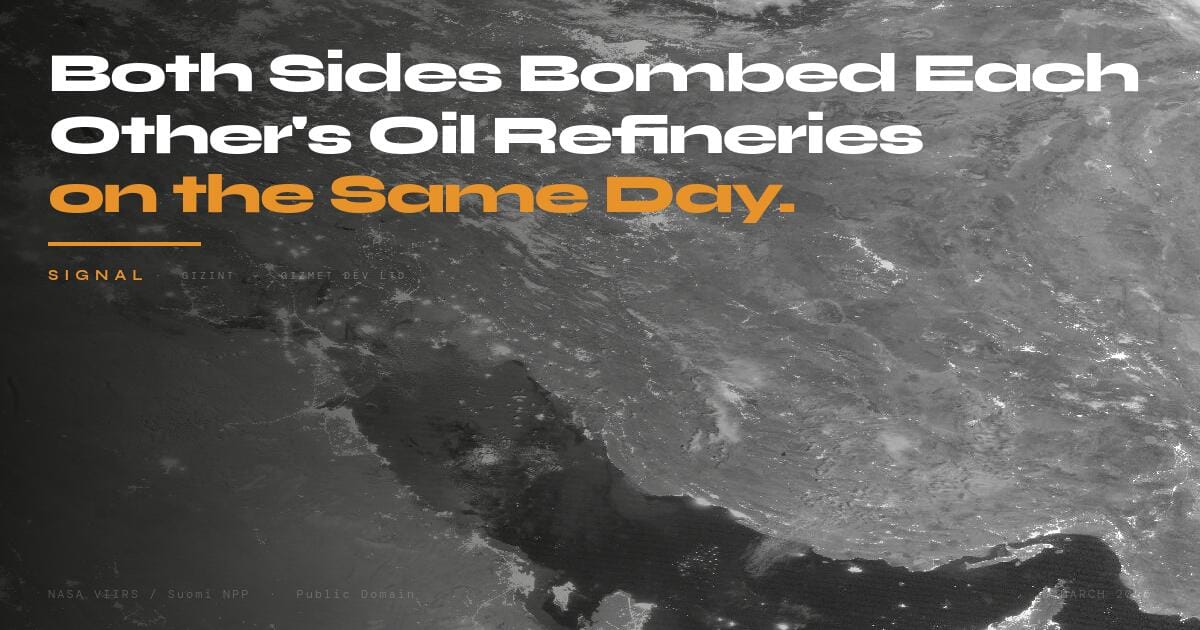
Israel struck Tehran's fuel depots at dawn. By nightfall, Iran's Kheibarshekan missiles hit Haifa's refinery. It is the first mutual energy infrastructure exchange since 1980.
On 8 March, the IDF deployed 80-plus fighter jets dropping 230 bombs on Tehran and central Iran, striking fuel storage facilities for the first time in the campaign (Times of Israel, 8 March 2026). Hours later, the IRGC responded with Kheibarshekan medium-range ballistic missiles — solid-fuel, 1,450km range, 550kg manoeuvrable warhead, Mach 2-3 terminal velocity — hitting the Haifa oil refinery (IRGC/Sepah News, 8 March 2026; Iran Watch).
This is not escalation by increment. Both sides targeted the other's energy infrastructure on the same day, erasing the redline both had previously observed. The speed of the exchange — dawn strike, nightfall response — indicates neither side is testing boundaries. They are operating without them.
The degradation numbers frame what comes next. IDF Chief of Staff Lieutenant General Zamir assessed 80% of Iran's air defences destroyed and 60% of ballistic missile launchers eliminated (Aviation Week, 5-6 March 2026). Those figures describe a state that is losing its capacity to strike back — which means the window for symmetric retaliation is closing. The Haifa strike may be among the last Iran can deliver at this scale.
The oil market priced this before the missiles landed. WTI posted its largest weekly gain in futures trading history — 35.63%, the biggest move since the contract's inception in 1983 (CNBC, 6 March 2026). Meanwhile, China negotiated bilateral safe passage through Hormuz, with two confirmed re-flagged transits (Bloomberg). One waterway, two insurance regimes, two prices for the same barrel of oil.
The campaign has crossed from military operation to energy war. The question is whether either side has an off-ramp — or whether the refinery exchange just closed the last one.
This is one of four cross-domain signals in today's GIZINT Daily Brief.
GIZINT is a daily intelligence brief covering geopolitics, defence, markets, and security. Every claim is source-attributed. No editorial line. No advocacy. Assessment only.