The Toll Booth Is Cheaper Than the Insurance
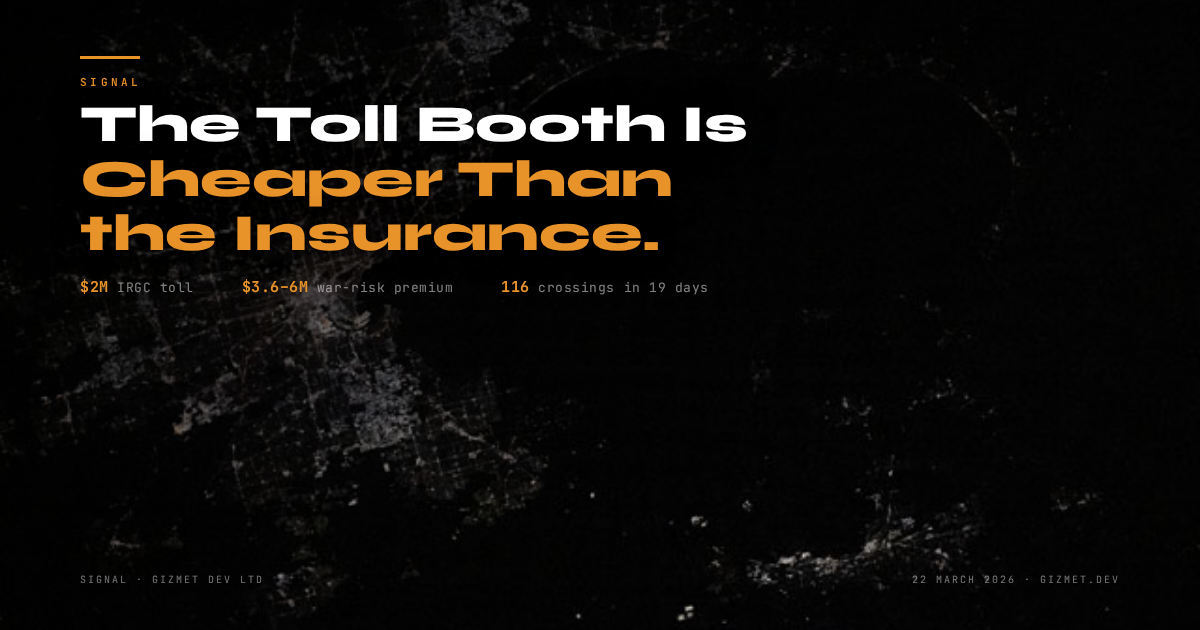
War-risk premiums run $3.6-6 million per VLCC voyage. The IRGC charges $2 million. The market made a rational choice — and that is why zero ships have used the US alternative.

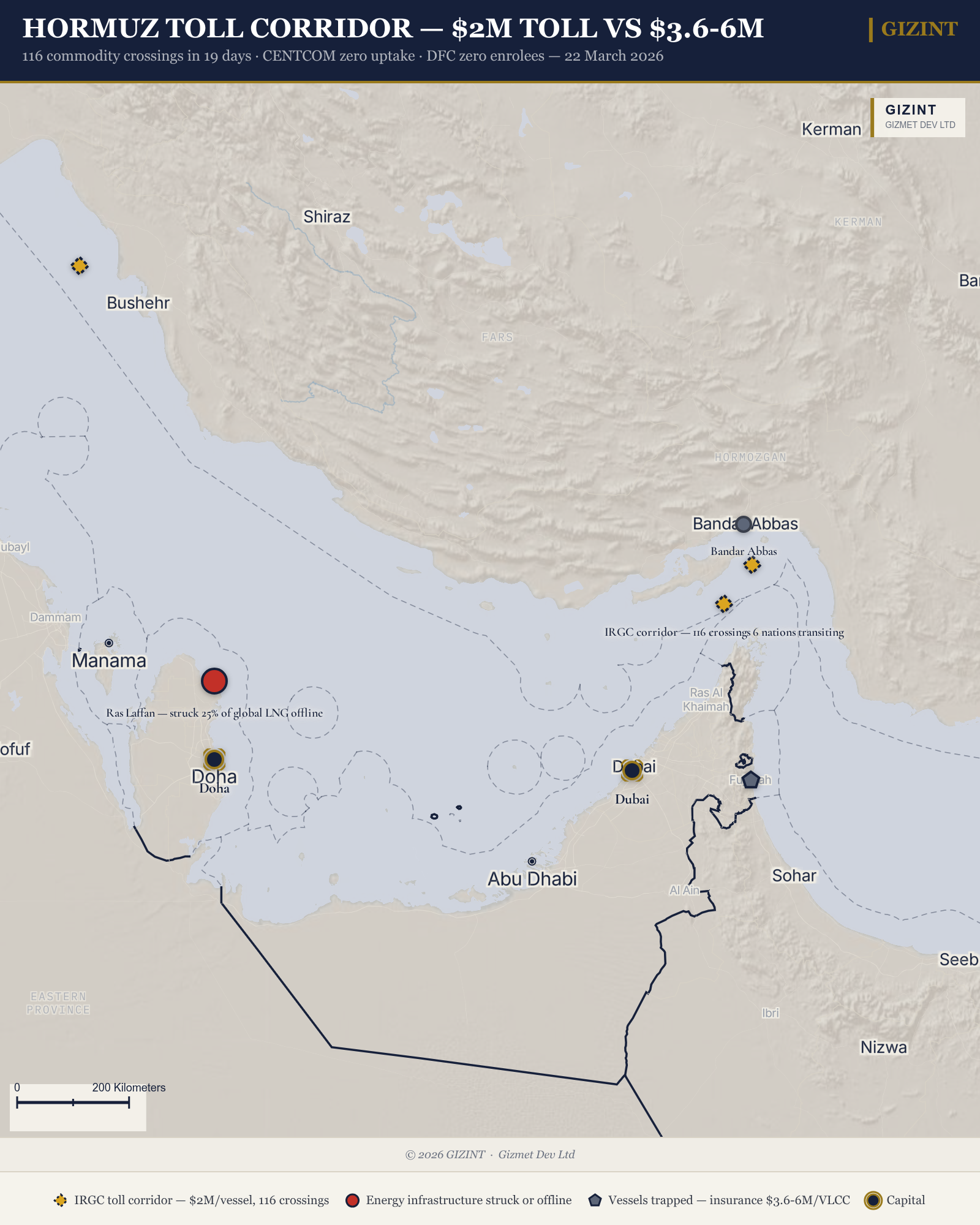
The IRGC toll corridor through the Strait of Hormuz is not succeeding because of military coercion. It is succeeding because it is cheaper than the insurance.
When Lloyd's Joint War Committee designated the entire Persian Gulf basin as a war-risk listed area on 3 March, commercial insurers withdrew cover. Hull war premiums surged to 1.5-3% of vessel value — levels not seen since the 1980s Tanker War. For a VLCC, that is $3.6 million to $6 million per voyage. The IRGC charges $2 million.
The arithmetic explains every data point that has confused Western analysts for three weeks. Why has the CENTCOM safe corridor attracted zero commercial uptake through Day 22? Because even with a military escort, the vessel still needs insurance — and the premium exceeds the toll. Why has the DFC reinsurance facility attracted zero enrolees, even after Chubb expanded coverage to include liability on 20 March? Because Moody's assessed it is "probably not enough" — shipowners will not assume the residual risk at any premium. Why have 116 commodity vessels crossed the Strait in 19 days while 22 nations that signed a freedom-of-navigation statement have committed zero warships? Because the market does not price principles. It prices risk.
The IRGC is not competing with navies. It is competing with Lloyd's. And it is winning on price.
Ships are now broadcasting false Chinese identification to gain passage through the Larak Island checkpoint, where IRGC Navy personnel conduct visual inspection and VHF radio verification. Payment is accepted in cash, cryptocurrency, or barter. The system is ad hoc — but a "new vetting and registration system" is reportedly under development, and two Iranian MPs have confirmed parliament is pursuing permanent legislation.
Charter rates have quadrupled to $800,000 per day. The corridor's revenue is unquantified but real — at least one $2 million payment has been confirmed. At current transit volumes, the IRGC is generating more revenue from the corridor than it costs the vessels to use it, and less than it would cost them not to.
The competing order is not being proposed. It is being priced.
For informational purposes only. No editorial line. No advocacy. Assessment only. AI-assisted collection and drafting; all analytical assessments are human-directed. Errors: corrections@gizmet.dev
Sources: Lloyd's Market Association JWC Circular 033, 3 Mar 2026 · S&P Global, Mar 2026 · Kennedys Law, Mar 2026 · Kpler via AFP, 19 Mar 2026 · Lloyd's List Intelligence, 18 Mar 2026 · Chubb press release, 20 Mar 2026 · Moody's/Insurance Journal, 16 Mar 2026 · Chatham House, 16 Mar 2026 · CENTCOM, 21 Mar 2026 · DFC, Mar 2026 · Blockonomi (industry data), Mar 2026
GIZINT · 22 March 2026 · Signal · Gizmet Dev Ltd — gizmet.dev