

GIZINT — The Daily Brief | Issue 015
Trump declared "this war has been won" and sent Iran a 15-point peace plan through Pakistan — while simultaneously deploying 3,000 troops from the 82nd Airborne and securing Saudi basing access.

Trump declared "this war has been won" and sent Iran a 15-point peace plan through Pakistan — while simultaneously deploying 3,000 troops from the 82nd Airborne and securing Saudi basing access. We assess the victory declaration and the peace proposal serve the same coercive function: escalation creates the conditions for terms, not compromise.
- Victory declared, 15-point plan sent: Trump declared "this war has been won" while deploying 3,000 troops from the 82nd Airborne and sending Iran a 15-point peace plan through Pakistan — escalation and negotiation running simultaneously through the same team (Vance, Kushner, Witkoff, Rubio).
- Lebanon occupation formalised: Israel's defence minister stated the IDF will occupy southern Lebanon to the Litani River — the first explicit territorial seizure statement of the campaign. IDF forces are 9-11km deep, all seven Litani bridges destroyed, and Hezbollah has conducted 915 attack waves since 2 March.
- Two chokepoints impaired: Ukrainian drones shut Primorsk (Russia's largest Baltic oil terminal) while the IRGC toll corridor formalises at $2M per Hormuz transit — two of four major global oil export nodes are simultaneously disrupted for the first time.

"This War Has Been Won" — Victory Declared, 15-Point Plan Sent, Ground Forces Deploy
The United States is simultaneously declaring victory, sending a structured peace proposal, and deploying ground forces — escalation and negotiation running through the same team, on the same timeline, toward the same deadline.
Changed from prior assessment: the five-day postponement was assessed as a third path between escalation and compliance. Now: the President has declared victory and regime change during the pause while deploying ground forces and facilitating mediation — the framing and the force posture are diverging at the widest point of the campaign.
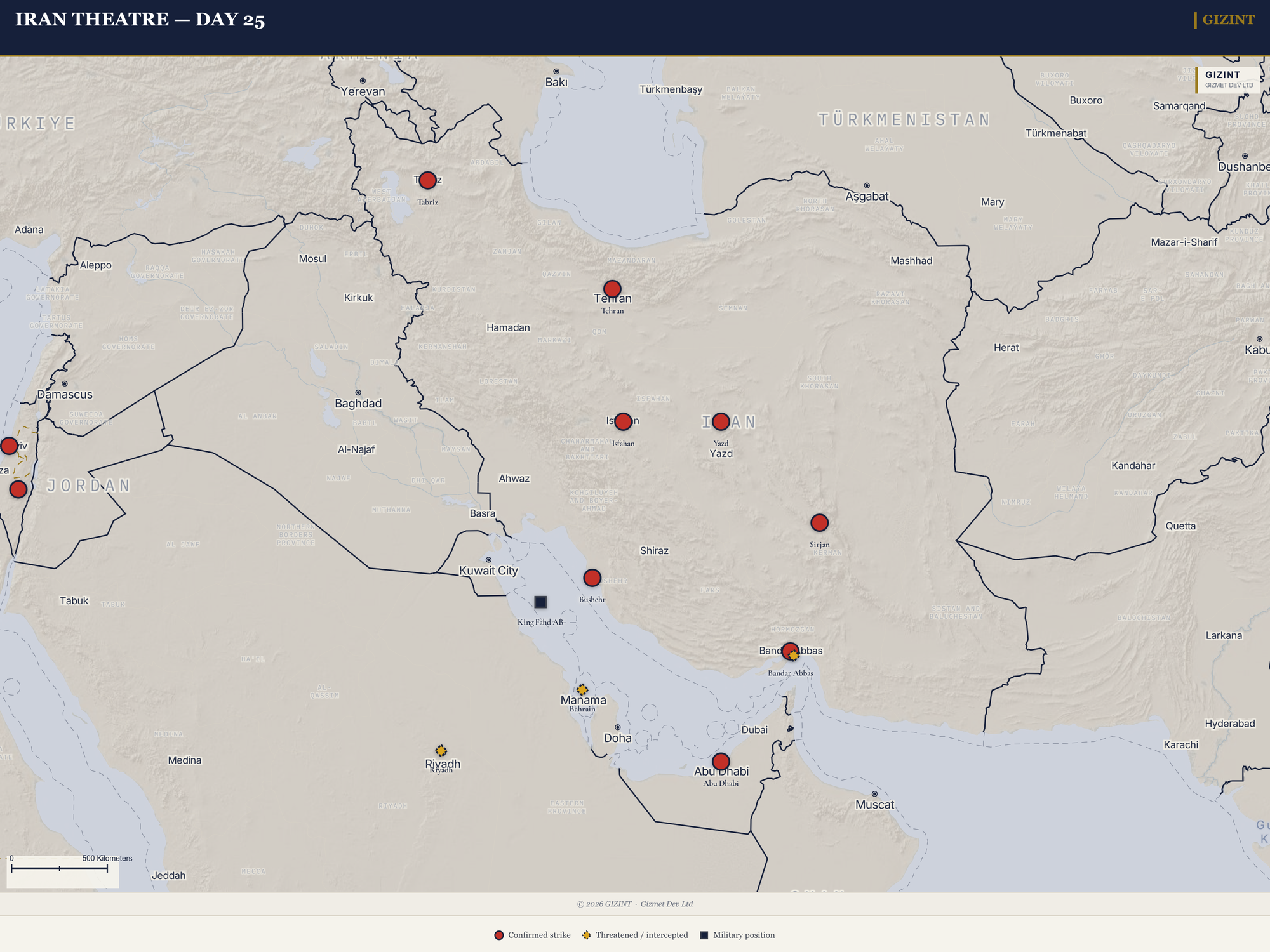
The US plans to deploy 3,000 troops from the 82nd Airborne Division to the Middle East, with division commander Maj. Gen. Tegtmeier and his command element ordered forward (WSJ/Stars and Stripes, 24 Mar). The Kharg Island seizure scenario remains under active discussion. Sen. Graham publicly urged Marines to seize Kharg (23 Mar). Saudi Arabia agreed to US military access at King Fahd Air Base — reversing its initial refusal (WSJ/Bloomberg, 24 Mar). The NYT reported (24 Mar) that MBS is speaking regularly with Trump and urging continued military operations, including ground troops in Iran to seize energy infrastructure — positioning Saudi Arabia beyond basing facilitation toward active co-belligerency advocacy. Saudi officials denied the characterisation. Trump stated Defence Secretary Hegseth was "quite disappointed" by the prospect of negotiations — the SecDef publicly positioned against the President's stated diplomatic preference is a civil-military indicator the brief has not previously tracked.
Combined with the IDF's continued strikes across Iran — 9,000+ separate strikes hitting Tehran (IRGC GF HQ, Aerospace Force HQ), Isfahan (4th Aviation Base), Yazd (Imam Hossein missile base), Bushehr (Chamran missile base), Tabriz (21st Hamzeh Div), Bandar Abbas, and Sirjan (ammo depot with secondary explosions); 330 of 470 launchers destroyed (CENTCOM, 24 Mar; CTP-ISW, 23 Mar) — the operational posture is escalatory regardless of the rhetorical posture.
On the Iranian side, Mohammad-Bagher Zolghadr was appointed SNSC secretary, replacing Ali Larijani, killed 17 March (Bloomberg, 24 Mar). Zolghadr is a career IRGC officer — former deputy commander of the IRGC, deputy interior minister under Ahmadinejad, with deep ties to the Basij. Larijani was the last senior figure who could bridge Iran's military and diplomatic establishments. His replacement with an IRGC loyalist consolidates the security establishment's grip on the negotiating apparatus and reduces the probability that Iran's SNSC will authorise face-to-face talks in Islamabad.
The intermediary framework is advancing regardless. The NYT reported the US has sent Iran a 15-point plan to end the war (NYT, 24 Mar). Israel's Channel 12 published the terms (Yaron Avraham, 24 Mar): dismantle all nuclear capabilities; destroy Natanz, Isfahan, and Fordow; hand all enriched material to the IAEA; abandon the proxy network; stop financing and arming proxies; Hormuz to become a "free maritime zone" with no blockade; limit missile quantity and range; future missile use for self-defence only. In return: all sanctions lifted, Bushehr civilian nuclear assistance, and removal of snapback sanctions. This is a demand for total capitulation — designed to establish the maximum opening position with the 82nd Airborne as the enforcement mechanism. Pakistan formally offered to host talks (FM spokesperson, 24 Mar). Trump confirmed the negotiation team: Vance, Kushner, Witkoff, and Rubio — the same team leading Ukraine-Russia negotiations (Trump, White House press conference, 24 Mar). Pakistani officials confirmed the delegation is expected in Islamabad "during the week" (Reuters, 24 Mar). Rubio's inclusion elevates the institutional weight to SecState level. An Israeli official confirmed planning (NPR, 24 Mar). An Iranian source told CNN there had been "outreach" and Iran would listen to "suitable" proposals — while Ghalibaf simultaneously called negotiations "fake news." Trump claimed Iran "agreed to" never have a nuclear weapon — "That's number one, two and three. They will never have a nuclear weapon" (ABC News, 23 Mar). Iran's three institutional pillars denied the claim. The gap between Trump's characterisation and Iran's denial is itself the diplomatic space: the channel survives its own repudiation.
Trump then declared from the Oval Office: "This war has been won" (BBC/CNN live, 24 Mar). He characterised the situation as "regime change" — "the leaders are all very different than the ones that we started off with." He stated Iran had delivered "a very big present, worth a tremendous amount of money" — "oil and gas related" and, when pressed, "related to the flow and to the strait." No Iranian source has confirmed any Hormuz concession; Iran's three institutional pillars continue to deny all contact. Fars News Agency (IRGC-affiliated) stated "special plans are arranged tonight for Tel Aviv" — followed by cluster munition impacts in Bnei Brak (3 wounded including a 7-year-old) and Petah Tikva (Fars, 23 Mar; Times of Israel, 24 Mar). Iran vowed "complete victory" against what it characterised as aggression.
We assess the victory declaration, the 15-point plan, and the force deployment are components of the same coercive mechanism — not contradictions. The plan gives Iran a structured off-ramp; the 82nd Airborne and the victory rhetoric make refusing it more expensive. Trump's claim to be "dealing with the right people" — implying the IRGC-dominated post-decapitation leadership is more amenable — directly contradicts the assessment that Zolghadr's appointment consolidates the security establishment's grip on the negotiating apparatus. The most likely outcome of the ~28 Mar deadline is a narrow extension with expanded military positioning, not a breakthrough.