
GIZINT — The Daily Brief | Issue 001
Iran campaign shifts to regime destabilisation. Hormuz insurance blockade creates two-tier energy order. Central banks trapped in stagflation scissors.
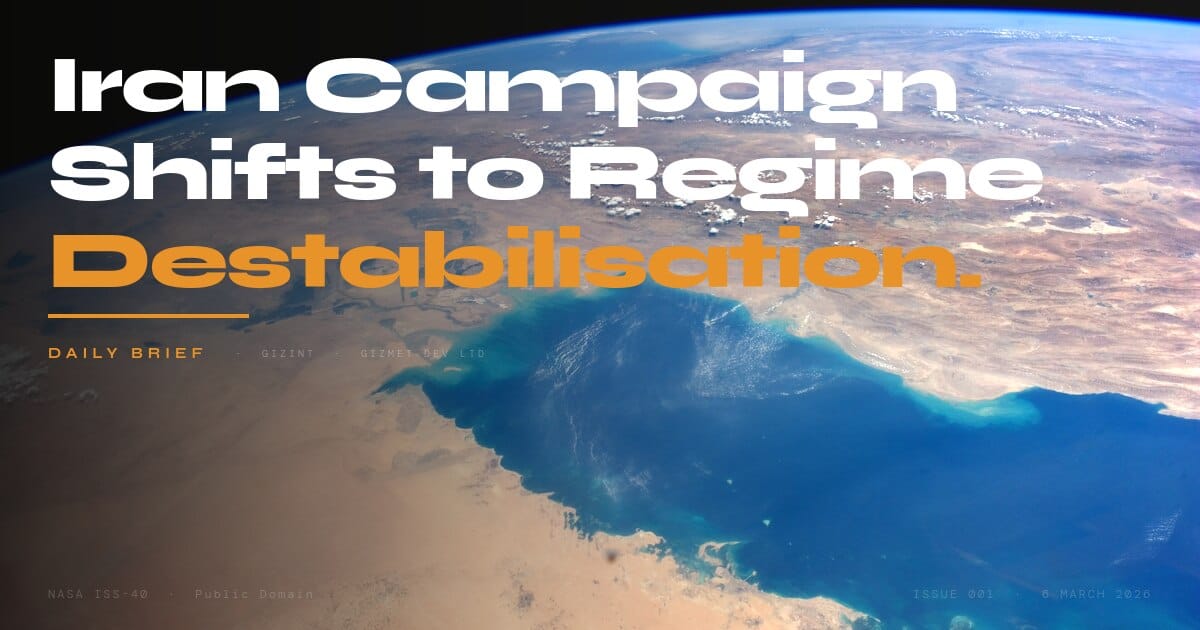
The Iran campaign has achieved air dominance but the destruction of every mediation channel means no diplomatic mechanism exists to convert military gains into a political outcome. We assess the insurance-driven Hormuz closure is proving more strategically consequential than the kinetic campaign itself.
- Iran / Operation Epic Fury Day 7: Combined force has achieved air dominance and is systematically dismantling Iran's internal security apparatus. Iranian retaliation down 90% from Day 1, but asymmetric strikes on Gulf shipping and energy infrastructure continue. Hormuz remains effectively closed by insurance withdrawal — transits down 94%. No diplomatic off-ramp exists: every mediation channel is damaged or destroyed.
- Central bank trap: The -92,000 February NFP report colliding with $90+ oil creates a stagflation scissors constraining every major central bank. BoJ decides 13-14 March (first mover), Fed 18 March, ECB 18-19 March, BoE 19 March. None can cut; none can hike. Qatar's one-month LNG shutdown transforms the energy outlook for European inflation.
- CBP compliance crisis: CBP told a federal judge on 6 March it cannot execute the $175 billion IEEPA tariff refund order, proposing 45 days to upgrade its systems. Interest accrues at $700 million per month. The government simultaneously faces a 24-state challenge to its Section 122 replacement tariffs and $352 billion in contingent DFC shipping insurance liability with no clear statutory authority.
PI-1: Diplomatic Channels Destroyed — Iran Campaign Shifts to Regime Destabilisation
The US-Israeli combined force has transitioned from air defence suppression to systematic destruction of Iran's internal security and defence industrial base, while every viable diplomatic channel for conflict termination has been damaged or destroyed.
Seven days into Operation Epic Fury, CENTCOM Commander Adm Brad Cooper confirmed air dominance over Iran (CENTCOM press conference, 5 Mar). The IDF reports approximately 2,500 strikes using over 6,000 munitions since 28 February, destroying an estimated 80% of Iran's air defences and rendering over 300 ballistic missile launchers inoperable (IDF, via CTP-ISW Evening Report, 5 Mar). Iranian ballistic missile attacks are down 90% from Day 1; drone attacks down 83% (CENTCOM, 5 Mar).
The targeting pattern on 5-6 March reveals the campaign's second-phase intent. Combined forces struck police stations in Kurdistan and West Azerbaijan Provinces, two Basij Resistance bases in Tehran, IRGC positions across four western provinces, facilities associated with the supreme leader's compound, and the HESA drone manufacturing facility in Esfahan — confirmed damaged via satellite imagery (CTP-ISW Morning/Evening Reports, 5-6 Mar). This is not force protection or capability denial. It is the deliberate degradation of the regime's capacity to maintain internal control.
Cyber operations preceded and enabled the kinetic campaign. US Cyber Command was designated the "first mover" — compromising Iranian air defences before the first bomb fell, hijacking the BadeSaba prayer app (5 million users) for psychological operations, and seizing state news websites including IRNA (Nextgov/FCW; Breaking Defense, Mar 2026). Iran's internet connectivity has collapsed to approximately 1% of normal (NetBlocks, 6 Mar).
The diplomatic landscape is barren. FM Araghchi rejected negotiations outright — Iran was attacked during two prior negotiation rounds, including hours after Oman announced a breakthrough on nuclear verification (Iran International, 5 Mar). The Oman channel, historically the primary US-Iran back-channel, was damaged when Iran struck Duqm Port and Salalah. Only the Swiss channel remains confirmed functional, limited to message-passing (Al-Monitor, Mar 2026). CENTCOM's request for intelligence officers through September 2026 confirms the Pentagon is planning for at least six more months of operations.
The Kurdish dimension introduces an insoluble NATO contradiction. Trump endorsed armed Kurdish groups inside Iran on 5 March (The Hill, 5 Mar); CNN reported the CIA is arming them (CNN, 3 Mar). This directly threatens Turkey — which Iran has pointedly NOT targeted despite hosting US bases. FDD describes Turkey as "Tehran's quiet ally within NATO" (FDD, 2 Mar). A US-armed Kurdish force coordinating with PKK-linked organisations would force Ankara to choose between alliance solidarity and national security, with the NATO summit scheduled for Ankara in July.
Iran International reported on 4 March that the Assembly of Experts, under IRGC pressure, selected Mojtaba Khamenei as supreme leader successor — but the decision has not been publicly announced. CTP-ISW reports no formal announcement as of 5 March. The process appears incomplete or contested. Trump stated the US "must be involved" in selecting Iran's next leader (Axios, 5 Mar).
CSIS estimates the first 100 hours of operations cost $3.7 billion — $891.4 million per day — with $3.5 billion unbudgeted (CSIS, 6 Mar). At least 1,332 Iranians have been killed according to Iranian authorities (Al Jazeera tracker citing Iranian government figures, 6 Mar). The Minab school strike — an estimated 165 dead according to Iranian authorities, overwhelmingly girls aged 7-12 — is the single incident most likely to shift international opinion and feature in any future ICC proceedings, though the US has simultaneously sanctioned more than 10 ICC officials (UNESCO, 3 Mar; OHCHR).
What changes if this assessment is wrong: If a functional mediation channel reopens within 72 hours — most likely via the Egypt-Turkey-Oman trilateral bid (El-Sisi, 5 Mar) — the campaign's shift to internal-security targeting becomes leverage rather than endgame, and the conditions for a negotiated outcome improve materially.
PI-2: Insurance Withdrawal Closes Hormuz — China Building the Replacement Order in Real Time
The Strait of Hormuz has been closed not by naval blockade but by insurance withdrawal — and China is building the replacement system in real time.