




GIZINT — The Daily Brief | Issue 016
Iran rejected the US ceasefire plan, issued five counterdemands including permanent Hormuz sovereignty, and threatened to seize the UAE and Bahrain coastline; we assess the conditions are designed to be rejected, establishing a negotiating floor while the 28 March convergence approaches in three day

Iran rejected the US ceasefire plan, issued five counterdemands including permanent Hormuz sovereignty, and threatened to seize the UAE and Bahrain coastline; we assess the conditions are designed to be rejected, establishing a negotiating floor while the 28 March convergence approaches in three days. Markets rallied on diplomatic optimism that Tehran explicitly denied — the Brent-Murban spread widened even as headline Brent fell, confirming the insurance market and the equity market are looking at different wars.
- Iran rejects, escalates: Tehran rejected the 15-point plan, issued five counterdemands including Hormuz sovereignty, and threatened GCC territorial seizure — the most expansionist claim of the campaign.
- Three days to convergence: The 28 March deadline clusters the strike decision, elevated cyber threat conditions, Easter recess, and the WPR 30-day deadline while Congress has failed three consecutive war powers votes.
- Hope-reality gap: Equities rallied on Trump's negotiation claims while VIX held above 25 for a fourth session and Iran struck Kuwait airport — the options market sees the tail risk equities are ignoring.

Iran Rejects the Plan, Deploys Counter-Strategy
Iran's five counterdemands are not a peace offer — they are a negotiating floor dressed as an ultimatum, and the two structurally impossible conditions reveal what the IRGC will not concede.
Changed from prior assessment: intermediary framework advancing with Pakistan venue confirmed. Now: Iran formally rejected the 15-point plan and issued conditions that make bilateral settlement impossible.
Iran rejected the US ceasefire proposal on 25 March with five conditions: halt to operations; mechanisms to prevent war reimposition; reparations; end of war across all fronts including resistance groups; and Hormuz sovereignty as a "natural and legal right" (Press TV, Fars News, 25 Mar).
Condition 5 would codify the IRGC toll corridor as permanent sovereign right — directly conflicting with UNCLOS Article 38. Condition 4 ties any bilateral deal to Hezbollah and potentially Houthi operations, making single-theatre settlement structurally impossible. No mediator can bridge this gap without one side abandoning a foundational position.
An Iranian national security analyst stated on IRIB that Iranian forces are "ready to seize the coastline of the UAE and Bahrain" if the US launches a ground operation (EADaily, MEMRI, 25 Mar) — the most expansionist declaratory threat of the campaign, escalating from "crushing strikes on Ras al-Khaimah" five days earlier. Iran lacks amphibious capability against US naval forces; the coercion signal to GCC states is the operative effect. Parliament Speaker Ghalibaf warned on X of imminent island seizure while attributing the war to US military leadership rather than Trump — leaving diplomatic space. He is widely assessed as the likely Iranian negotiating counterpart (Bloomberg, AP, 25 Mar).
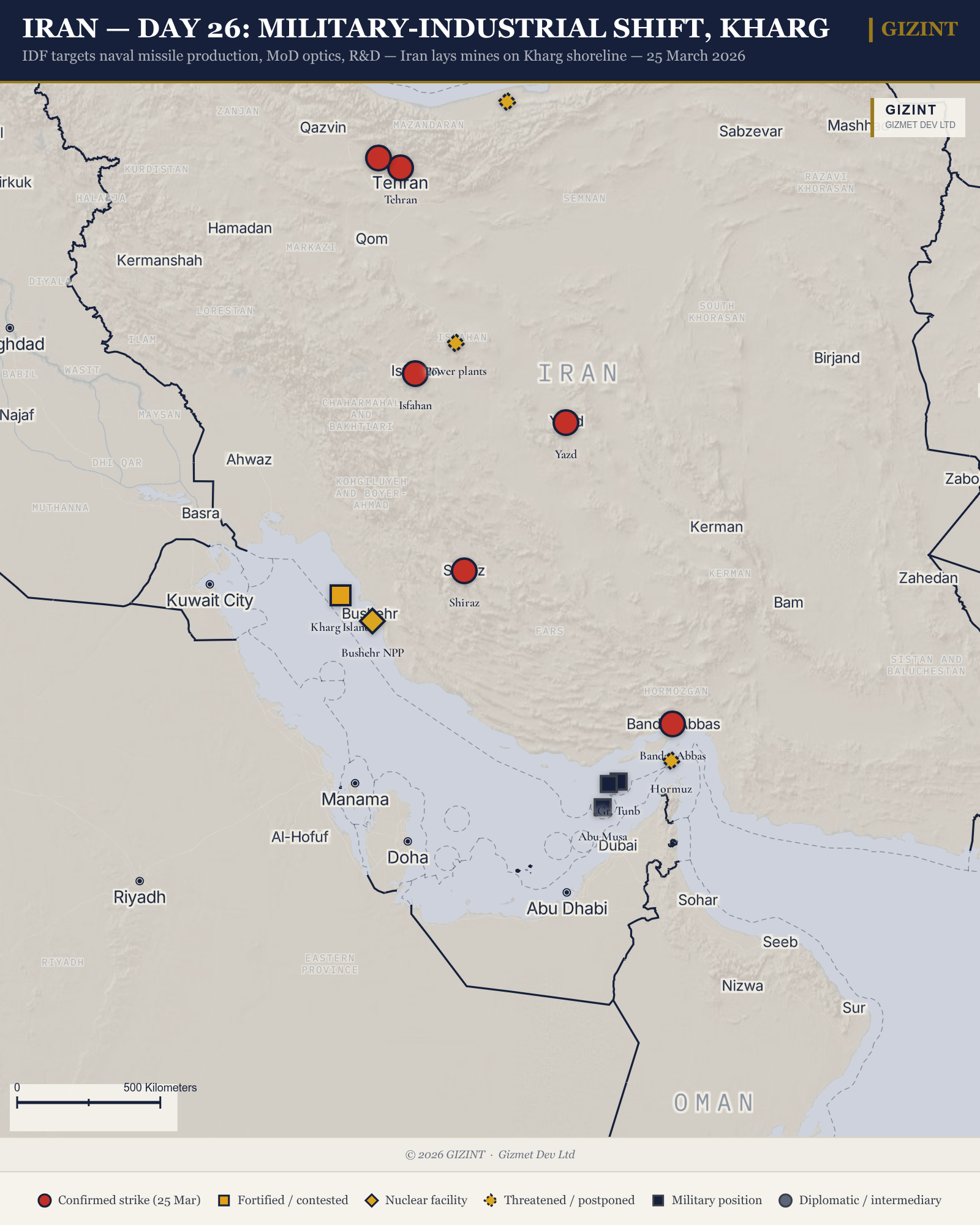
The Pentagon confirmed deployment of the 82nd Airborne's 1st BCT under MG Tegtmeier — 2,000-3,000 paratroopers within a week (Military Times, Stars and Stripes, 25 Mar). Combined with the 31st MEU at Diego Garcia, 11th MEU departed San Diego, and King Fahd Air Base access (WSJ, 24 Mar), we assess the 5,400-7,700 ground force package is sized for disputed Strait island seizure (Abu Musa, Greater and Lesser Tunbs) — not mainland invasion.
Iran anticipated this: the Defence Council's mining trigger names "coasts or islands," IRGC reinforced all three disputed islands as of 22 March, and Khatam al-Anbiya designated all US military personnel in the Gulf as targets (Press TV, 25 Mar). The intermediary framework (Pakistan, Turkey, Oman, Egypt, Qatar) has no confirmed meeting, no agenda, and no Iranian commitment to attend.
What changes if this assessment is wrong: If the five conditions are a genuine opening position rather than a designed rejection, Iran would accept modifications on Conditions 4 and 5 within 72 hours. This would require Zolghadr (IRGC, now heading the SNSC) to authorise compromise — we assess this is unlikely given IRGC institutional incentives.