



GIZINT — The Daily Brief | Issue 017
Israel killed the officer who designed the Hormuz closure while Iran's parliament drafted legislation making the $2M toll permanent — the physical blockade now has a statutory author, not just an operational one.
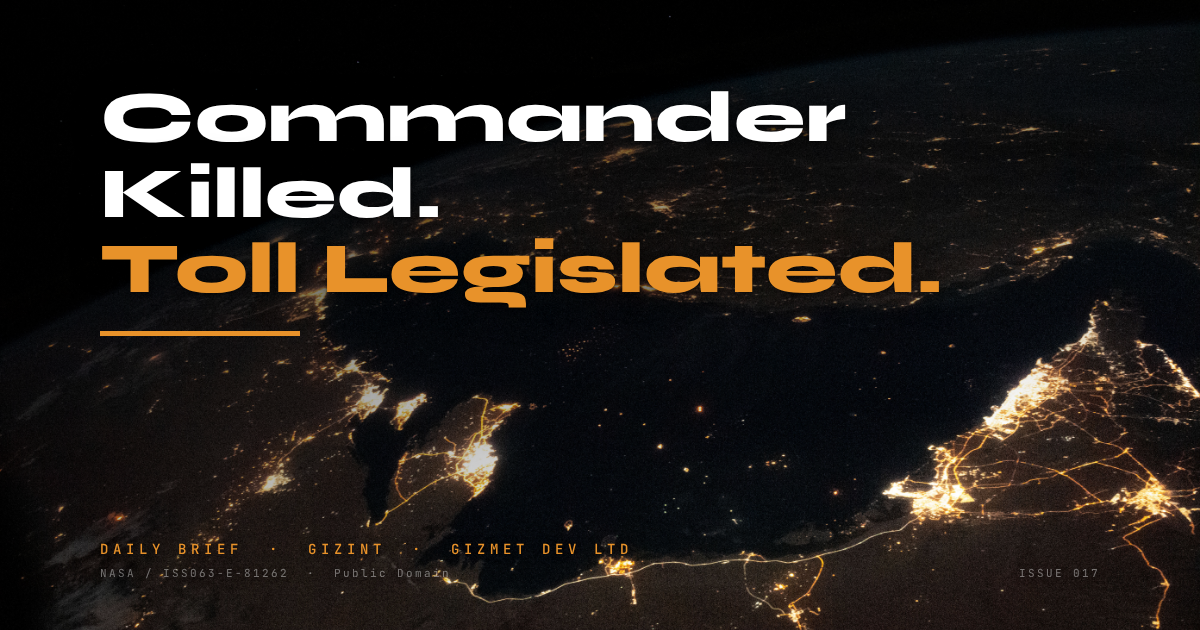

Israel killed the officer who designed the Hormuz closure while Iran's parliament drafted legislation making the $2M toll permanent — the physical blockade now has a statutory author, not just an operational one. Trump extended the power plant strike pause 10 days to 6 April citing an Iranian request, but the 82nd Airborne arrives during the pause window and every institutional check has already failed.
- Command killed, toll survives: The IRGC Navy commander, intelligence chief, and district commander all killed within days, but the Majlis is codifying the Hormuz toll into permanent law — a wartime measure becoming statute that outlasts any ceasefire.
- Pause announced, deployments continue: Trump extended the power plant strike pause 10 days to 6 April "as per Iranian Government request" — but the 82nd Airborne deployment, Majlis toll legislation, and cyber pre-positioning all continue on their original timelines.
- Quadruple energy shock: Hormuz crude near-closed, three Baltic export terminals struck (40% of Russian oil exports), South Pars pipeline gas halted, and Ras Laffan LNG damaged — crude, refined products, pipeline gas, and LNG simultaneously impaired without precedent since at least the 1973 embargo.

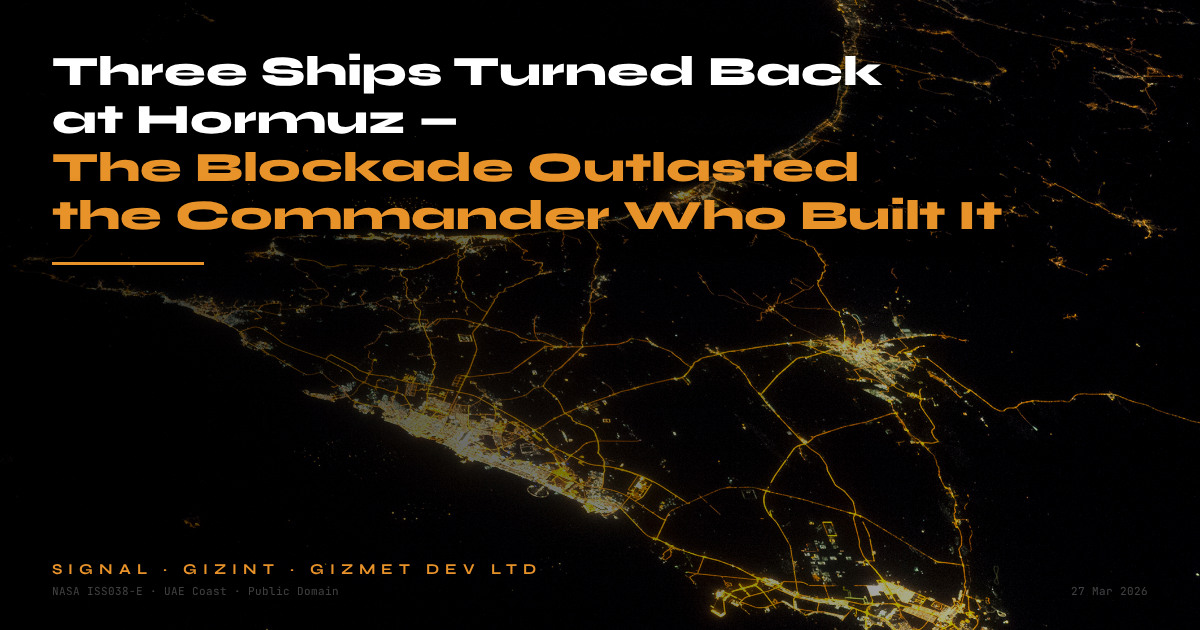
Hormuz's Architect Killed — The Toll Gets a Parliament Instead
Israel eliminated the IRGC Navy's operational chain of command while Iran's legislature moved to make the blockade permanent — killing the commander does not kill the mechanism.
Changed from prior assessment: Tangsiri alive and directing Hormuz operations. Now: Tangsiri and intelligence chief Rezaei killed 26 Mar; 1st Naval District Commander Bakhtiari killed 25 Mar. Majlis drafting permanent toll legislation.
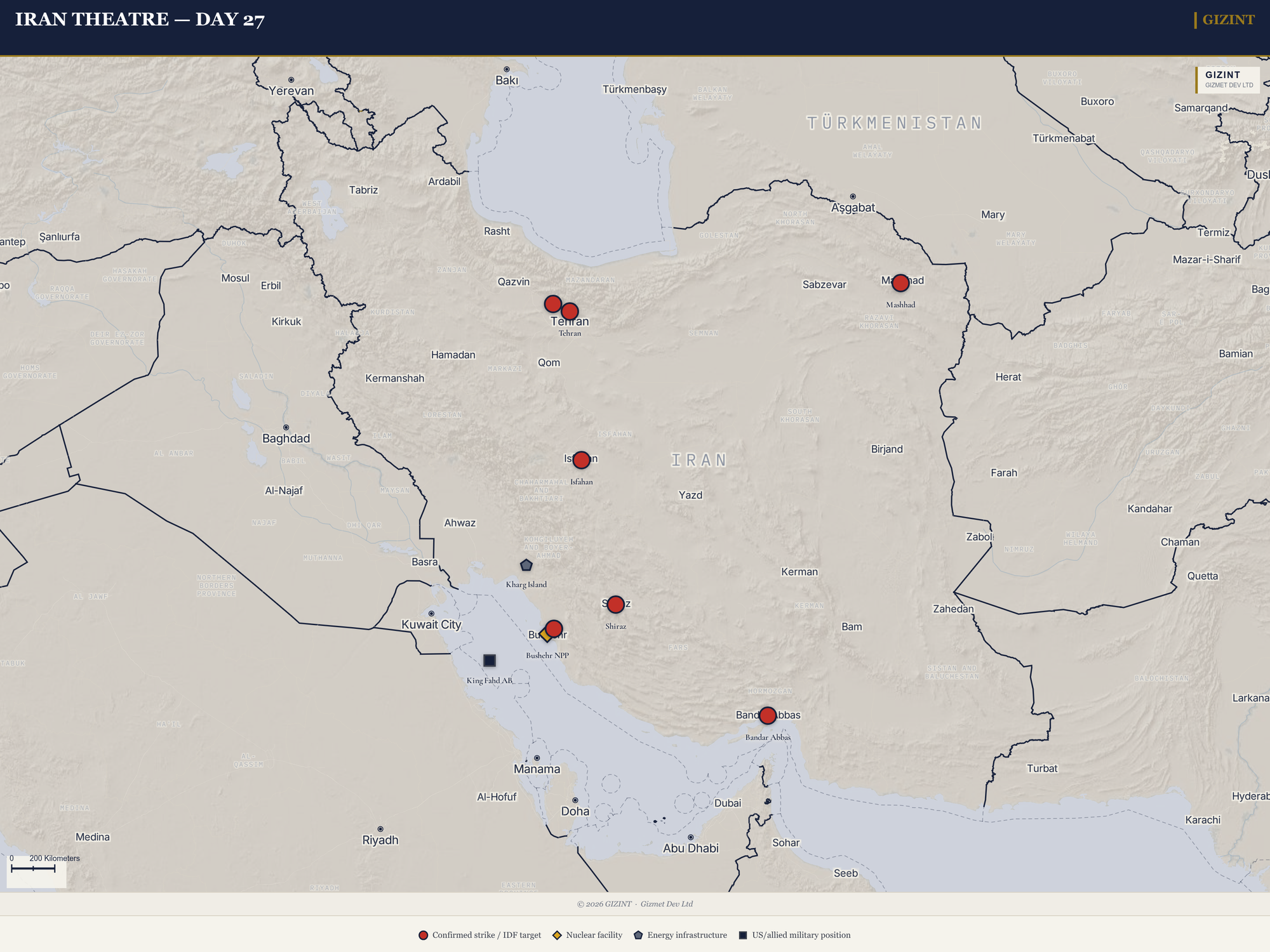
Israel killed IRGC Navy Commander RADM Alireza Tangsiri in a strike on Bandar Abbas at 0300 local on 26 March — alongside intelligence chief Behnam Rezaei and "the rest of the navy's top leadership" (IDF/Katz video statement, 26 Mar; CENTCOM confirmed on X). Tangsiri led the IRGC Navy since 2018, designed the toll corridor, oversaw the mine-laying programme, and directed the "non-hostile vessel" protocol formalised with the IMO on 22 March. His death follows the killing of 1st Naval District Commander Bakhtiari, confirmed by IRGC-affiliated media on 23 March (CTP-ISW, 25 Mar). Three of the IRGC Navy's most senior officers — the overall commander, the district commander covering Hormuz, and the intelligence chief — were eliminated within approximately 72 hours.
CENTCOM announced the 10,000th target struck (CENTCOM, 25 Mar). Adm. Brad Cooper stated 92% of Iran's largest naval vessels have been destroyed and drone/missile launch rates are down 90% from campaign peak (CENTCOM, 25-26 Mar). Two-thirds of military manufacturing capacity is destroyed or heavily damaged. The 92% figure covers surface combatants; it excludes 20+ Ghadir-class midget submarines and surviving fast boats — the platforms that threaten mine-clearance and Hormuz transit operations. Netanyahu ordered the IDF to destroy as much of Iran's arms industry as possible within 48 hours (NYT, 25 Mar) — consistent with the defence-industrial targeting surge observed since 24 March.
The decapitation creates a command vacuum in Hormuz naval operations — fast-boat patrols, mine warfare, and toll enforcement all depended on Tangsiri's personal authority. We assess IRGC naval coordination will be degraded for 24-72 hours given simultaneous loss of commander, intelligence chief, and district commander.
However, Iran's Majlis is drafting legislation to make the $2M/voyage Hormuz toll permanent — the first attempt to impose unilateral transit charges on an international strait since at least the 1970s (Bloomberg, 26 Mar; Fars, 26 Mar). The bill frames the levy as compensation for providing "security" along the shipping route, citing sovereignty and damage compensation. Finalisation is expected next week. This converts the toll from a wartime IRGC operation into a statutory sovereign claim — making it structurally harder to dismantle in any ceasefire, because the Majlis would need to repeal its own law. Iran signed UNCLOS in 1982 but never ratified it.
Mine fields remain. Nine vessels per day transit versus 120 pre-conflict — a 92.5% reduction, up from five earlier in the campaign (Windward, 26 Mar). JWC-033 covers the entire Gulf basin. DFC reinsurance: zero uptake Day 27. Toll corridor traffic composition: Iranian 67%, Greek 15%, Chinese 10% (Lloyd's List, 25 Mar).