


GIZINT — The Daily Brief | Issue 018
The Hormuz blockade survived the death of the man who built it and split into two systems that do not answer to each other: the IRGC turned back Chinese state-owned vessels hours after Iran's MFA promised China safe passage, while Malaysia transited the same Strait on the same day through a bilatera
The Hormuz blockade survived the death of the man who built it and split into two systems that do not answer to each other: the IRGC turned back Chinese state-owned vessels hours after Iran's MFA promised China safe passage, while Malaysia transited the same Strait on the same day through a bilateral deal the MFA did not broker. We assess the MFA's diplomatic framework has zero operational value at Hormuz. Only IRGC-granted passage works, and Majlis legislation is converting that passage into permanent statute.
- Two gates, one Strait: IRGC Navy turned back Chinese COSCO mega-carriers despite China's MFA exemption, while Malaysia transited via a separate IRGC bilateral deal. The MFA's diplomatic framework is decorative. The IRGC decides who passes.
- FBI Director's email burned: A DOJ-attributed MOIS front group published Kash Patel's personal Gmail as retaliation for the 19 March domain seizures, the fourth escalation in a sequence where targets rise in prominence while intelligence value diminishes.
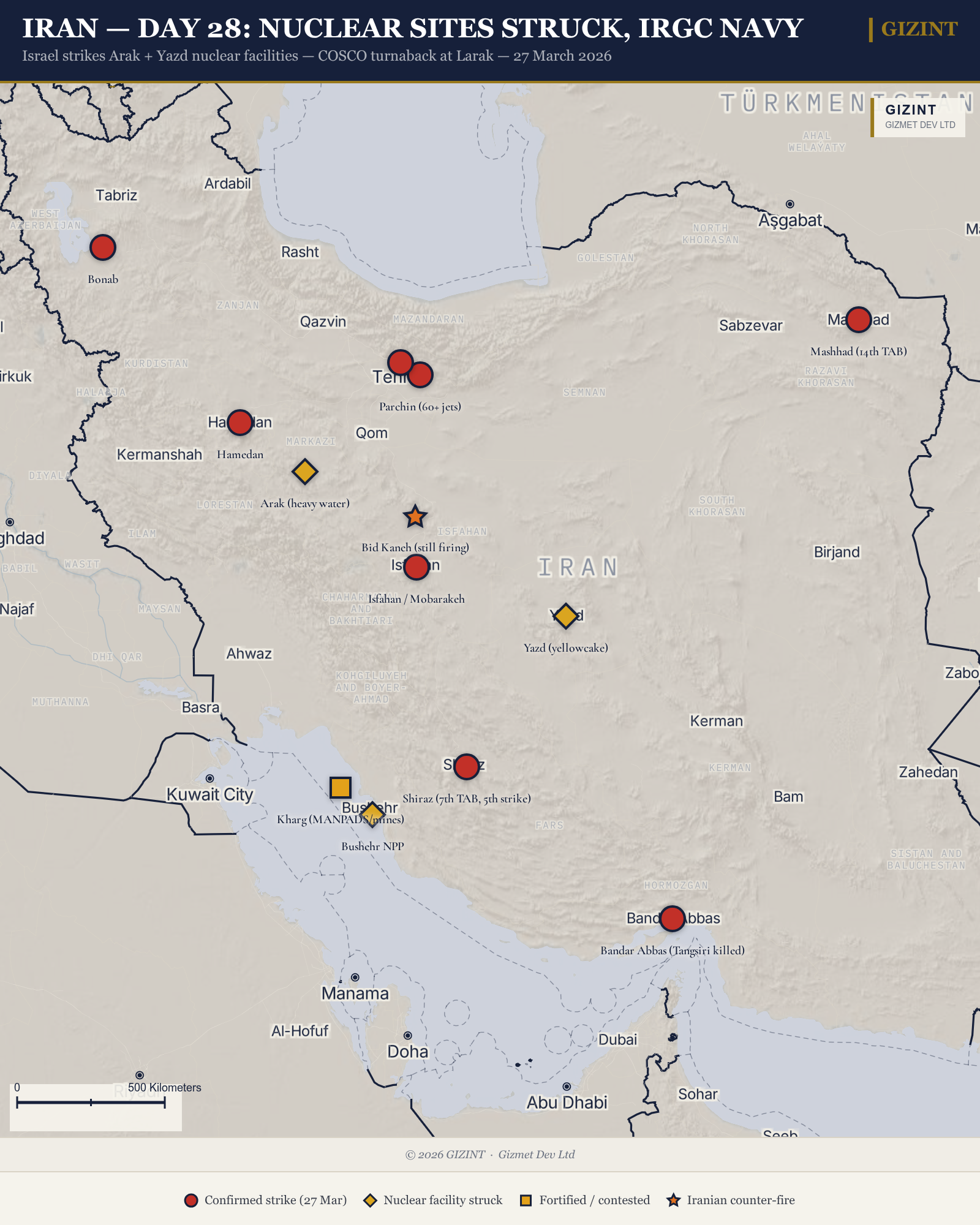
- Nuclear programme struck for first time: Israel hit the Arak heavy water complex and Yazd yellowcake plant on 27 March; IRGC warned "the equation will no longer be an eye for an eye," and hardliners are already advocating NPT withdrawal.

Hormuz Runs Two Gates. The MFA Controls Neither.
The IRGC Navy rejected Chinese state-owned vessels less than 24 hours after Iran's MFA granted China safe passage. Malaysia transited the same Strait on the same day via a bilateral deal with the IRGC. The MFA's diplomatic framework is decorative. The IRGC decides who passes.
Changed from prior assessment: Tangsiri's death assessed likely to degrade enforcement for 24-72 hours; MFA exemption framework assumed to have some operational value. Now: enforcement continued without interruption; MFA exemptions proved meaningless within hours while IRGC bilateral deals with Malaysia and Thailand functioned. Two parallel systems confirmed.
Three vessels were turned back near Larak Island on 27 March: CSCL Indian Ocean and CSCL Arctic Ocean (both COSCO mega-container vessels) and Marshall Islands-flagged Lotus Rising (Kpler AIS data; AFP, 27 Mar). The two COSCO ships had been trapped inside the Persian Gulf since the campaign began. This was the first attempt by a major container carrier to transit outward since 28 February. COSCO had resumed booking acceptance on 25 March. The IRGC Navy issued a statement declaring "The Strait of Hormuz is closed. Any movement through the strait will be met with a harsh response," explicitly contradicting Trump's 26 March claim that the Strait was open (Sepah News via AFP, 27 Mar).
China is on Iran's five-nation "friendly" exemption list, announced by FM Araghchi on 26 March. The IRGC rejected Chinese vessels less than 24 hours later. On the same day, Malaysian PM Anwar confirmed Malaysian ships were granted transit through a separate bilateral arrangement (Al Jazeera, 27 Mar). Thailand has also been granted access. The distinction is critical: Malaysia and Thailand negotiated directly with the IRGC or through channels that bypass the MFA. China relied on the MFA's diplomatic assurance, which the IRGC does not honour. Two parallel approval systems now operate at Hormuz. The MFA's is decorative. The IRGC's is operational. Tangsiri's death has not degraded enforcement; unit-level commanders are executing independently under mosaic doctrine pre-delegation.
Wang Yi, in a call with Pakistan's foreign minister, linked peace talks to "restoring normal navigation" for the first time (People's Daily, 27 Mar). Beijing's MFA has not publicly responded to the turnaback. The silence after a direct commercial confrontation with a "friendly nation" designation is itself a signal. We assess this incident will accelerate Chinese pressure on Iran to negotiate.
The Majlis toll legislation continues advancing independently. Permanent legislation codifying the $2M/voyage toll is in final stages, with finalisation expected next week (Bloomberg/Fars, 26 Mar). This converts the wartime measure into a domestic legal claim that survives any ceasefire. The toll corridor now has both a military enforcer (even without Tangsiri) and a parliamentary author. War risk insurance of $10-14M per voyage, not the toll itself, remains the binding constraint (Lloyd's List, Mar 2026).
Approximately 20,000 seafarers are stranded on vessels near the Strait; seven have died. The International Transport Workers' Federation designated Hormuz a "Warlike Operations Area," its highest classification, and reports ships running low on drinking water (ITF, 27 Mar). A dark fleet continues operating AIS-dark, moving an estimated 28M barrels via Malaysia to China, generating approximately $2B in IRGC revenue (UANI, 24 Mar).
No mine countermeasure operations have been reported in 28 days. The US Navy decommissioned its last four Avenger-class minesweepers from Bahrain in September 2025 (USNI News, Sep 2025). LCS-based clearance requires 4-8 weeks minimum in a permissive environment; the Strait is not permissive. Even an immediate ceasefire cannot physically reopen Hormuz for weeks to months. The market is pricing the diplomatic blockade; it has not yet priced the mine risk.