








GIZINT — The Daily Brief | Issue 019
The campaign is consuming irreplaceable platforms faster than diplomacy can produce a framework: Iran struck a PSAB AWACS aircraft that has no production-line replacement, the Houthis opened a fifth front with the stated option to close a second chokepoint, and Iran's five counter-conditions are non


The campaign is consuming irreplaceable platforms faster than diplomacy can produce a framework: Iran struck a PSAB AWACS aircraft that has no production-line replacement, the Houthis opened a fifth front with the stated option to close a second chokepoint, and Iran's five counter-conditions are non-starters. We assess the military campaign is approaching concurrent limits in munitions, platforms, and manpower while the diplomatic track has no deliverable agreement within its stated timeline.
- Irreplaceable loss: An Iranian strike on Prince Sultan Air Base damaged at least one E-3 AWACS and multiple KC-135 tankers, degrading the integrated air picture across the Gulf with no production-line replacement available.
- Second chokepoint: The Houthis launched three attacks on Israel on Day 29 (ballistic missile, cruise missile, drone) and publicly stated that closing Bab al-Mandeb is "among our options"; Iran simultaneously granted 20 Pakistani ships Hormuz passage, in what we assess is payment to the ceasefire mediator in access.
- Fractured from within: Vance chided Netanyahu for selling the war "as being easy"; Axios reported Israel leaked a fabricated story to undermine him; Iran's five counter-conditions are non-starters; the negotiating position is contradicted before it reaches Tehran.

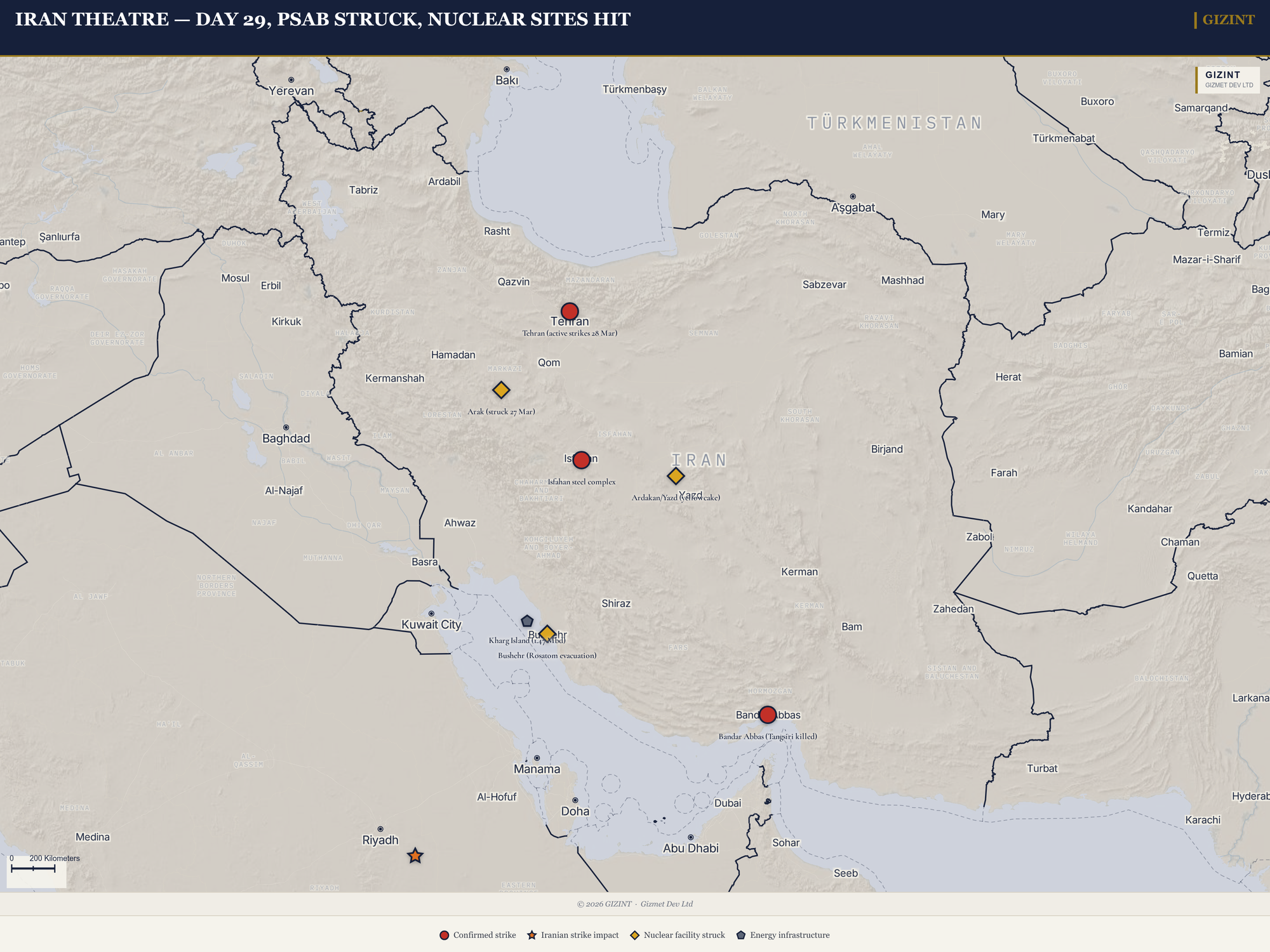
One AWACS Down. The Campaign Is Burning Platforms Faster Than It Gains Ground.
Iran's ballistic missile and drone strike on Prince Sultan Air Base on 27 March damaged at least one E-3G Sentry AWACS and multiple KC-135 Stratotankers, the most strategically consequential single engagement of the campaign.
The E-3 is the Gulf's airborne battle management platform; the USAF has no production line to replace losses. This is the second PSAB tanker attack; five KC-135s were damaged in mid-March (Military Times, 16 Mar). Reduced airborne battle management cueing compounds the interceptor sustainability constraint assessed in Section IV. Ten to fifteen US service members were wounded, two to five seriously (Stars and Stripes, 28 Mar).
CENTCOM's cumulative count: 10,000+ targets, 92% of Iran's largest surface combatants destroyed, launch rates down 90% (CENTCOM/Cooper, 25-27 Mar). The IDF assesses it has struck 1,000+ weapons production industry targets and that Iran cannot manufacture new missiles (Times of Israel, 27 Mar). The campaign is approaching the limits of targetable military infrastructure.
Yet the missile threat persists. Reuters reported (27 Mar, five US intelligence officials) that only one-third of Iran's missile stockpile is confirmed destroyed, one-third unclear, and one-third operational or recoverable. The Critical Threats Project / Institute for the Study of War (CTP-ISW) confirmed 330 of 470 launchers destroyed or inoperable (27 Mar). Iran fired six ballistic missiles and 29 drones in the PSAB attack alone and struck eight sites in Tel Aviv on 28 Mar, killing one (Al Jazeera). Cluster munition warheads now constitute 70% of Iranian missiles fired at Israel, up from 50% on 10 March (CTP-ISW, 27 Mar). The shift reflects inability to threaten discrete military targets rather than a choice; it is rationing, not depletion.
Force posture: third carrier (USS Bush) departed Norfolk; USS Tripoli with 2,200 Marines en route; 10,000 additional troops under consideration. Total theatre: 50,000 personnel. Fairford: 21 bombers (SOF News, 28 Mar; Axios, 27 Mar). TLAM expenditure: 850+ expended (SOF News, 28 Mar). Replenishment timelines are classified (SOF News, 28 Mar).
Changed from prior assessment: campaign degrading Iran's production capacity and naval forces. Now: campaign simultaneously consuming high-value US platforms while the last third of Iran's missile stockpile remains operational. No publicly stated conditions for mission accomplishment exist; the campaign is approaching an operational pause driven by target exhaustion rather than a negotiated settlement.
What changes if this assessment is wrong: If PSAB E-3 damage proves repairable rather than permanent, the air battle management gap closes and the interceptor cascade does not materialise. If IDF claims of zero Iranian missile production capacity prove overstated, the timeline for threat elimination extends well beyond Rubio's "2-4 more weeks."