



GIZINT — The Daily Brief | Issue 024
The air campaign has shifted to economic infrastructure because the military target ceiling is approaching. A third carrier group has deployed for a timeline measured in months, not weeks.

The air campaign has shifted to economic infrastructure precisely because the military target ceiling is approaching, and a third carrier strike group has deployed for a timeline measured in months; we assess Trump's "2-3 weeks" promise is domestic political management, not operational intent. Forty nations assembled the largest post-Cold War maritime coalition outside NATO and without the US, signalling that European-led Gulf security planning has moved from concept to operational framework.
- Brent whiplash: Oil collapsed $17 on Trump's ceasefire rhetoric then rebounded $10.65 overnight to $111.69 when the IRGC's second consecutive ultimatum expired without action, the sharpest 24-hour reversal of the campaign.
- Coalition without America: The UK convened 40 nations including GCC states, Japan, and the EU for post-conflict Hormuz security planning; the US was not present; Macron called military reopening "unrealistic."
- IRGC credibility collapse: Two unfulfilled ultimatums in 72 hours, an English-language presidential appeal contradicted by the foreign minister in the same news cycle, and a military council that has sidelined the elected government.

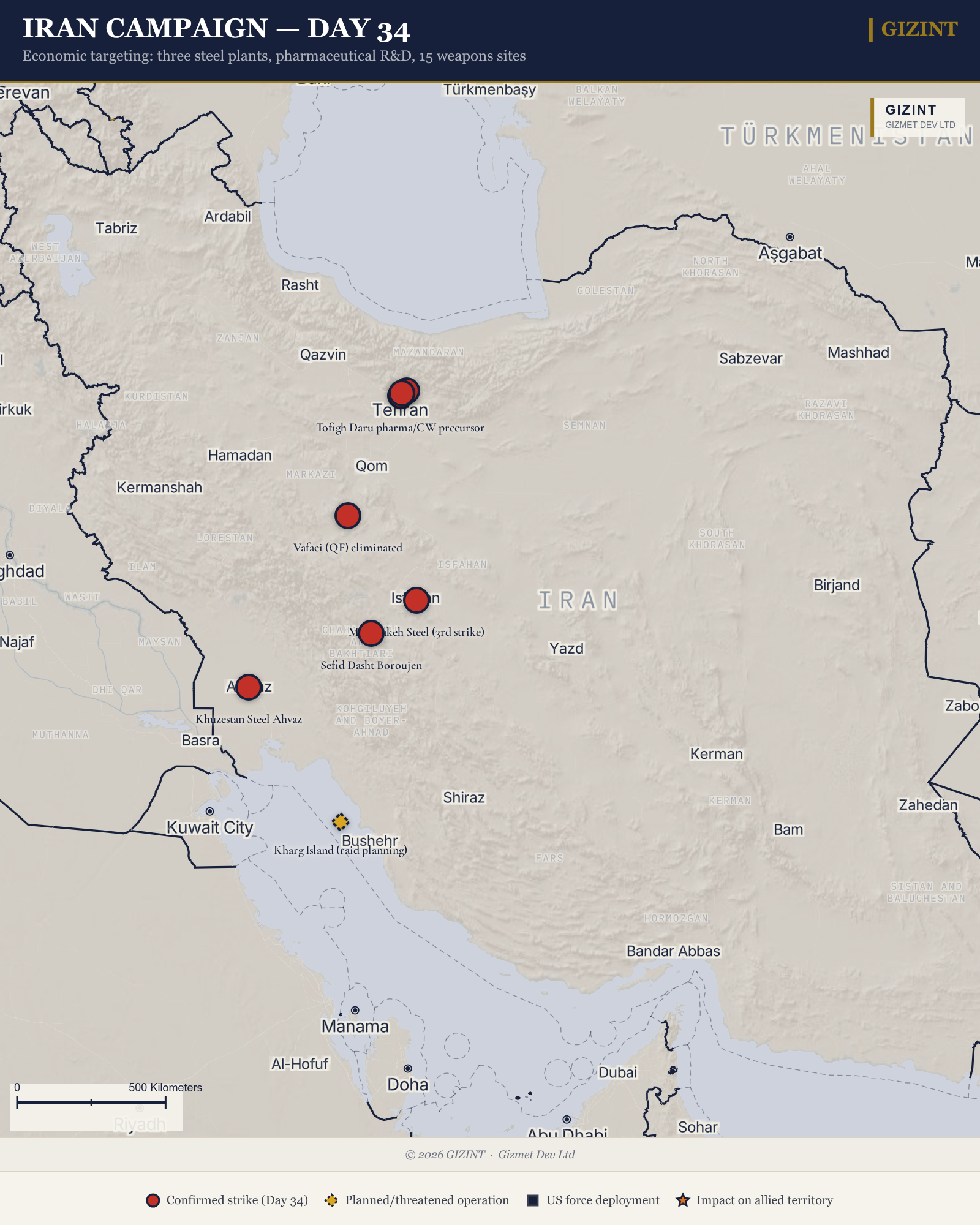
Air Campaign Shifts to Factories as Target Ceiling Approaches and Third Carrier Deploys
The combined force struck three steel plants, a chemical weapons precursor facility, and approximately 15 weapons production sites in a single day as CENTCOM acknowledged 12,300 targets struck; a third carrier departed Norfolk for a deployment built for months.
Changed from prior assessment: air campaign was in military-target phase. Now: economic and dual-use targeting phase confirmed, with target exhaustion forcing transition. Third CSG committed.
CENTCOM reported 12,300+ targets struck with "absolute air and naval control" and 155+ warships and submarines destroyed (CENTCOM via Voice of Emirates, 2 Apr). The IDF struck three major steel facilities on 31 Mar: Mobarakeh Steel in Isfahan (second time in five days), Khuzestan Steel in Ahvaz, and Sefid Dasht in Boroujen (Critical Threats Project / Institute for the Study of War [CTP-ISW], 1 Apr). The IDF also struck Tofigh Daru, a pharmaceutical R&D facility in Tehran Province, stating it was a "central supplier of fentanyl-based compounds" to SPND, the MODAFL entity sanctioned by the US for WMD proliferation since 2014 (CTP-ISW, 1 Apr; Treasury.gov). On 1 Apr, approximately 15 weapons production sites were struck including a MODAFL advanced ballistic missile complex (IDF via CTP-ISW).
Attack waves dropped to three in 24 hours, the lowest daily rate of the campaign. However, one 10-missile salvo was among the largest of the war (CTP-ISW, 1 Apr). Cluster munitions fell in central Israel including Bnei Brak, injuring civilians and children (CTP-ISW, 1 Apr; Alma Center, 1 Apr). Iran, Hezbollah, and the Houthis claimed the first trilateral coordinated salvo of the war (CTP-ISW, 1 Apr).