

GIZINT — The Daily Brief | Issue 031
We assess the ceasefire is structurally compromised: Lebanon's exclusion produced the war's deadliest strikes (at least 303 killed, 8 Apr), Hezbollah resumed fire with ~70 rockets on 9 Apr, and the IRGC published a mine map converting Hormuz from a commercial blockade to a physical threat.
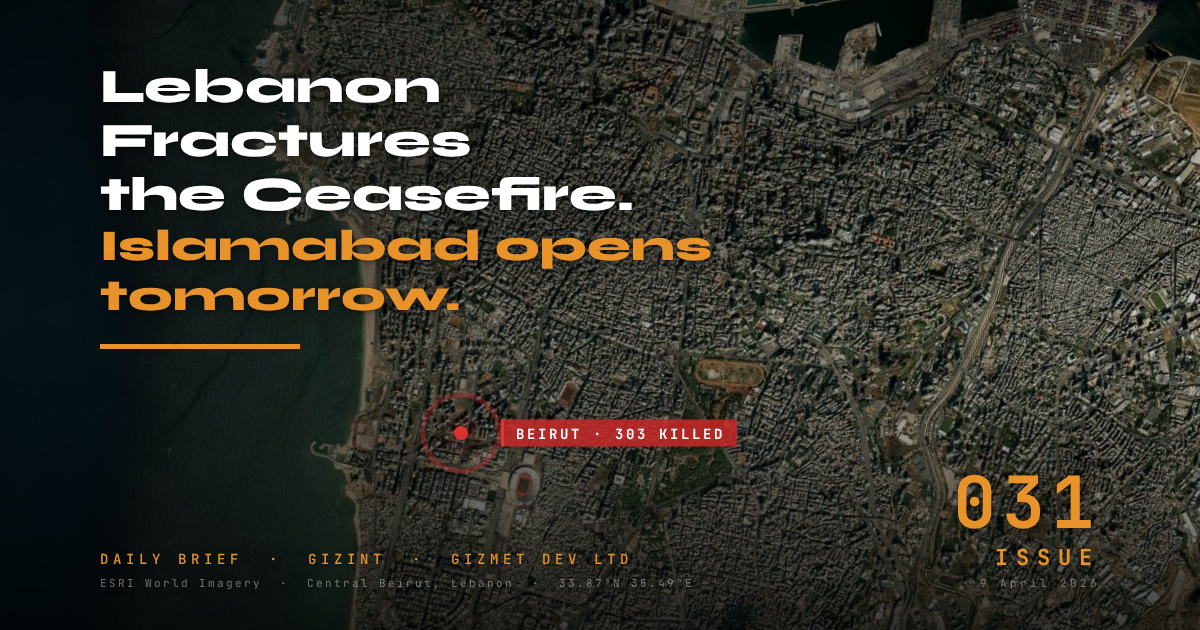
We assess the ceasefire is structurally compromised: Lebanon's exclusion produced the war's deadliest strikes (at least 303 killed, 8 Apr), Hezbollah resumed fire with ~70 rockets on 9 Apr, and the IRGC published a mine map converting Hormuz from a commercial blockade to a physical threat. The two-week ceasefire expires 22 Apr; Islamabad on 10 Apr faces a contradiction no party has empowered the mediator to resolve, with Iran demanding Lebanon's inclusion and Israel refusing to stop.
- Lebanon fractures ceasefire: Israel's heaviest strikes killed at least 303 on 8 Apr; Hezbollah resumed ~70 rockets on 9 Apr; Netanyahu ordered talks but stated "no ceasefire in Lebanon." Historically, ceasefires excluding active theatres have not survived the exclusion.
- Hormuz mines confirmed: The IRGC published a mine danger zone dated from 28 Feb; only 2 tankers have transited since the ceasefire; mine clearance takes 6-12 months based on Tanker War/Gulf War precedent regardless of diplomatic outcome.
- GCC defence is a wasting asset: The Attack tempo has dropped sharply but has not stopped (Bahrain intercepted 7 drones, Kuwait reported drones targeting a National Guard site on 9 Apr); interceptor stocks remain critically depleted and no resupply channel can deliver in the window that matters.
Lebanon Fault Line Threatens to Collapse Ceasefire Before Islamabad
The US-Iran ceasefire's deliberate exclusion of Lebanon has produced a structural contradiction that the Islamabad talks cannot resolve without reopening terms neither side has empowered Pakistan to negotiate.
The two-week ceasefire announced on 7 April expires on 22 April, giving the Islamabad talks a hard deadline. Pakistan and Egypt are co-guarantors. The indirect format (Pakistani intermediaries carry positions between delegations) is structurally significant: intermediaries with drafting authority produced agreements at Algiers (1981) and in early JCPOA channels (2013) that direct talks could not. The US presented a 15-point counter-proposal to Iran's 10-point plan; neither document is public. On its second day (9 Apr), the Iran front was quiet, the GCC experienced its first attack-free day since 28 February, and the Iraq militia alignment held. But Lebanon has emerged as the fault line that could collapse the entire structure before the 22 Apr expiry.
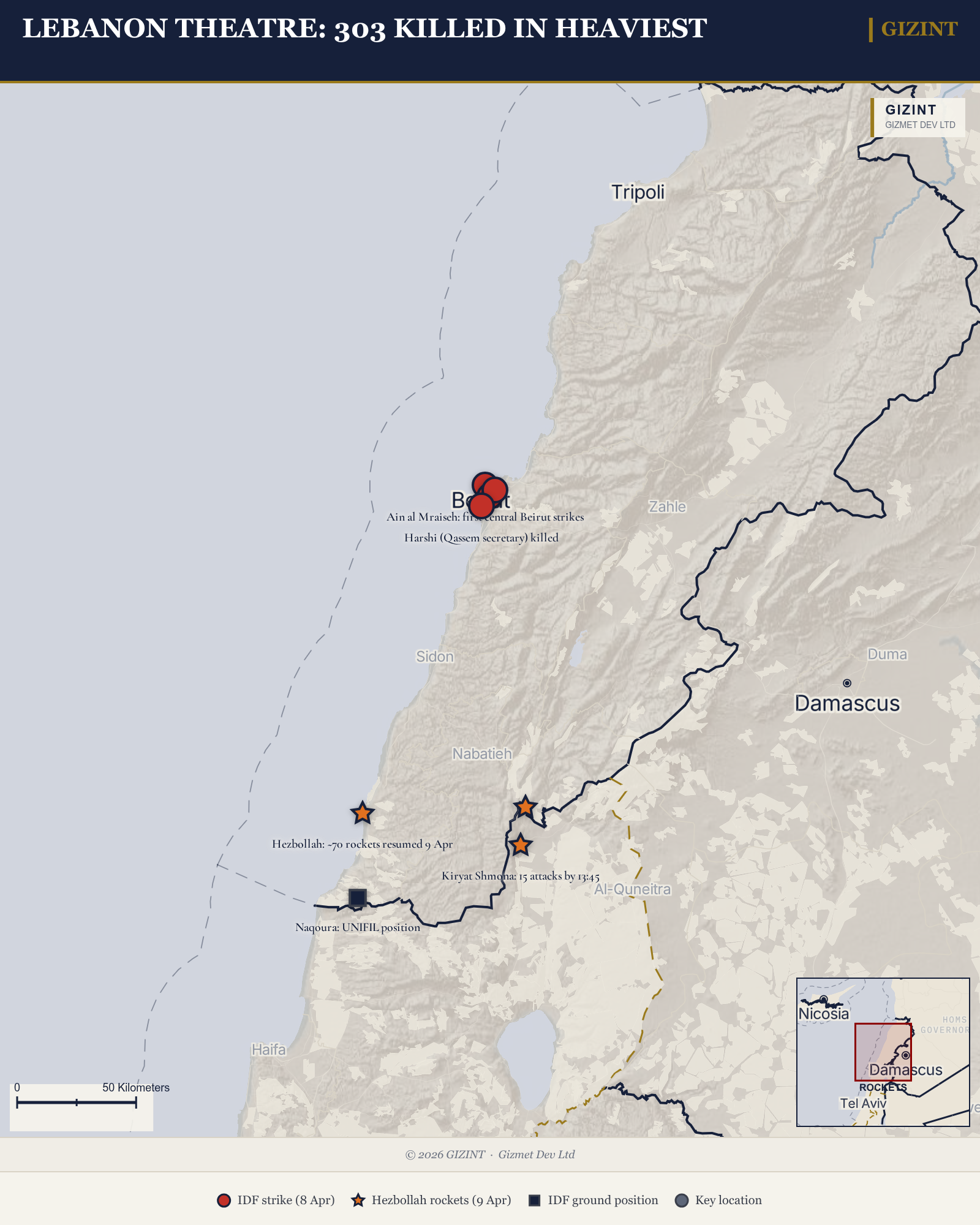
On 8 April, the IDF conducted the largest strike wave of its Lebanon campaign: 100+ targets in 10 minutes, including the first strikes on central Beirut (Ain al Mraiseh, Mazraa, Tallet Khayat), killing at least 303 and wounding 1,150 (CNN via Lebanese Health Ministry, 9 Apr). The Lebanese Health Ministry's cumulative toll stands at 1,888 killed and 6,092 wounded as of 9 Apr (up from 1,751/5,804 in Issue 030; the increase reflects both the 8 Apr strikes and ongoing rescue operations recovering previously uncounted casualties). Israeli forces killed Naim Qassem's personal secretary and nephew Ali Yusuf Harshi, his bodyguard Fadl Abbas Najm, and Hezbollah militia commander Maher Qassem Hamedan in a single operational cycle. Multiple outlets incorrectly reported Qassem himself killed; the IDF retracted the claim the same day (Turkiye Today, 9 Apr).
Hezbollah adhered to the ceasefire for approximately 36 hours, with zero confirmed attacks from 18:00 ET on 7 April through 8 April (Critical Threats Project / Institute for the Study of War (CTP-ISW), 8 Apr). Attacks resumed early 9 April: approximately 70 rockets struck northern Israel, with 15 attacks recorded by 13:45 local time targeting primarily Kiryat Shmona and Metula (Alma Center, 9 Apr; Times of Israel, 9 Apr).
The political dynamics are a four-way split. Netanyahu instructed his cabinet to open direct negotiations with Lebanon "as soon as possible" and named Ambassador Yechiel Leiter as representative, but an Israeli official stated to CNN: "No ceasefire in Lebanon. The negotiations with the Lebanese government will begin in the coming days... under fire." Lebanon's position: "No negotiations under fire" (Lebanese official to CNN, 9 Apr). Trump asked Netanyahu to be "a little more low-key" (NBC News, 9 Apr). Vance, speaking in Budapest, called the Lebanon exclusion a "legitimate misunderstanding" and said Israel "offered to check themselves a little bit." This contradicts Trump's PBS statement that Lebanon was deliberately excluded "due to Hezbollah." We assess the Vance framing is diplomatic damage control ahead of Islamabad, not a policy correction.
Iran's SNSC listed cessation "on all fronts including Lebanon" as non-negotiable in its 10-point proposal. However, mediators told the Wall Street Journal that Iran has separately softened several demands, including on nuclear enrichment, US force withdrawal, and reparations (WSJ via CTP-ISW, 9 Apr). The gap between public maximalism and private flexibility may be wider than the published positions suggest. The eleven-leader European joint statement (Consilium, 8 Apr) explicitly called for ceasefire implementation "including in Lebanon." France separately condemned the strikes "in the strongest possible terms."
The historical pattern is consistent: Dayton deferred Kosovo (conflict resumed within three years), Oslo left settlements unresolved (Second Intifada followed), UNSCR 1701 included all of Lebanon (held nearly two decades). Available precedent suggests ceasefires that deliberately exclude an active theatre do not survive the exclusion.
Changed from prior assessment: Issue 030 assessed the ceasefire as collapsed on its first day due to Lebanon strikes and Hormuz re-closure. Now: the Iran and GCC fronts are holding, but Lebanon has become the structural fault line that will determine whether Islamabad can produce a durable basis for talks. The contradiction has sharpened, not resolved.
What changes if this assessment is wrong: What changes if wrong: If the Lebanon track and Iran track prove separable in practice, with Islamabad producing an Iran-specific arrangement while Lebanon negotiations proceed independently at the State Department, the ceasefire survives despite the contradiction. The evidence against this: Iran has made Lebanon inclusion a stated precondition for continued participation.