
GIZINT — The Daily Brief | Issue 032
Islamabad Day 1. Iran's two preconditions unmet. Fewer than five tankers have transited Hormuz in three days of ceasefire. Physical Brent $132 against futures $95. Ceasefire expires in 12 days.
We assess the Islamabad talks face structural failure before they begin: Iran's two preconditions have not been met, the US and Israel explicitly exclude Lebanon, and neither framework can accommodate the other within 12 days. Fewer than five tankers have transited Hormuz in three days of ceasefire; physical Brent at $132 against futures near $95 is a $37 spread the market has never priced.
- Islamabad impasse: Iran's two preconditions (Lebanon ceasefire, asset release) are unmet; Pakistan's realistic objective is an agreement to keep talking past the 22 Apr expiry.
- Hormuz closed: Fewer than five tankers in three days of ceasefire, 325 stranded, physical Brent $132 against futures $95; the insurance blockade has not moved and mine clearance requires months.
- Easter ceasefire: First officially agreed pause since 2022; Ukraine confirmed 11,000+ daily drone sorties and 150,000 targets in March while Russia pivots the ceasefire to demand Ukraine talks.
Islamabad Opens Under Impossible Conditions, and Both Sides Know It
The highest-level US-Iranian engagement since 1979 opens in Islamabad with two mutually exclusive frameworks, no agreed agenda, and 12 days before the ceasefire expires.
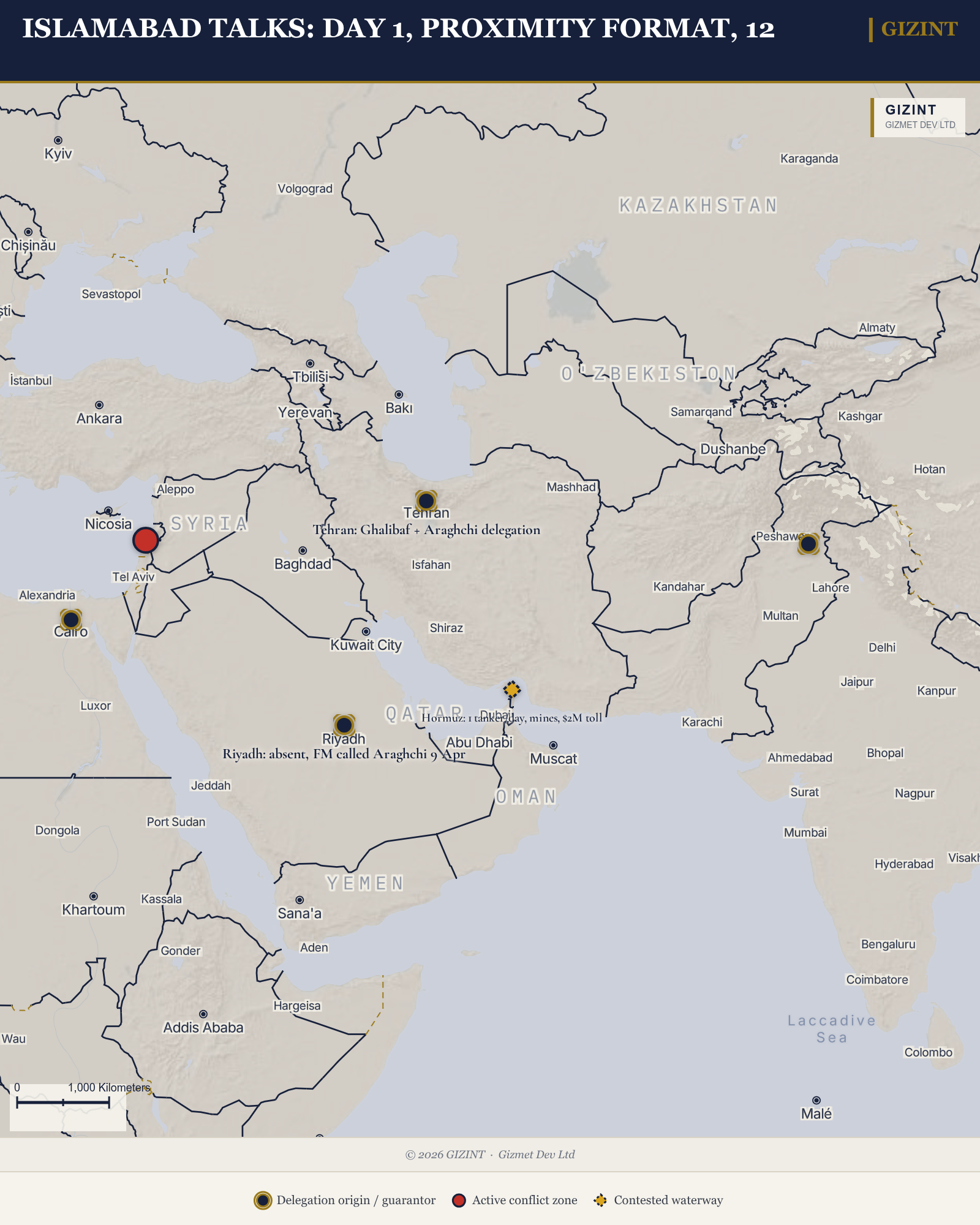
Vice President Vance arrived at the Serena Hotel, Islamabad, on 10 Apr with Special Envoy Witkoff and Senior Adviser Kushner for proximity talks beginning Saturday. The Iranian delegation, led by Ghalibaf and Araghchi, arrived Friday evening. Separate rooms, Pakistani officials shuttling between them. (CNN, 10 Apr; Guardian, 10 Apr)
The structural problem is not negotiating positions but incompatible preconditions. Ghalibaf posted on X that talks cannot begin until two conditions are met: a ceasefire in Lebanon and the release of Iran's blocked assets. Neither has been met. The US and Israel explicitly exclude Lebanon from the ceasefire framework. Araghchi framed the impasse on 9 Apr: "The US must choose, ceasefire or continued war via Israel. It cannot have both." (CNN, 10 Apr; MEE, 10 Apr)
Two versions of Iran's 10-point plan appear to exist. The public version includes maximalist demands: Hormuz control, enrichment recognition, sanctions lifting, reparations, US force withdrawal. The White House indicated Trump referenced a "more reasonable" version sent directly. The 15-point US counter-proposal reportedly requires: no enrichment, HEU stockpile removal, ballistic missile limits, and Hormuz reopening. Vance described the public version as thrown "in the garbage." (Critical Threats Project / Institute for the Study of War (CTP-ISW), 9 Apr; WSJ, 8 Apr; CNN, 10 Apr)
Trump gave 24 hours for progress, stated Iran has "no cards" (Truth Social, 10 Apr), and threatened to resume strikes "with even more intensity" (NY Post, 10 Apr). Speaking to reporters before departing for Charlottesville on the evening of 10 Apr, Trump defined a good deal as "no nuclear weapon, that's 99% of it," stated Hormuz "will open up automatically" and "fairly soon," and said "we don't need a back-up plan." The nuclear framing narrows the US position to enrichment while leaving Hormuz, missiles, and sanctions as negotiable. (Pool reports, 10 Apr)