






GIZINT — The Daily Brief | Issue 033
US warships transited the Strait of Hormuz for the first time in 43 days, but the insurance regime that closed the waterway to commercial shipping remains unchanged; we assess the Strait will not reopen to normal trade for months regardless of military progress.


US warships transited the Strait of Hormuz for the first time in 43 days, but the insurance regime that closed the waterway to commercial shipping remains unchanged; we assess the Strait will not reopen to normal trade for months regardless of military progress. Islamabad talks have reached a technical phase with no agreements and Tasnim reports this round may be the "last opportunity" for a framework, while reporting that China is preparing MANPADS deliveries to Iran creates a collision with the 12 May Trump-Xi summit.
- Hormuz transit, not reopening: Two US destroyers crossed the Strait but commercial traffic remains at 3-5% of pre-war because the JWC insurance listing, not the minefield, is the binding constraint.
- Islamabad enters technical phase: The highest-level US-Iran talks during an active military conflict have moved to trilateral format with 11 days to ceasefire expiry; Tasnim calls this round the "last opportunity" for a framework.
- China MANPADS tests broker narrative: US intelligence indicates Chinese MANPADS routed to Iran through third countries; if confirmed, the first breach of the reimposed UNSC arms embargo by a P5 member.

Hormuz Mine Clearance Begins, but the Insurance Blockade Holds
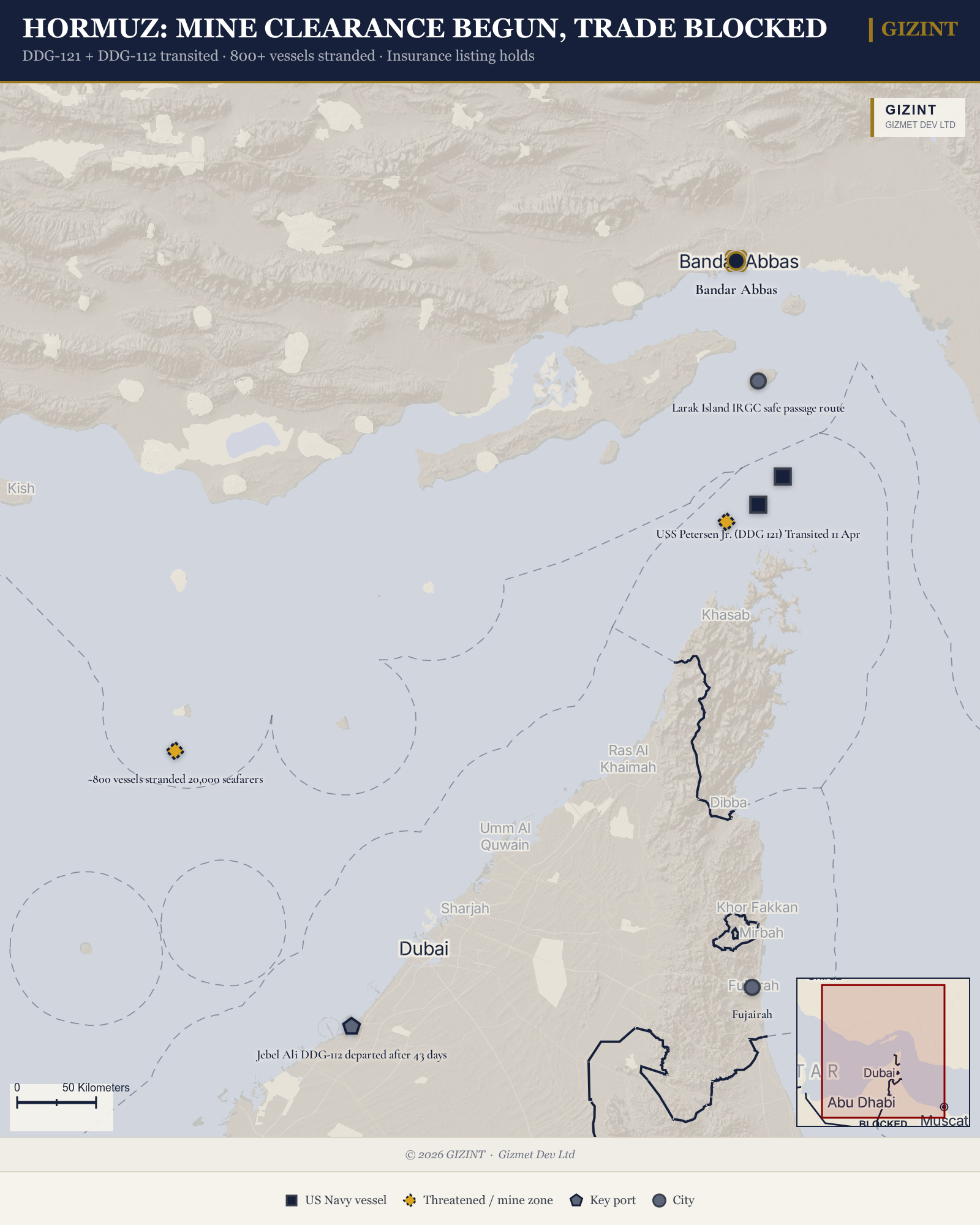
Two US destroyers transited the Strait of Hormuz on 11 Apr, the first warship passage in 43 days, but the JWC insurance listing, not the minefield, is the binding constraint on commercial reopening.
CENTCOM confirmed forces began "setting conditions for clearing mines" and that underwater drones will join the effort "in the coming days" (CENTCOM/DVIDS, 11 Apr). DDG-112 broke 43 days of radar silence from Jebel Ali, proceeding at approximately 20 knots toward the Strait (itamilradar, 11 Apr). The transit is the most operationally significant event since the 8 Apr ceasefire.
The transit accounts are disputed and cannot be independently verified. US officials (three, per Axios) stated both destroyers crossed with "no threats received." Iranian state television reported the vessels were warned and "forced to turn back" (Axios, 11 Apr; Iranian state TV via Fortune, 11 Apr). These accounts are mutually exclusive. CENTCOM confirmed both destroyers are currently operating in the Arabian Gulf; the IRGC subsequently warned that any military vessel transiting the Strait will be met with a "strong response" (IRGC via Sky News, 11 Apr).
IRGC deployed mines "without systematic tracking" using small boats; the Strait is described as a "navigational nightmare" (NYT via JPost, 11 Apr). The Cooper Coalition (40+ nations, UK-led) has planners meeting in coming days, but MCM capability has not yet deployed to the theatre (USNI Proceedings, Apr 2026). Iran's assessed mine inventory: 2,000-6,000 (IISS), 43 days of emplacement. Clearance timelines are measured in months, not weeks, and begin when MCM capability deploys.
Commercial transit is unchanged. Critical Threats Project / Institute for the Study of War (CTP-ISW) maritime tracking (cutoff 10 Apr) shows three cargo vessels entered the Strait since 9 Apr, all sanctioned or Iranian-flagged. No commercial tanker traffic. Approximately 800 vessels remain stranded.
The insurance regime is the durable constraint. JWC JWLA-033 designates the entire Arabian Gulf a Listed Area; war-risk premiums of 1.5-5.0% of hull value make transit uneconomic. The LMA stated 8 Apr that trade resumption is "highly unlikely." Mid-year delistings require treaty amendments no reinsurer will grant during an active campaign. We assess complete mine clearance by June would not produce commercial reopening until Q1 2027.