
GIZINT — The Daily Brief | Issue 034
21 hours of US-Iran talks in Islamabad collapsed on a nuclear demand absent from the original ceasefire. Within hours, Trump declared a naval blockade of Hormuz. The E3 pivot toward Berlin, Paris, and London is now the only viable path to extending the ceasefire past 22 Apr.
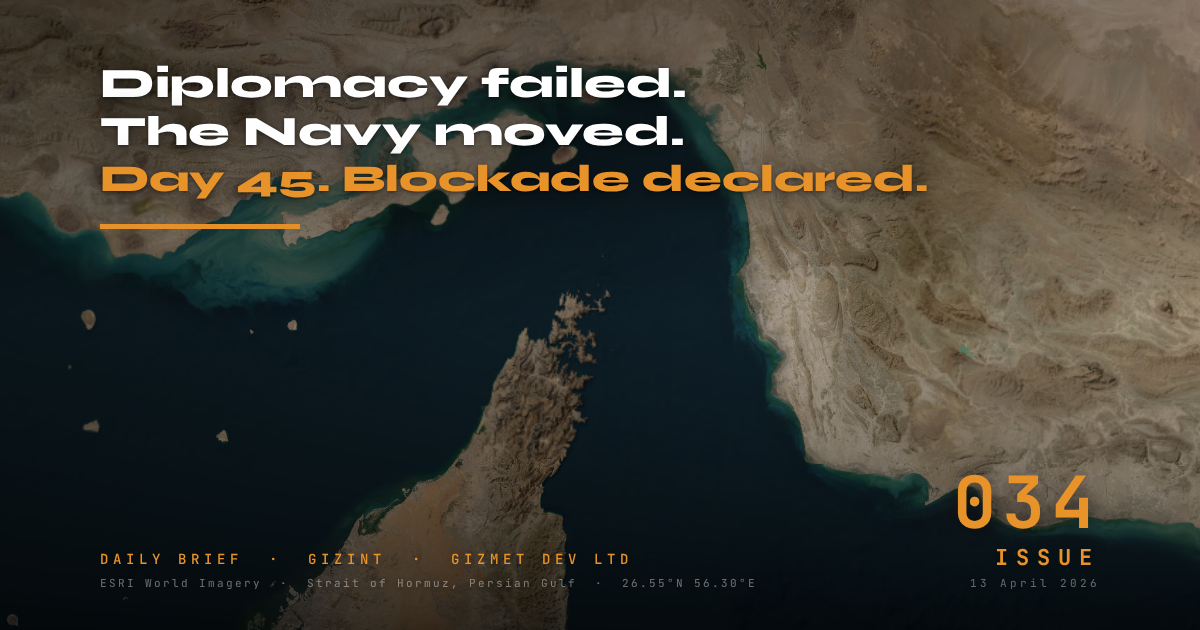
Twenty-one hours of direct US-Iran talks in Islamabad produced no agreement and no date for another round; within hours, Trump declared a naval blockade of the Strait of Hormuz, transforming the crisis from a commercial insurance question to sovereign enforcement with 9 days to ceasefire expiry and no diplomatic track active. We assess the blockade was pre-positioned rather than reactive, and we assess the E3 pivot signalled by Iran's FM Araghchi toward Berlin, Paris, and London is now the only viable mechanism for extending the ceasefire past 22 Apr.
- Diplomacy exhausted, enforcement began: The Islamabad trilateral collapsed on a nuclear demand absent from the original ceasefire terms, and the blockade announcement hours later suggests escalation was pre-loaded, not contingent on the outcome.
- Five Eyes fracture widens: The UK, France, Germany, Italy, and Greece refused blockade participation in the biggest operational divergence since Iraq 2003; the Cooper Coalition holds for mine clearance but has split from the US on enforcement.
- Three supply mechanisms fail simultaneously: The blockade, GL-U sanctions expiry (19 Apr), and SPR buffer exhaustion converge in a six-day window with Brent assessed to breach $100 at Monday's open.
Diplomacy Failed, the Navy Moved: Islamabad Collapses, Blockade Declared
The United States and Iran failed to reach agreement after 21 hours of direct negotiations in Islamabad, described by analysts as the highest-level engagement between the two governments since 1979. VP Vance confirmed: "The bad news is that we have not reached an agreement. I think that's bad news for Iran much more than it's bad news for the U.S." (Vance, press conference, Islamabad, 12 Apr). The talks collapsed on a nuclear demand that was not part of the original ceasefire framework. Vance stated the US required "an affirmative commitment that they will not seek a nuclear weapon, and they will not seek the tools that would enable them to quickly achieve a nuclear weapon." The 7 Apr ceasefire covered Hormuz sovereignty, sanctions, reparations, and war termination. Nuclear weapons were absent from those terms. Iran's FM spokesperson Baghaei blamed "excessive demands" (NPR; ABC News, 12 Apr). Tasnim reported the "ball in America's court." Qalibaf stated Iran "had good initiatives to show goodwill" and claimed "progress in the negotiations," while asserting the "US ultimately failed to gain the trust of the Iranian delegation" and dismissing the blockade as something that "will not affect Iran" (Sky News, 12 Apr). We assess the nuclear demand functions as a structural poison pill: no Iranian delegation could deliver an affirmative nuclear commitment without Supreme Leader authority that the current leadership cannot credibly provide. Qalibaf: "If you fight, we will fight, and if you come forward with logic, we will deal with logic" (Sky News, 12 Apr). Neither side has closed the channel.
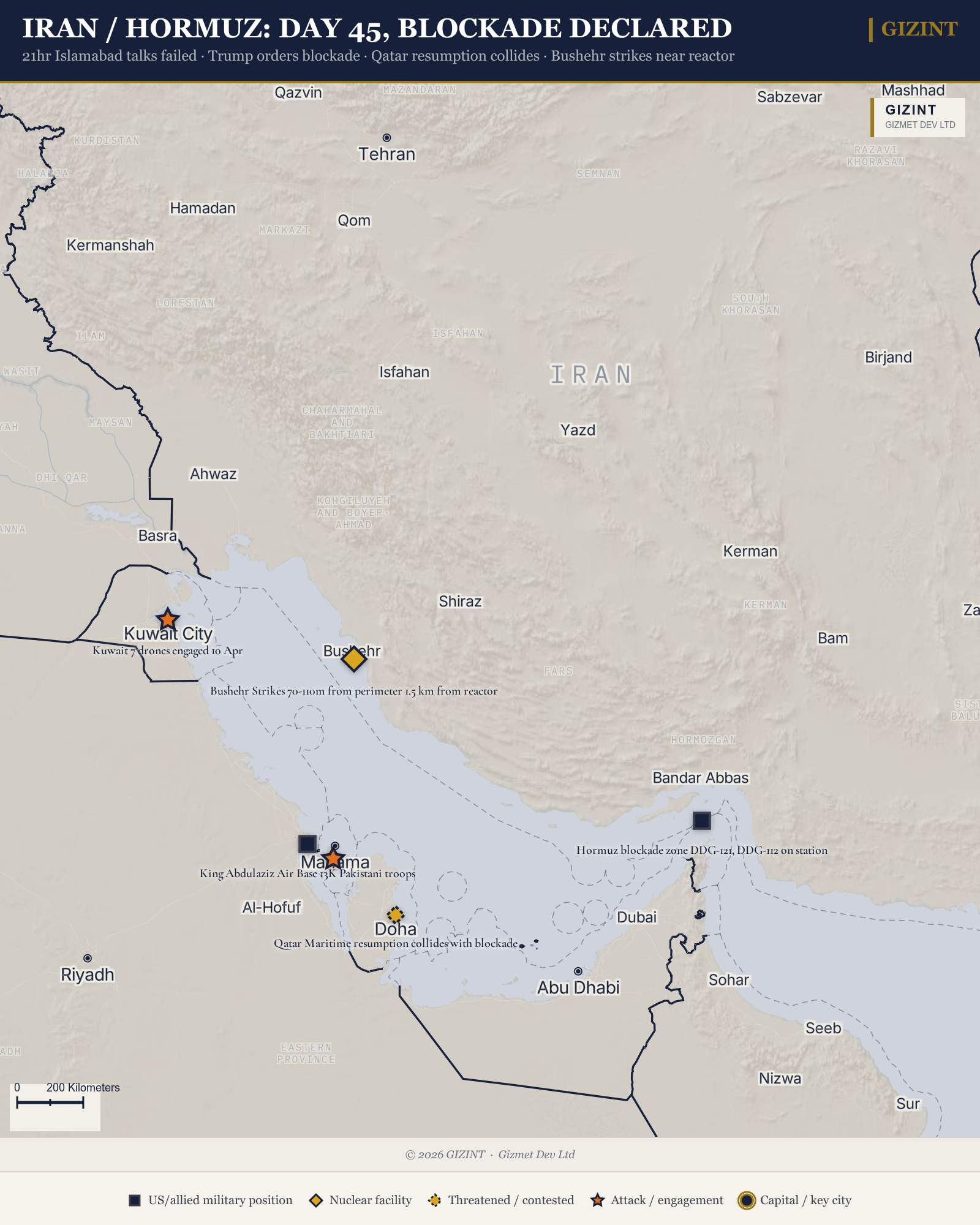
Within hours of Vance's announcement, Trump declared a naval blockade via Truth Social: "Effective immediately, the United States Navy, the Finest in the World, will begin the process of BLOCKADING any and all Ships trying to enter, or leave, the Strait of Hormuz." In a separate post, he ordered the Navy to "seek and interdict every vessel in International Waters that has paid a toll to Iran" (Truth Social, 12 Apr). The sequencing is the analytical signal. The Fifth Fleet has approximately 20-25 ships in the CENTCOM area, simultaneously running the campaign, protecting Gulf partners, and conducting mine clearance. A declared "complete blockade" with current forces is a patrol with interdiction capability, not an airtight closure. We assess the blockade was pre-positioned to follow any outcome short of full Iranian capitulation, not a reactive escalation to diplomatic failure.
The blockade transforms the legal character of the Hormuz closure from an insurance question to sovereign enforcement. Under the San Remo Manual (Articles 93-104), a blockade is an act of war requiring formal declaration, notification to all belligerents and neutral states, and effectiveness. A Truth Social post meets none of these. The US has not notified the UNSC under Article 51, holds no AUMF for Iran, and no declaration of war exists. The WPR 60-day clock expires 29 Apr. Congress returns 14 Apr.
Qatar announced maritime resumption on 12 Apr, hours before the blockade declaration, creating a direct collision between a Major Non-NATO Ally's sovereign port access and US enforcement (Critical Threats Project / Institute for the Study of War (CTP-ISW), 11 Apr). US blockade enforcement and Cooper Coalition mine clearance now overlap in the Strait with no public deconfliction regime.
Iran's FM Araghchi indicated readiness to engage with Europeans in Berlin, Paris, and London (Araghchi, X, 12 Apr), the first signal of a deliberate bypass of Washington. The E3 holds a differentiated position: inside the Cooper Coalition, aligned with the EU ceasefire stance including Lebanon, opposed to the blockade. Oman's FM Albusaidi publicly urged ceasefire extension (Albusaidi, X, 12 Apr); Starmer called Oman's Sultan on 12 Apr (gov.uk). The historical pattern when both parties blame the other but neither burns the channel (Panmunjom, Dayton, Doha) produces either a quiet back-channel deal or a sharp escalation before the next round. We assess the blockade and the European shuttle are complementary, not contradictory.
Changed from prior assessment: Insurance blockade as binding Hormuz constraint; Islamabad in technical phase with 11 days left. Now: Sovereign naval enforcement supersedes insurance; talks collapsed, no next round scheduled, 9 days to ceasefire expiry.
What changes if this assessment is wrong: If the blockade is declaratory rather than operational, the insurance regime remains the binding constraint and the pre-blockade assessment holds. The test is whether a commercial vessel attempts transit in the next 72 hours and whether the US Navy physically intercepts it.