










Pentagon Orders 82nd Airborne Forward as US Sends Iran 15-Point Plan — The Offer and the Enforcement Mechanism
The United States ordered the 82nd Airborne Division's command element and Immediate Response Force to the Middle East on the same day it sent Iran a 15-point peace plan through Pakistan, Egypt, and Turkey (WSJ, 24 Mar; NYT, 24 Mar).

The United States ordered the 82nd Airborne Division's command element and Immediate Response Force to the Middle East on the same day it sent Iran a 15-point peace plan through Pakistan, Egypt, and Turkey (WSJ, 24 Mar; NYT, 24 Mar).
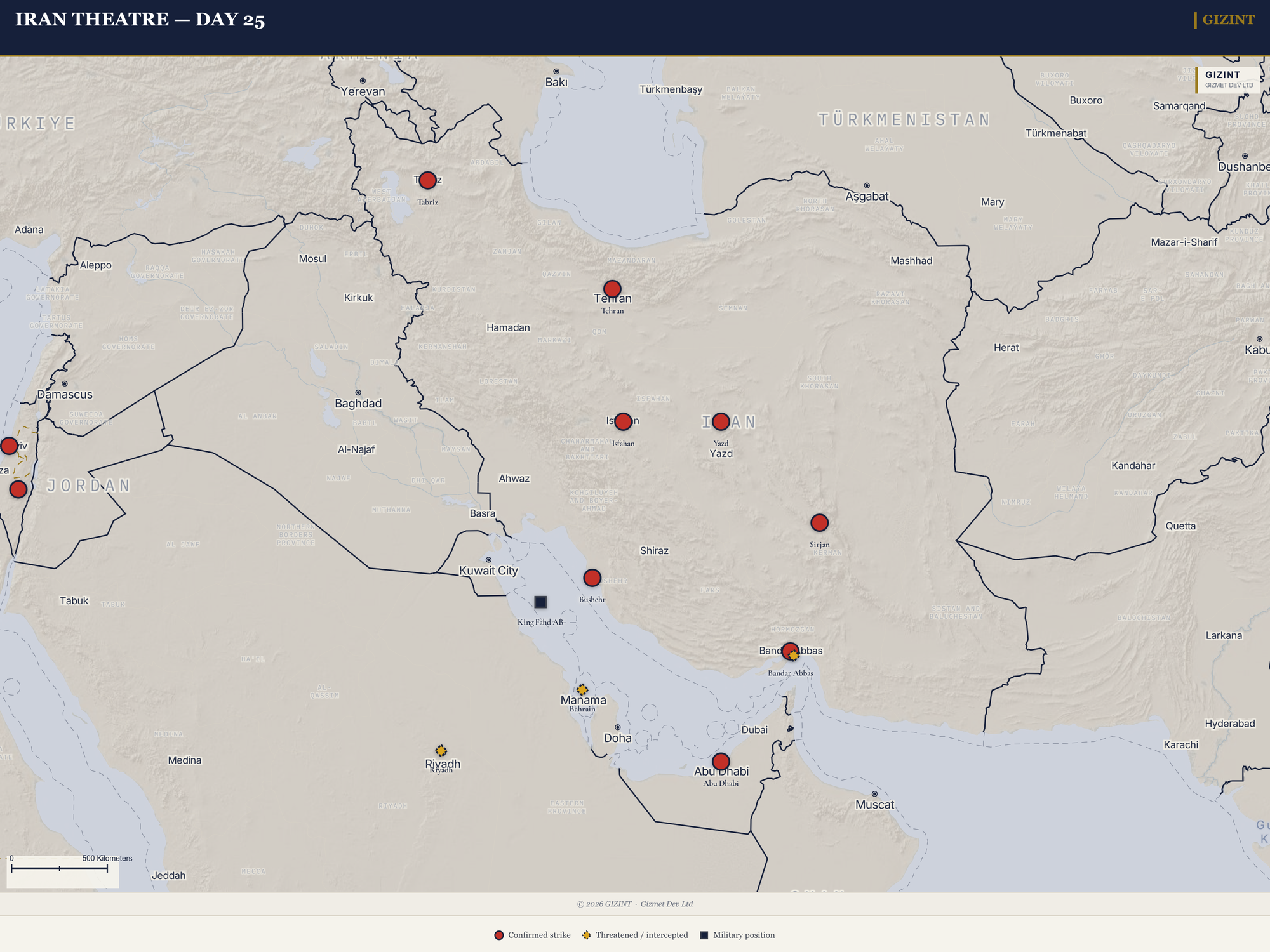
The 82nd deploys regularly — its IRF maintains 18-hour readiness. But forward movement of Maj. Gen. Tegtmeier and his headquarters staff signals preparation to assume operational control, not routine rotation (Stars and Stripes, 24 Mar). Reporting on troop numbers varies: CNN reports approximately 1,000; Bloomberg reports 2,000; WSJ reports up to 3,000 (all 24 Mar). These join two Marine Expeditionary Units already en route (CBS News, 20 Mar), putting combined ground-capable forces above 5,000. Saudi Arabia reversed its initial refusal and granted access to King Fahd Air Base (WSJ/Bloomberg, 24 Mar).
The IRF last deployed rapidly to the region in January 2020 after the Soleimani strike, but that was a crisis response — no division HQ moved forward to assume campaign command. The distinction now is that Tegtmeier's headquarters are deploying, which is the element that coordinates a ground campaign. The last time the 82nd's division HQ deployed forward with that function was Iraq in 2003.
The 15-point plan, published by Channel 12 (Yaron Avraham, 24 Mar), demands nuclear dismantlement, proxy abandonment, and Hormuz as a free maritime zone. In return: sanctions lifted. Every opening position starts maximalist — but the enforcement mechanism distinguishes this one. No Iranian government has accepted terms approaching this scope, and the 82nd's primary mission is forced entry. Kharg Island seizure was under active consideration before the five-day postponement (Axios, 20 Mar).
On Iran's side, Zolghadr was appointed SNSC secretary, replacing Ali Larijani, killed in an IDF strike on the night of 16-17 March (Bloomberg, 24 Mar). Zolghadr is a career IRGC officer — deputy commander-in-chief through 2005, then deputy interior minister and Expediency Council secretary — but zero diplomatic postings. Iran's parliamentary speaker, Ghalibaf, has publicly called negotiations "fake news" used to "manipulate oil markets" (Iran International, 23 Mar). The body that would authorise talks has a new secretary from the security establishment; the legislature's speaker has publicly rejected the premise of negotiation.
Congress has not authorised this campaign. No AUMF covers Iran. The House voted 219-212 to defeat the Khanna-Massie War Powers Resolution on 5 March (Roll Call); Gottheimer introduced a softer alternative with a 30-day deadline from the start of hostilities (28 February). That deadline falls 30 March — during Easter recess, with no recall mechanism scheduled (rules.house.gov, 24 Mar).
The deployment and the plan serve the same function: the offer provides a structured exit; the 82nd makes refusing it more expensive. Whether this produces talks or a ground operation now rests with an IRGC veteran who spent two decades in the security establishment and holds zero diplomatic postings.
Full assessment in today's Daily Brief: Issue 015.
CASCADE
How does the war affect your budget?
A missile hits a gas plant. Your grocery bill changes. CASCADE traces every link.
SEE YOUR IMPACT