Trump Declared Hormuz 'Nothing to Do With' the US. China Filed a Peace Plan the Same Day.
Trump told four outlets in one day the US has nothing to do with Hormuz. The same day, China and Pakistan filed a five-point peace framework for the strait.
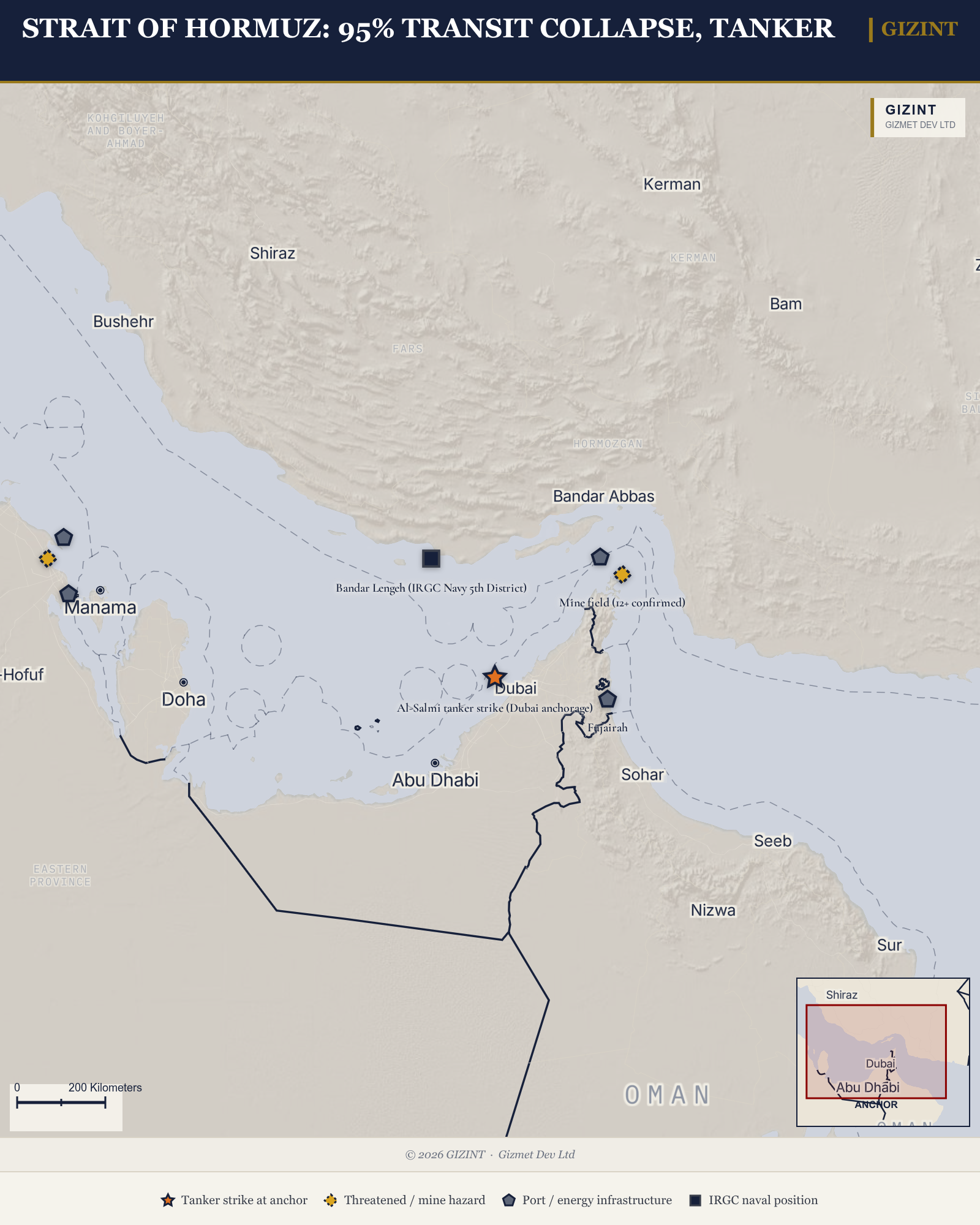
President Trump told allies across four outlets on 31 March to "TAKE" the Strait of Hormuz themselves (Truth Social, 31 Mar), declaring the US will have "nothing to do with" what happens there (CBS News, Weijia Jiang, 31 Mar; ABC News, Jonathan Karl, 31 Mar). In the New York Post he narrowed the war's purpose to nuclear prevention: "My sole function was to make sure that they don't have a nuclear weapon," omitting earlier justifications including Houthi Red Sea attacks and freedom of navigation. Separately, China and Pakistan released a joint five-point peace framework for the strait (Chinese MFA, fmprc.gov.cn, 31 Mar).
Trump made the same declaration to four separate audiences in one day. The day before, Press Secretary Karoline Leavitt omitted the strait from Operation Epic Fury's "core objectives" (White House briefing, 30 Mar), signalling a deliberate narrowing of stated war aims.
Trump has reversed himself before; two deadline extensions in ten days and a "not quite yet" qualifier in the same interview preserve residual ambiguity. The 5th Fleet remains in theatre and no withdrawal orders have been issued. Available reporting suggests the public stance is, at minimum, negotiating leverage.
The timing of three developments on 31 March may be coincidental; the directional alignment is not. Iran's Majlis National Security Committee approved a toll bill for Hormuz passage (Anadolu Agency citing committee proceedings, 31 Mar). Tehran is not waiting for the US to leave; it is building revenue infrastructure around the chokepoint. Pakistan flew to Beijing to co-author a framework whose Point IV calls for "normal passage" (Chinese MFA English text, 31 Mar), implicitly rejecting Iran's toll model.
Every US president since Carter's 1980 State of the Union has treated Hormuz as a vital American interest. We assess the question is no longer whether the US will reopen the strait, but who sets the terms: Iran through unilateral tolls, the China-Pakistan framework, or a multilateral coalition that has not yet been proposed.
Full assessment in today's Daily Brief.
This is a free Signal from GIZINT.
The full Daily Brief covers theatre maps, regional assessments, financial data, legal developments, cyber threats, and narrative intelligence.
Every section. Nothing held back.