


Three Ships Turned Back at Hormuz — The Blockade Outlasted the Commander Who Built It
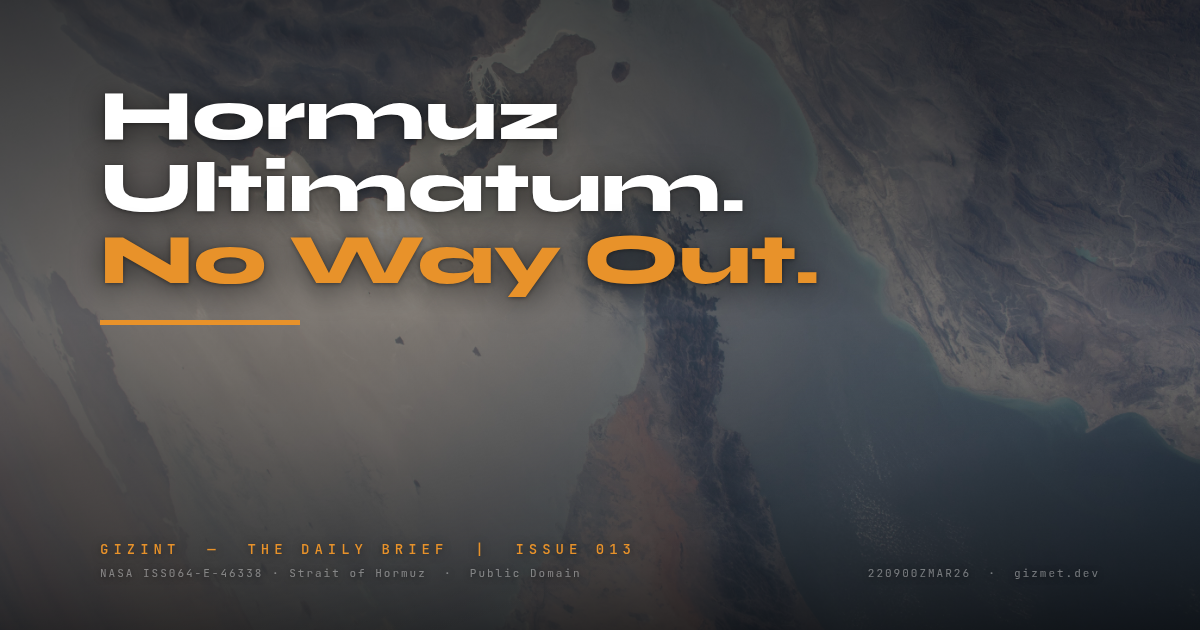
Iran's IRGC Navy turned back three vessels attempting to exit the Strait of Hormuz on 27 March — hours after Trump extended his reopening deadline, citing ongoing talks (Truth Social, 26 Mar; NPR, 26 Mar), the day after Israel killed the commander it held responsible for the blockade.
Iran's IRGC Navy turned back three vessels attempting to exit the Strait of Hormuz on 27 March — hours after Trump extended his reopening deadline, citing ongoing talks (Truth Social, 26 Mar; NPR, 26 Mar), the day after Israel killed the commander it held responsible for the blockade.
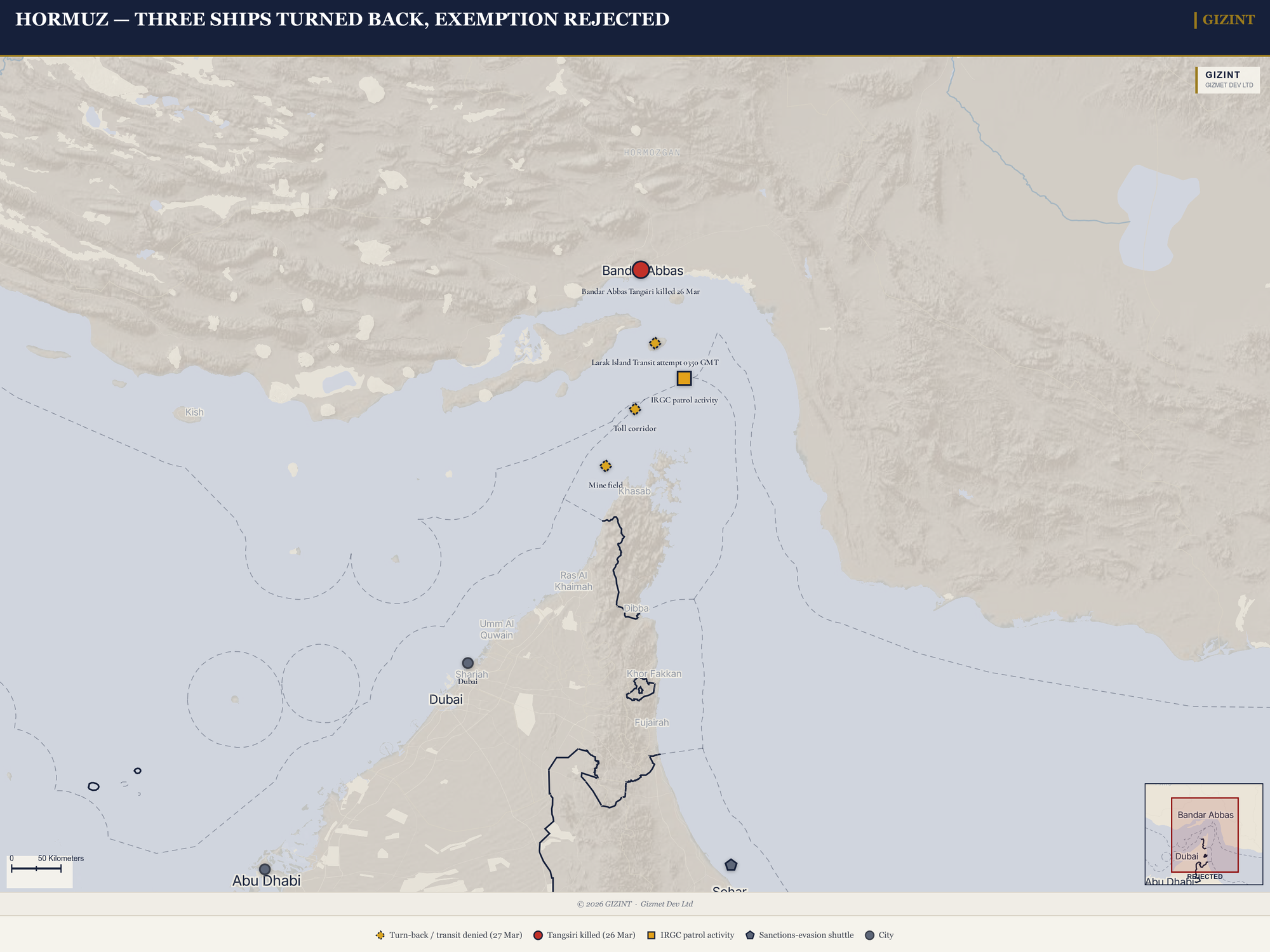
The IRGC stated it had turned back "three container ships of different nationalities" (Sepah News via AFP/Euronews, 27 Mar). Two were COSCO-chartered Hong Kong-flagged mega-container ships — the CSCL Indian Ocean and CSCL Arctic Ocean, both over 19,000 TEU — stranded in the Persian Gulf since the conflict began on 28 February (Kpler AIS, 27 Mar; Newsweek, 27 Mar; The National, 27 Mar). The third was the Marshall Islands-flagged bulk carrier Lotus Rising, also reported to be Chinese-owned (The Week, 27 Mar; Argus Media, 27 Mar). All three broadcast AIS destination fields claiming Chinese ownership. The COSCO pair attempted to transit at 0350 GMT near Larak Island, approximately 20 miles from Bandar Abbas, before reversing course. Kpler assessed, based on AIS and IRGC patrol activity, that safe passage could not be guaranteed (Kpler via Al-Monitor, 27 Mar). This piece focuses on the COSCO vessels because they are the direct test of China's exemption status.
On 26 March, Iran's Foreign Ministry announced safe passage for five nations including China (Deccan Herald, 26 Mar). COSCO had resumed Gulf bookings the previous day (COSCO customer advisory, 25 Mar; Ship & Bunker, 25 Mar; Caixin Global, 25 Mar). The vessels were rejected anyway (Newsweek, 27 Mar). The IRGC's statement framed the action as a response to "the lies of the corrupt US president claiming that the Strait of Hormuz was open" (Sepah News via AFP/Euronews, 27 Mar). The broader declaration: "The Strait of Hormuz is closed. Any movement through the strait will be met with a harsh response."
This was the first publicly observed operational test since RADM Alireza Tangsiri — whom Israel assessed to have overseen the blockade strategy, mine programme, and asymmetric naval doctrine that closed the Strait (IDF statement, 26 Mar; Netanyahu video statement, 26 Mar; JPost, 26 Mar) — was killed in Bandar Abbas alongside IRGC Navy Intelligence Directorate chief Behnam Rezaei (IDF/Katz, 26 Mar; CENTCOM, 26 Mar). Iran threatened Hormuz closure during the Tanker War (1984–88) but never followed through — Tehran depended on the same sea lanes for oil exports (Strauss Center; Britannica). The current blockade, declared by the IRGC on 2 March, is the first time Iran has actually closed the Strait to transit traffic. No successor to Tangsiri has been announced. The IRGC's mosaic defence doctrine pre-delegates authority to unit-level commanders (JPost, Mar 2026). The system continued — and we assess it became less discriminating. Selective access required command judgment; without senior command, the operating default reverted to blanket denial.
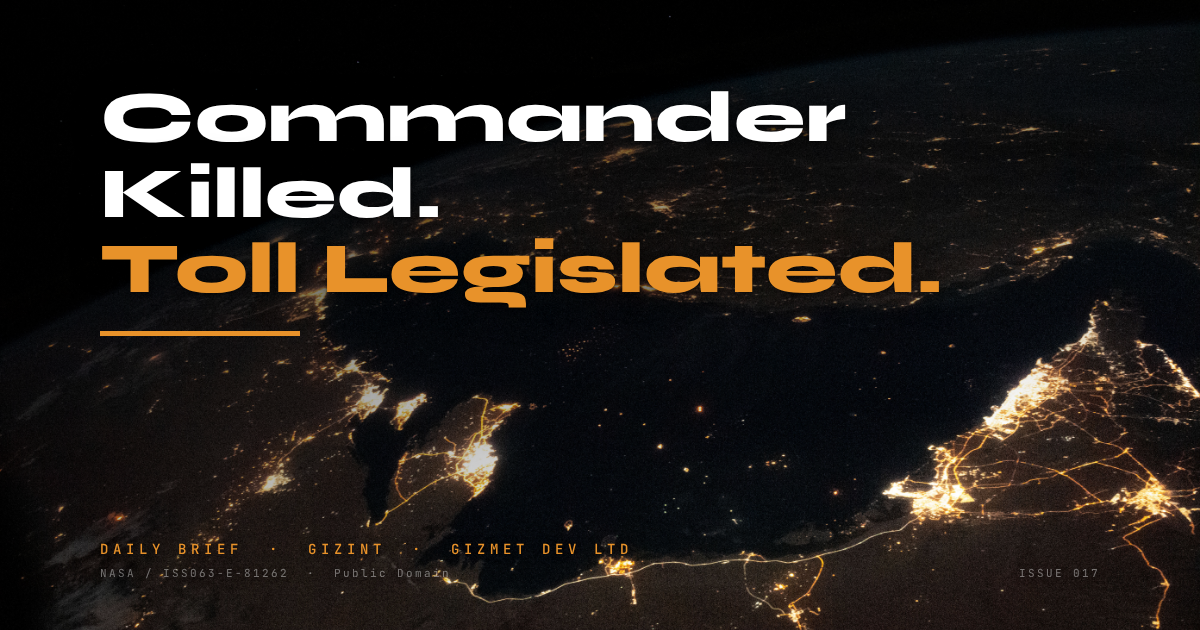
We assess the blockade has survived its architect — though it may have hardened beyond what he built. The toll corridor implied selective access; what remains is closer to blanket denial. No mine clearance operations have been reported. The Majlis is advancing legislation to make a toll of up to $2M per transit permanent law — positioning for post-conflict leverage even as current operations have degraded from selective toll to blanket denial (Bloomberg, 26 Mar; Fars, 26 Mar). Windward tracked nine internationally trading vessels transiting the corridor in the 24 hours to 26 March, against a pre-conflict average of 120 per day (Windward, 26 Mar). If Chinese state-owned carriers from an exempted nation cannot exit, the question is no longer who controls the Strait — it is whether anything short of mine clearance reopens it.
Background context in yesterday's Daily Brief: Issue 017.
This is a free Signal from GIZINT.
The full Daily Brief covers theatre maps, regional assessments, financial data, legal developments, cyber threats, and narrative intelligence.
Every section. Nothing held back.