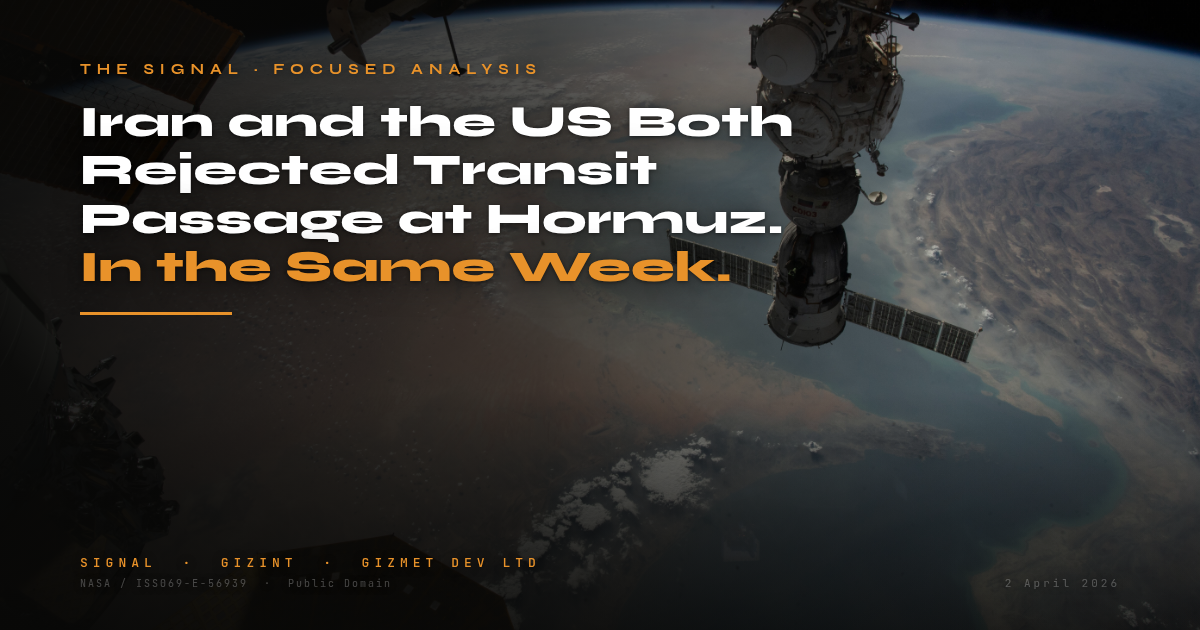
Iran and the US Both Rejected Transit Passage at Hormuz. In the Same Week.
Iran invoked sovereign waters. The US called Hormuz irrelevant. In the same week, both sides rejected the legal principle that kept the strait open for four decades.
The legal principle that kept 21% of global oil flowing through the Strait of Hormuz for four decades is now being rejected from both ends. During the Tanker War of 1987-88, both sides attacked commercial shipping but neither challenged the principle of free transit through the strait. The legal framework that codified that principle, UNCLOS, entered into force in 1994. Neither Iran nor the United States has ratified it. But both have historically observed the transit passage regime as customary international law, which is widely regarded as binding on all states regardless of treaty status. This week, both broke with that practice.
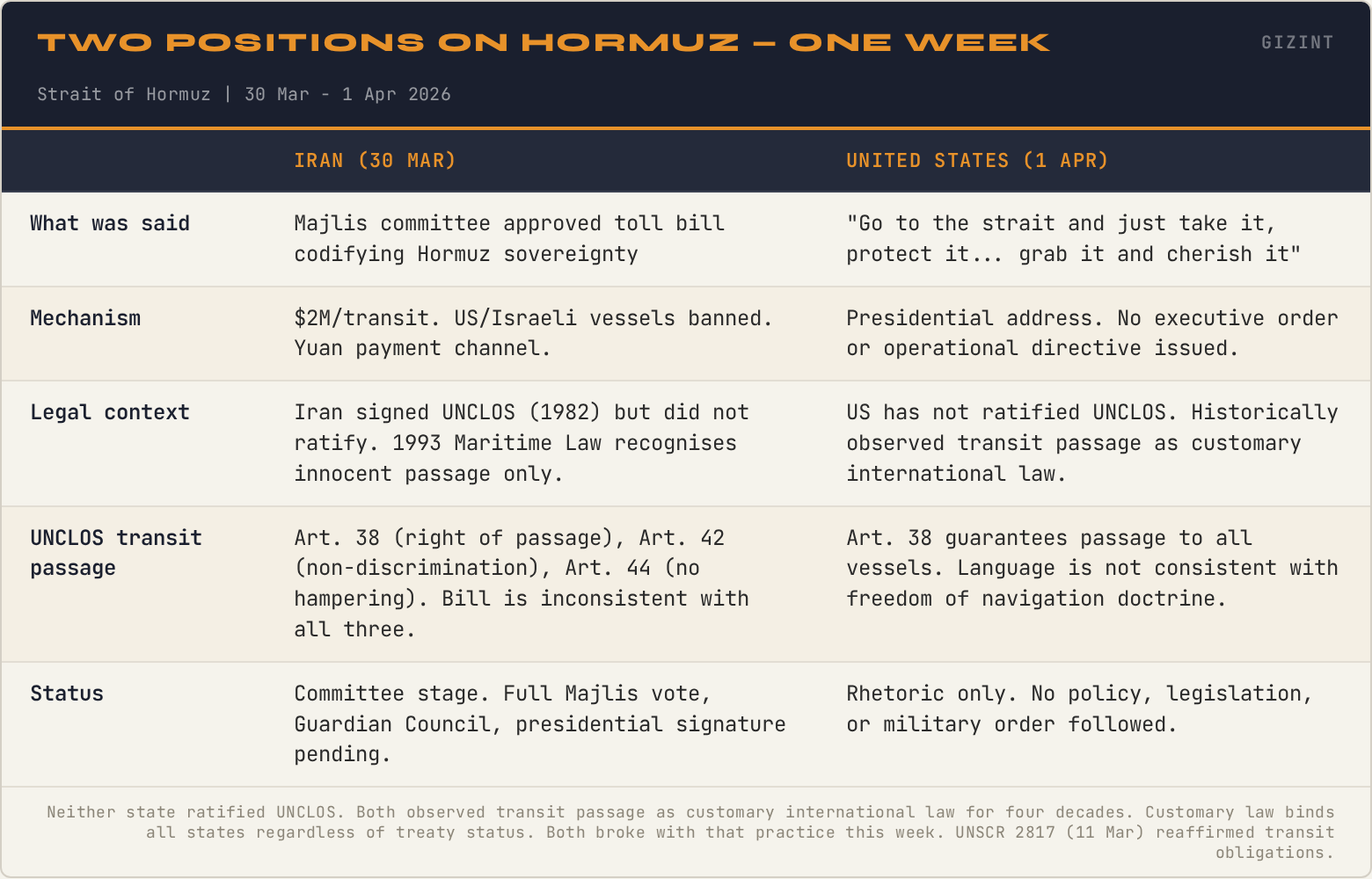
On 30 March, Iran's Parliamentary National Security and Foreign Policy Committee approved legislation codifying permanent sovereignty over the Strait: $2M per transit, US and Israeli vessels banned, yuan payment channel, a proposed cooperation framework with Oman. The bill still requires a full Majlis vote, Guardian Council review, and presidential signature. But the direction is clear. UNCLOS Article 38 guarantees all ships the right of transit passage through international straits. Article 42 prohibits discrimination. Article 44 prohibits any hampering of passage. The committee-approved bill is inconsistent with all three. GCC Secretary-General Al-Budaiwi called the proposed fees illegal. UNSCR 2817, passed on 11 March, reaffirmed these obligations explicitly.
Iran has never fully accepted transit passage through Hormuz. It signed UNCLOS but did not ratify it. When signing, it declared it would apply transit passage only to ratifying states. Its own 1993 Maritime Law recognises only innocent passage, not transit passage. The Majlis bill is not a new legal position. It is the codification of a decades-old one, now with an enforcement mechanism: tolls, vessel bans, and IRGC naval assets already controlling the waterway.
On 1 April, President Trump addressed the nation and told countries dependent on Hormuz oil that they "must take care of that passage, they must cherish it, they must grab it." We assess this language is not consistent with a freedom of navigation operation or an escort mission. It is consistent with instructing other nations to assert physical control over an international waterway that borders Iran and Oman, the latter of which has maintained neutrality throughout the conflict.
The two positions are not symmetrical. Iran's is domestic legislation, advancing through a parliamentary process with an enforcement mechanism behind it. Trump's is rhetoric from a televised address, with no executive order, no operational directive, and no legislative backing. But both reject the same legal principle. Iran asserts the strait is sovereign territory subject to domestic law. The US president instructs other nations to claim it by force. Neither position is compatible with transit passage rights under customary international law as historically observed. The framework that has governed this waterway since UNCLOS entered force in 1994 is being rejected by the state that controls the coastline and the coalition leader whose predecessors built the legal order it belongs to.
The consequence extends beyond the Gulf. Transit passage under customary international law applies to Hormuz, Malacca, and Bab al-Mandeb. If the principle fails at the world's most important chokepoint because both the belligerent and the guarantor abandoned it in the same week, we assess the precedent is available to any littoral state at any strait. Chinese state media covered both developments extensively.
The physical closure preceded the legal erosion. War-risk insurance premiums remain at $10-14M per Hormuz voyage (Lloyd's List). The DFC reinsurance programme has produced no escorted tanker transits since its announcement on 6 March. March transits fell to approximately 195 (Kpler), a decline of approximately 95% from peacetime levels. But the legal breakdown is what makes reopening structurally harder. When both sides have publicly rejected the legal basis for free passage, restoring it requires more than a ceasefire. It requires both a belligerent and a coalition leader to reverse positions they have now stated on the record.
The UK convened a 35-nation maritime security meeting this week to plan post-war Hormuz operations. That planning now takes place in a legal vacuum created, in part, by the state whose legal order the operation would enforce.
Full assessment in today's Daily Brief. The brief also covers the IRGC's threat against 18 named US companies, a four-way fracture in Iranian institutional messaging, and the widest gap between NATO allies since the alliance was founded.
Sources: Majlis National Security and Foreign Policy Committee toll bill approval (Anadolu Agency / BNN Bloomberg / AFP, 30 Mar). Trump address to nation (White House / CBS News / NPR, 1 Apr). UNCLOS Articles 38, 42, 44 (entry into force 16 November 1994). UNSCR 2817, 11 Mar 2026. GCC Secretary-General statement (gcc-sg.org). Iran 1993 Maritime Law (innocent passage only). Lloyd's List war-risk premiums. Kpler transit data. UK 35-nation maritime meeting (gov.uk, 1 Apr). DFC programme (DFC.gov, 6 Mar). Transit passage as customary international law (ASIL, Washington Institute). Operation Earnest Will (1987-88) precedent.
This is a free Signal from GIZINT.
The full Daily Brief covers theatre maps, regional assessments, financial data, legal developments, cyber threats, and narrative intelligence.
Every section. Nothing held back.