



GIZINT — The Daily Brief | Issue 008
We assess the Iran campaign has entered its industrial-destruction phase — CENTCOM confirmed the shift from counterforce to defence industrial base targeting — while the claimed killing of the SNSC secretary and Basij commander would eliminate the diplomatic personnel required to end it.
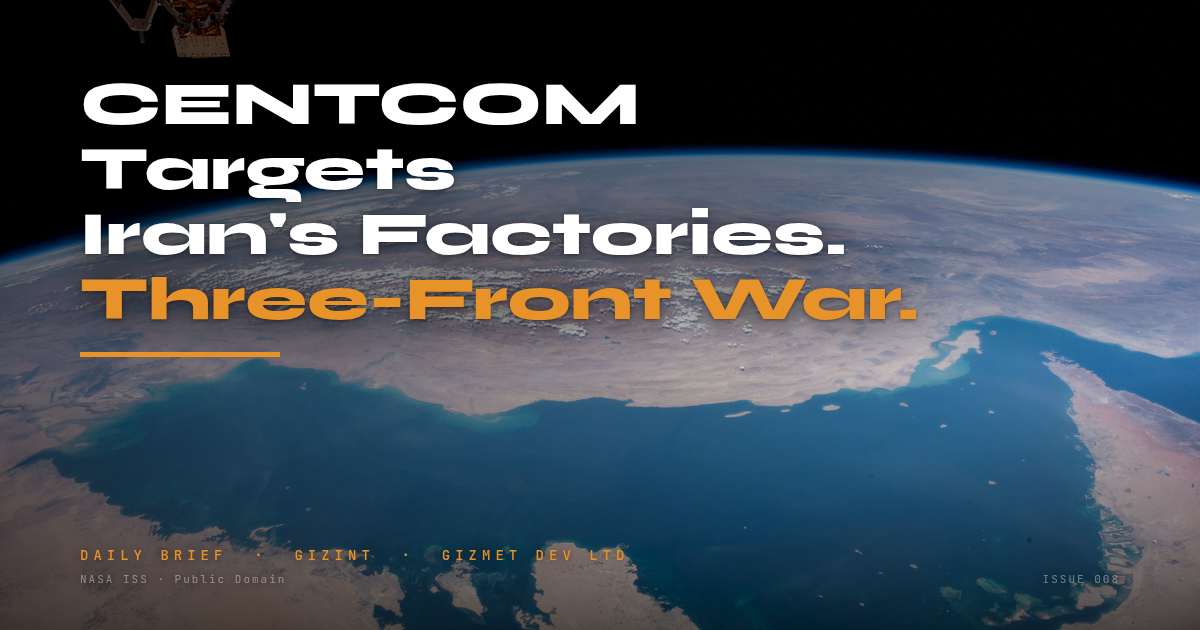

We assess the Iran campaign has entered its industrial-destruction phase — CENTCOM confirmed the shift from counterforce to defence industrial base targeting — while the claimed killing of the SNSC secretary and Basij commander would eliminate the diplomatic personnel required to end it. The conflict is simultaneously expanding into Iraq, where combined force strikes killed two proxy commanders and hit Baghdad's Green Zone diplomatic hotel, and the FOMC must price a widening, multi-theatre war with no interlocutor and no off-ramp when it announces tomorrow.
AT A GLANCE
- Campaign phase shift: CENTCOM acknowledged transition from neutralising launch threats to systematic destruction of Iran's defence industrial base, with 70% of launchers and 85% of air defences neutralised across 6,000+ combat flights.
- Last interlocutor eliminated: Mojtaba Khamenei rejected two intermediary peace proposals; hours later Israel claimed the killing of Ali Larijani, the only remaining Iranian figure with demonstrated negotiating capacity.
- Central bank gauntlet opens: Seven central bank decisions this week beginning with the FOMC, into a market pricing Brent above $100 and US diesel above $5 for the first time since December 2022.

Campaign Enters Industrial Phase — Decapitation Reaches Political Leadership
The combined US-Israeli campaign has transitioned from counterforce to systematic destruction of Iran's defence industrial base and political leadership, extending the campaign timeline and foreclosing near-term diplomatic resolution.
CENTCOM Adm Brad Cooper confirmed on 16 March that strikes shifted from "neutralizing immediate missile and drone threats" to Iran's "wider manufacturing apparatus" — 6,000+ combat flights, 7,000–7,600+ strikes (range reflects source methodology), 100+ naval vessels destroyed, a drone facility struck at Birjand 800km inland. The Critical Threats Project / Institute for the Study of War (CTP-ISW) reports 70% of missile launchers neutralised; Alma Centre reports 85% of air defence capabilities neutralised — a new figure significantly exceeding previous estimates.
The decapitation campaign escalated beyond military commanders. On 17 March, Defence Minister Katz announced IDF strikes killed Ali Larijani — SNSC Secretary, former Parliament Speaker, former nuclear negotiator — alongside Basij commander Brigadier General Gholamreza Soleimani. Larijani's status remains contested: Iran published a handwritten note but no video. If confirmed, he is the most senior political — not military — figure killed since the campaign began. CTP-ISW (16 Mar) identified Mojtaba's inner circle: Taeb, Vahidi, Jafari, Ghalibaf, and newly appointed adviser Mohsen Rezaei (active Interpol Red Notice, 1994 AMIA bombing). This first-generation IRGC command layer "will almost certainly drive Iran toward more hardline, anti-Western policies." The command regenerates from within. Iran's decentralised mosaic defence doctrine (WaPo, 16 Mar) means local units retain authority without central command — decapitation does not produce capitulation, and the campaign is destroying the people who could negotiate its end while failing to disable the forces that sustain it.