





GIZINT — The Daily Brief | Issue 035
The US naval blockade went operational but remains untested. Congress returns to six deadlines in six days. The E3 builds a parallel fleet without Washington.
The US naval blockade of Iranian ports went operational on 13 April but remains functionally untested with near-zero traffic to interdict, while Congress returns today to a six-way legislative pileup with six days to resolve whether the campaign, the surveillance programme, and the sanctions framework have legal authority to continue. We assess the 14-20 April window is the most compressed legal decision space since the campaign began, and we assess Congress will not resolve all six vectors before FISA 702 expires on 20 April.
- Blockade operational, untested: The US Navy began enforcement on 13 April, but Iran's mine field had already halted commercial traffic; the first genuine test comes when a vessel challenges the line, and no interdiction has been confirmed.
- Congress faces six deadlines in six days: War Powers, FISA 702, blockade authorisation, GL-U sanctions expiry, a $200B supplemental, and DHS funding compete for floor time as telecom carriers threaten to halt foreign surveillance authority on 20 April.
- E3 builds a parallel fleet: The UK-France 40-nation maritime conference escalated from diplomatic coordination to operational planning for a "strictly defensive" naval mission, separate from the blockade, the largest European autonomous maritime initiative in a generation.
Blockade Day 1 Meets Congress Day 1: Six Days to Decide Whether This War Is Legal
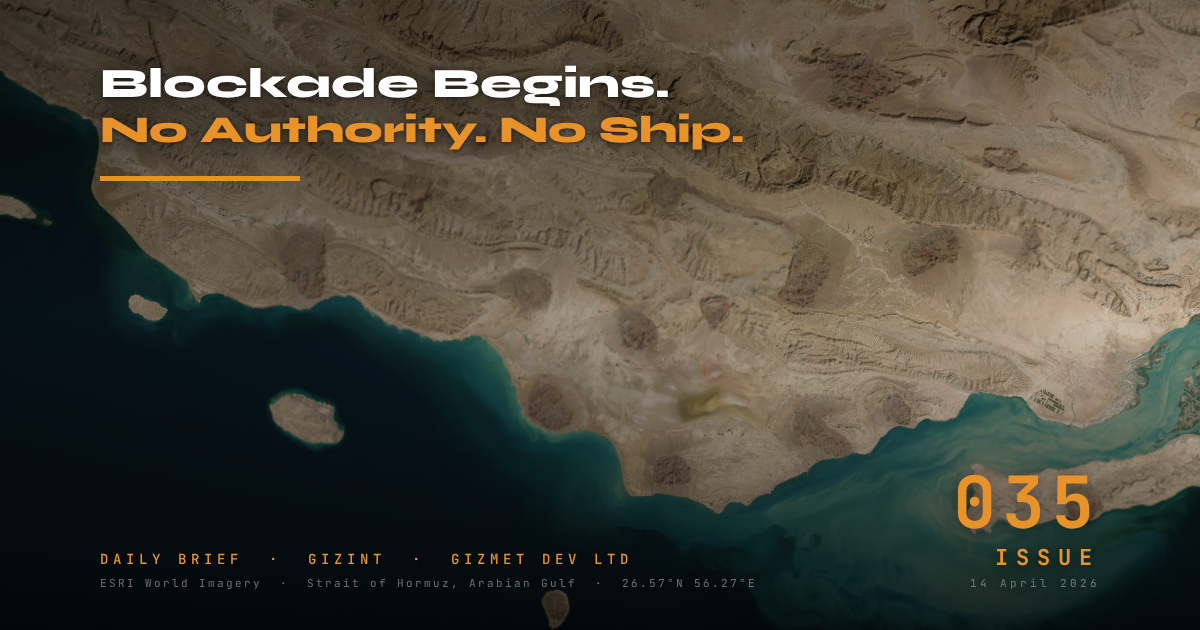
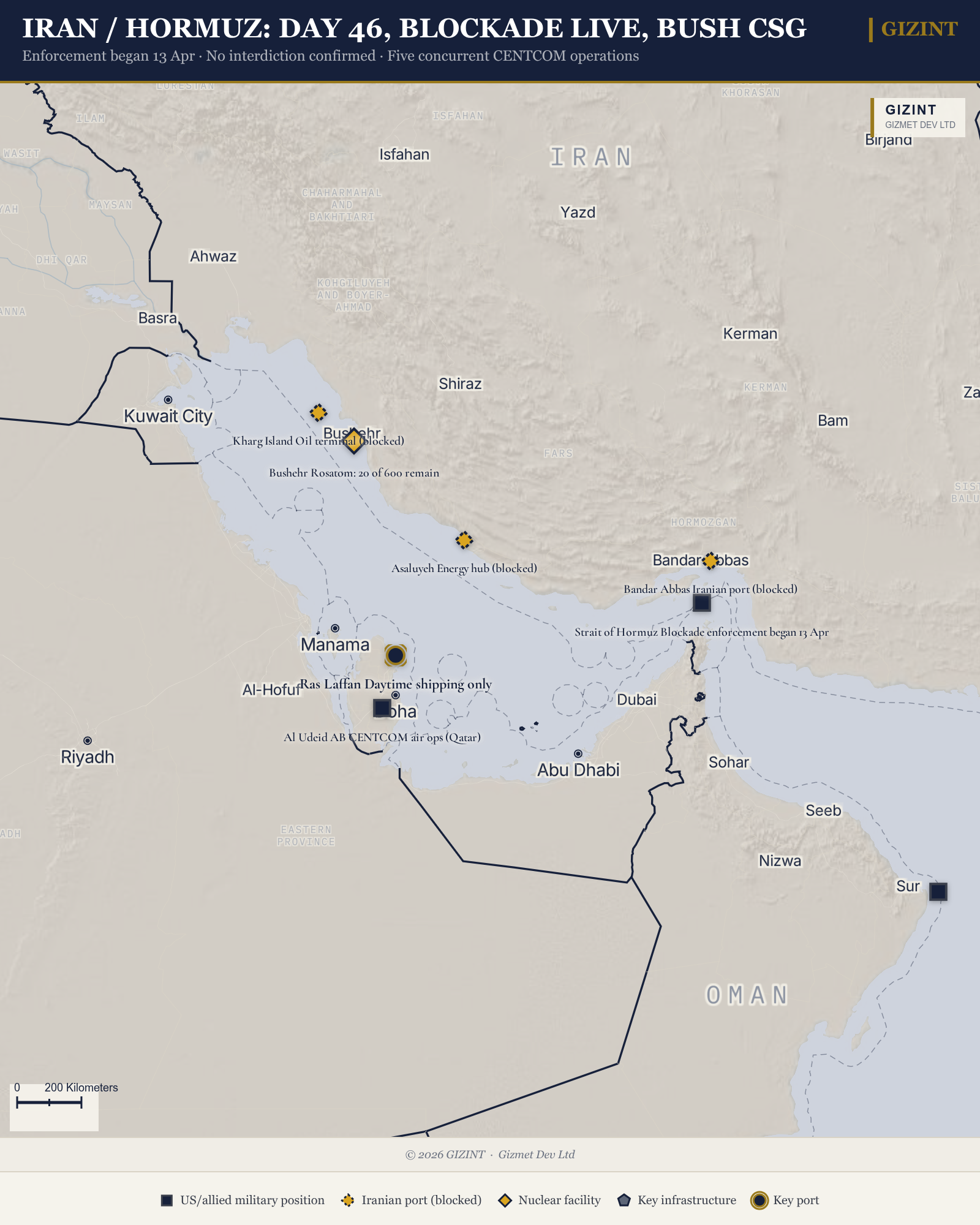
The US naval blockade of all Iranian ports went operational at 10:00 ET on 13 April. A notice to mariners obtained by USNI News confirmed the grace period for neutral vessels at Iranian ports ended at that time; "any vessel entering or departing the blockaded area without authorization is subject to interception, diversion, and capture" (USNI News, 13 Apr). Critical Threats Project / Institute for the Study of War (CTP-ISW) maritime tracking shows visible AIS traffic was already near zero: approximately four vessels per day, 3-5% of pre-war 107. Dark fleet activity (179 events) suggests actual transits exceed the AIS figure (CTP-ISW, 10 Apr). Iran declared "maximum combat alert" and labelled the blockade "piracy" (Iranian state media, 13 Apr).
The on-station force: USS Abraham Lincoln (CVN-72) and escorts in the Arabian Sea, plus the Tripoli ARG (LHA-7) and seven independently deployed destroyers. A third carrier, USS George H.W. Bush (CVN-77), is routing around the African continent to avoid the Houthi-contested Bab el-Mandeb; no US carrier has transited that strait since USS Eisenhower in December 2023 (USNI News, 13 Apr). CNO Admiral Caudle acknowledged at the Atlantic Council: "This is a major undertaking that would have to take place here to do this effectively." We assess the force is viable only because Iran's mines already closed the Strait.
Congress returns today to the other side of this equation. Six legislative vectors compete for approximately six days:
FISA Section 702 (6 days, 20 Apr). Carriers have privately warned they will cease collection on 20 April (CNN, 13 Apr). House GOP lacks votes: the April 2024 procedural vote failed 193-228, and the current three-way split (SAVE Act, warrant requirements, reform demands) has not narrowed. A lapse cuts visibility into Iranian cloud-based C2 channels targeting US critical infrastructure (Section VII).
War Powers Resolution (15 days, 29 Apr). Jeffries will force a House vote this week; Senate Democrats plan a parallel vote. Five Republican senators have conditioned support on the 60-day clock (Collins, Curtis, Young, Tillis, Murkowski; NPR, 10 Apr; Roll Call, 13 Apr). Previous margins: 7 House, 6 Senate.
GL-U expiry (5 days, 19 Apr). Approximately $14-16B in Iranian crude loses its OFAC legal shield with no extension signal. GL-134A already lapsed 11 April. Chinese refiners and Reliance face overnight sanctions exposure (OFAC, 20 Mar).
The back-channel is alive. Trump claimed "the right people in Iran" called and "want to make a deal" (Reuters, 13 Apr 1950Z); unverified by any Iranian source. Channel 12 reports mediators from Egypt, Pakistan, and Turkey remain active, with a US official confirming contacts "still ongoing" (Channel 12 via Times of Israel, 13 Apr). The enrichment gap narrowed at Islamabad: the US proposed a 20-year freeze, Iran offered fewer than 10 years but rejected stockpile export. Neither side has repudiated the process. Ceasefire expiry: 22 April (8 days).
Changed from prior assessment: Blockade declared but not yet operational. Now: Enforcement began 13 Apr, but functionally untested; back-channel alive despite formal collapse.
What changes if this assessment is wrong: If the blockade is declaratory rather than operational, and no vessel is interdicted within 72 hours, the pre-blockade insurance regime remains the binding constraint and the blockade announcement functions as a signalling device, not an enforcement action. If Congress passes a clean FISA extension this week, the defensive gap assessed in Section VII narrows significantly.