

















US Intelligence Says China Is Preparing to Deliver MANPADS to Iran. The Law Says Sanctions Are Mandatory.
Three US intelligence sources say China is preparing MANPADS deliveries to Iran via third countries. CAATSA Section 107 makes sanctions mandatory. The statute says shall impose. The question is whether the administration will comply with its own law.
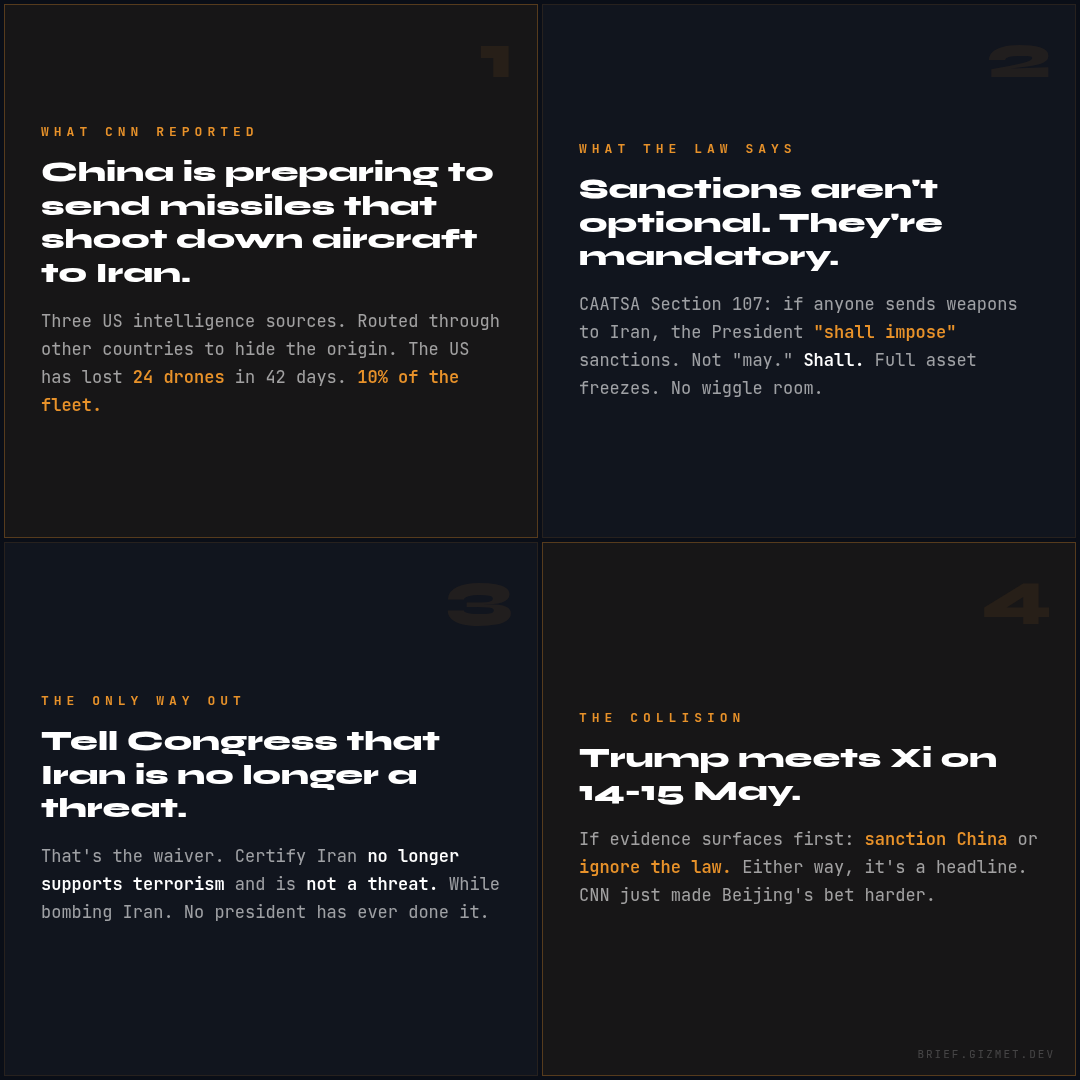
Three US intelligence sources told CNN on 11 April that China is preparing to deliver man-portable air defence systems to Iran, routed through third countries to conceal origin. The Chinese Embassy denied it: "China has never provided weapons to any party to the conflict; the information in question is untrue." The Embassy added that Washington was making "baseless allegations" and "engaging in sensationalism" (CNN, 11 Apr).
The denial is on record. What matters now is what it triggers.
The MANPADS reporting is one of five legal tripwires closing on the administration in the next 18 days. The others are mapped in today's brief.
China produces the FN-6 and the upgraded FN-16, shoulder-fired systems that engage targets at altitudes up to 3,800 metres. Earlier unverified reporting claimed Chinese weapons reached Iran before the campaign began (GlobalDefenseCorp, 7 Mar; single source, unconfirmed). The CNN reporting is a qualitative upgrade: three independent US intelligence sources with detail on third-country routing to conceal origin. Russia has separately contracted to supply 500 Verba MANPADS launchers and 2,500 missiles under a deal signed in December 2025 (Financial Times, 22 Feb), with reporting indicating a small number may already have been delivered. If the Chinese reporting holds, two permanent Security Council members are supplying the same class of weapon to the same belligerent during the same conflict.
The battlefield context makes the delivery significant. The US has lost 24 MQ-9 Reapers in 42 days to vehicle-mounted air defence systems, roughly ten percent of the Air Force’s 230-aircraft Reaper inventory (CBS News, 9 Apr). Trump confirmed an F-15 was hit by “a handheld shoulder missile” (White House press conference, 6 Apr). MANPADS operate below MQ-9 cruise altitude; the current Reaper losses are from medium-range systems. Chinese MANPADS would add a different layer: shoulder-fired coverage against low-altitude platforms that vehicle-mounted systems cannot efficiently engage. The question is not what is already downing drones. It is what Beijing is adding to the threat picture while positioning itself as peacemaker.
The Reaper attrition compounds a force posture problem. The US just sent two destroyers through Hormuz for the first time in 42 days. What that changes, and what it doesn't, is in today's brief.
The statutory dimension is the part nobody is covering. CAATSA Section 107, codified at 22 USC 9406, enforces arms embargoes against Iran. The operative word is "shall." Any person who knowingly contributes to the supply, sale, or transfer of missiles, missile systems, or related materiel to Iran triggers mandatory sanctions: full IEEPA property blocking and visa denial. The statute does not say "may." It does not say "at the President's discretion." It says "shall impose." The only waiver requires the President to certify to Congress that doing so is "vital to the national security interests of the United States." No president has made that certification regarding Iran. While Iran remains on the State Sponsors of Terrorism list, under active US military operations, and subject to a reimposed UNSC arms embargo, that certification is politically impossible.
The Trump-Xi summit is on 14-15 May. Wang Yi has made 26 calls positioning Beijing as a peace broker (FMPRC, 7 Apr). If physical evidence of Chinese-origin MANPADS surfaces in Iranian hands before the summit, the diplomatic credit built over weeks collides with a statute that removes presidential discretion. The reported third-country routing is consistent with a deniability strategy. The CNN reporting is testing that deniability in real time.
Beijing's response is the final data point. The Embassy issued a denial and a counter-accusation. State media did not amplify either. Compare this with China's response to accusations it considers fully fabricated: the Xinjiang allegations produced a sustained, multi-platform rebuttal campaign across CGTN, Xinhua, and the Foreign Ministry spanning years. The MANPADS accusation produced two sentences and silence. That asymmetry does not confirm the reporting. It suggests Beijing has calculated that drawing attention to the specifics carries more risk than letting the news cycle move on.
This Signal covers one statute. Today's Daily Brief covers five expiring mechanisms, three theatre maps, the mine clearance assessment, and why this week's insurance data matters more than the military transit. The brief published today. Read it here.