


Hezbollah Fired an Iranian Cruise Missile That Reaches Riyadh. The Gulf Is Running Out of Interceptors.
Hezbollah has fired an Iranian Paveh cruise missile. This is the first documented operational use of a 1,650km-class Iranian cruise missile by a non-state actor (Terrogence TGA0877, Mar 2026; Alma Center, 19 Mar; CTP-ISW, 14 Apr).

UPDATE 16 APR 2200Z: President Trump has announced a 10-day Israel-Lebanon ceasefire starting 2100Z (France24, NBC, Bloomberg, 16 Apr 2026). We assess the capability transfer and procurement gap this Signal describes are unaffected by the truce; the magazine is not restocked by a pause in hostilities.
Hezbollah has fired an Iranian Paveh cruise missile. This is the first documented operational use of a 1,650km-class Iranian cruise missile by a non-state actor (Terrogence TGA0877, Mar 2026; Alma Center, 19 Mar; CTP-ISW, 14 Apr).
The same missile family that defeated Saudi air defences in 2019 now has a longer-range variant in Hezbollah's hands.
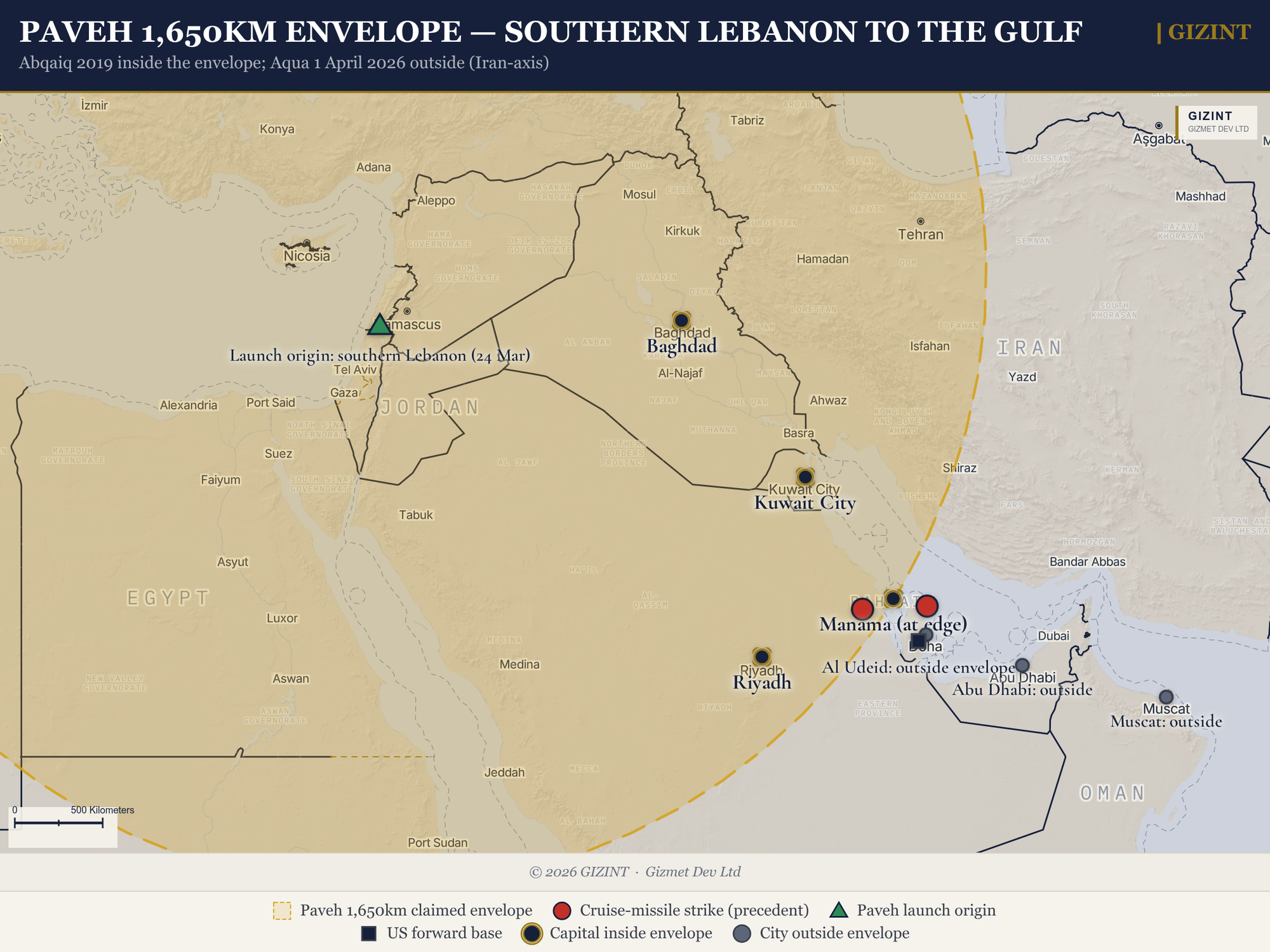
Alma Research and Education Center traces the transfer to Iran via the Iraq-Syria corridor before Assad fell in December 2024. The Critical Threats Project / Institute for the Study of War (CTP-ISW) confirmed first use on 14 April: a 24 March launch near Misgav Am. We assess the Paveh's claimed 1,650km range puts GCC capitals and US regional bases within reach from southern Lebanon (IRGC unveiling, Feb 2023; CSIS Missile Threat). The full envelope from Lebanon remains undemonstrated. The Fateh-110 threatens Israel; the Paveh's claimed envelope reaches Riyadh.
Precedent is specific. In September 2019, Iranian-origin cruise missiles, assessed as Paveh-type from the Soumar family, struck Abqaiq and Khurais, knocking out 5.7 million barrels per day (Alma Center, 19 Mar 2026; NPR, 19 Sep 2019; UN Panel of Experts S/2020/326 identified the debris as Quds-1 land-attack variants). Saudi Patriot batteries, configured toward Iran and Yemen, intercepted none; low-altitude cruise missiles defeated defences not oriented to the northwestern axis. The Paveh is a longer-range member of the same family, now launchable from Lebanon.
That shift is not hypothetical. On 1 April, three Iranian cruise missiles targeted the fuel tanker Aqua 1, chartered by QatarEnergy, 17 nautical miles north of Ras Laffan. Qatari forces intercepted two; the third hit above the waterline (Insurance Journal, 1 Apr; QatarEnergy, 1 Apr). Bloomberg reported on 30 March that sustained Iranian missile attacks had depleted Gulf interceptor stocks and raised US defence pressure (Bloomberg, 30 Mar 2026). Gulf states have expended approximately 2,400 Patriot interceptors, primarily PAC-3 and GEM-T variants, since 28 February (Defense News, Apr 2026). Saudi Arabia has approximately 400 PAC-3 rounds left of a roughly 2,800 pre-war stockpile (HouseofSaud analysis, 11 Apr 2026), and the US expended roughly 150 THAAD interceptors from its global stockpile of 534 defending Israel during the June 2025 twelve-day war (JINSA, 30 Jan 2026).
The January 2026 framework agreement targets 2,000 PAC-3 interceptors per year (Lockheed Martin, 6 Jan 2026); the first $4.7 billion contract under that framework runs through June 2030 (Lockheed Martin, 10 Apr; Breaking Defense, 10 Apr). We assess the ramp does not reach scale until 2028. We assess dedicated cruise-missile defence systems such as NASAMS remain limited in GCC operator coverage (IISS Military Balance 2025-26), and that PAC-3 is not the primary layer for cruise-missile engagement.
The question is procurement, not intent. Does production scale before the next demonstration of the capability the 1 April Aqua 1 strike foreshadowed? The truce holds remaining stocks above zero. It does not restock the magazine.
Full assessment in today's Daily Brief. Today's issue covers the Shamkhani "Economic Fury" designations and the GL-U cliff on 19 April, the FISA 702 lapse converging with three surveillance failures, and the four-country mediation corridor that assembled faster than the military one.
This is a free Signal from GIZINT.