


GIZINT — The Daily Brief | Issue 038
The 19-26 April arc holds four converging cliffs. We assess the Lebanon ceasefire as tactical reprieve: Hezbollah linked adherence to Iranian Hormuz posture, and the 10-day window lands four days past Iran ceasefire expiry.
The 19-26 April arc now holds four converging cliffs, Iran sanctions GL-U expiry, FISA 702 sunset, Iran ceasefire expiry, and the new Israel-Hezbollah 10-day ceasefire announced overnight, with the Lebanon pause creating leverage the brief could not have assessed even 24 hours ago. We assess the Lebanon ceasefire as tactical reprieve rather than political settlement: Hezbollah explicitly linked adherence to Iranian Hormuz posture via MP Moussawi (AFP), and the 10-day window lands on ~26 April, four days past the Iran ceasefire expiry.
- Lebanon paused: Trump-announced 10-day Israel-Hezbollah ceasefire effective midnight 16 April; Hezbollah MP Moussawi conditionally adheres with explicit Iran-Hormuz linkage (AFP).
- Hinge compressed: GL-U 19 Apr, FISA 702 20 Apr, Iran ceasefire 22 Apr and Lebanon 10-day expiry ~26 Apr form a four-cliff window; US secondary-sanctions warnings now reach Chinese correspondent banks though no Chinese refinery has been designated (Treasury SB-0443).
- Iranian hedge contested internally: Zolghadr (SNSC) pulled Araghchi from Islamabad Round 1 after 21 hours; US preconditions for next round are full Hormuz reopening and delegation with "full authority" (Israel Hayom via CTP-ISW).
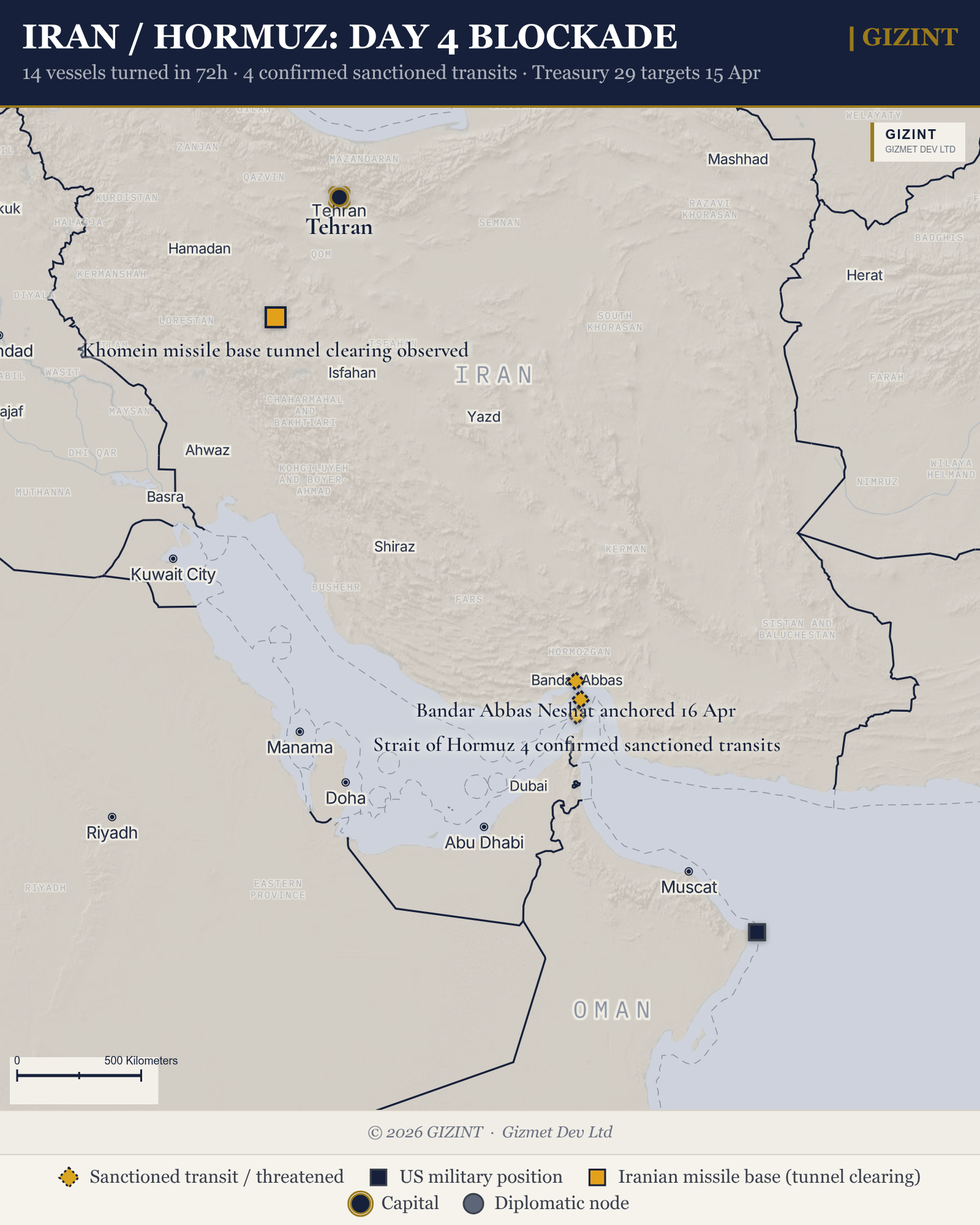
PI-1. Blockade Enters Hinge Window: Financial Enforcement Tests Before Boarding Doctrine
The US blockade of Iran enters a 72-hour test of whether financial enforcement can substitute for physical interdiction before Washington must answer a boarding-authority question that would collapse its own Libya-precedent war-powers argument.
Day 4 of the US blockade. CENTCOM reports 14 vessels turned in 72 hours by radio challenge (up from 9), with a tonal shift from "prevented all crossing attempts" framing (CENTCOM via Critical Threats Project / Institute for the Study of War (CTP-ISW), 15-16 Apr). Four confirmed sanctioned transits now sit against that tally: Alicia (IMO 9281695, AIS falsified) and RHN (IMO 9208215) inbound 15 April (ABC News, Maritime Executive); and on 16 April, Zaynar 2 westward toward Larak Island and Neshat anchored ~ten miles off Bandar Abbas by 1500 GMT (Times of Israel, 16 Apr). Sharpe (fmr Royal Navy, via Windward): "There's evidence that ships are perhaps breaking through."
The mechanism has shifted from "can you transit?" to "can you get paid?", and the answer arrives in 48 hours. Treasury broke the 48-day Iran SDN gap on 15 April with the Shamkhani designations (29 targets under EO 13902 and EO 13224; see Financial). Paired 14 April: warning letters to institutions in Oman, UAE, Hong Kong and the PRC; Bessent (14 Apr, Reuters) confirmed non-renewal of Iranian and Russian general licenses. Hong Kong is the novel jurisdictional test. GL-U expires 00:01 EDT 19 April (OFAC 20260320_33), exposing ~$14-16B of Iranian-origin crude.
On 16 April, Washington warned it will "consider boarding and seizing any sanctioned vessels regardless of location" (Bloomberg, 16 Apr; ABC News, 16 Apr). The 14-vessels-turned tally with zero boardings sits in a narrower doctrinal slot than Gulf War Maritime Interception Operations (UNSCR 665) or the Proliferation Security Initiative regime, both of which had UN authorisation or flag-state consent the 2026 blockade has declined to invoke. CENTCOM's drop of "prevented all crossing attempts" for a turn-back count reads as a formal posture downgrade: the commander is narrowing what he claims in the same 72 hours Washington publicly widens the authority he might be given.
The 19-22 April window carries two tests: secondary-sanctions sufficiency and whether radio deterrence contains transits without physical interdiction. Branch A: a Chinese teapot, HK correspondent bank or Indian refiner takes a secondary hit AND radio deterrence reasserts control; the boarding question slips past 22 April and the AUMF decision is kicked to 29 April. Branch B: no secondary hit lands OR transits outpace turn-backs; boarding authority becomes unavoidable before the 60-day clock expires. CTP-ISW's three-COA sequencing places run-blockade as the live shaping phase, restart-conflict second-order at 7-14 day lag after 22 April. Iranian escalation doctrine favours graduated sequencing (run-blockade, Hezbollah breach, Houthi activation, conventional restart), each step buying mediation time at rising cost. Four stages at 3-5 days each lands a decisive-restart window 10-15 May, coincident with the Trump-Xi Beijing summit. We assess that coincidence is engineered: Iran has institutional reason to time escalation to the summit and force Xi's public choice between the Russia-China-Iran axis and the Trump commercial track.
The Iranian storage clock operates beneath both branches: Vortexa and Iran International assess onshore buffer at ~13 days before forced well shutdowns, putting the Iranian economic deadline at ~26 April. Iranian production at permanent risk is 300-500 kbd ($9-15B annualised). The 13-day clock is physical-plant, not diplomatic: forced shut-in of gas-condensate and high-H₂S offshore fields runs single-digit billions in rework costs and can induce irreversible productivity loss, which means Iran's run-blockade option gets materially more expensive the longer it runs regardless of vessel-transit success.
What changes if this assessment is wrong: What changes if wrong: If a Chinese or Indian buyer absorbs the secondary-sanctions hit without retaliating and Iran accepts a short tactical extension on 22 April, the financial channel looks sufficient and the boarding question disappears from the critical path. If Tehran instead activates Bab al-Mandeb or runs a vessel into deliberate confrontation, the hinge collapses toward kinetic restart before any AUMF vehicle reaches the floor.