GIZINT — The Daily Brief | Issue 036
The US naval blockade is enforcing a two-tier Strait: Iran is locked out while more than 20 commercial ships transited in the past 24 hours under US escort, the highest volume since the war began (WSJ, 14 Apr, citing US officials).
The US naval blockade is enforcing a two-tier Strait: Iran is locked out while more than 20 commercial ships transited in the past 24 hours under US escort, the highest volume since the war began (WSJ, 14 Apr, citing US officials). A sanctioned Chinese tanker exploited the definitional gap between Iranian-port-bound enforcement and broader sanctions reach, narrowing the remaining credibility question to sanctioned vessel interdiction. We assess the 15-22 April convergence of GL-U sanctions expiry (19 Apr), FISA 702 lapse (20 Apr), and ceasefire expiry (21-22 Apr, date disputed) creates the most compressed decision window of the campaign.
- Two Straits in one: More than 20 commercial ships transited the Strait under US escort, the highest volume since the war began, while zero reached Iranian ports; a sanctioned Chinese tanker exploited the gap, narrowing the enforcement question to sanctioned vessel interdiction.
- Five days to dark: FISA Section 702 expires 20 April with 98 House Democrats formally opposing reauthorisation and telecom carriers confirmed to halt collection on expiry, opening a surveillance gap into the most active Iranian offensive cyber campaign since the war began.
- China forced off the fence: Defence Minister Dong Jun declared "the Strait of Hormuz is open to us," Beijing's MFA called the blockade "dangerous and irresponsible," and a Lavrov-Wang Yi meeting in Beijing reinforced the Russia-China coordination bloc, with 27 days to the Trump-Xi summit.
Two Straits in One: Iran Locked Out as Commercial Traffic Resumes Under US Escort
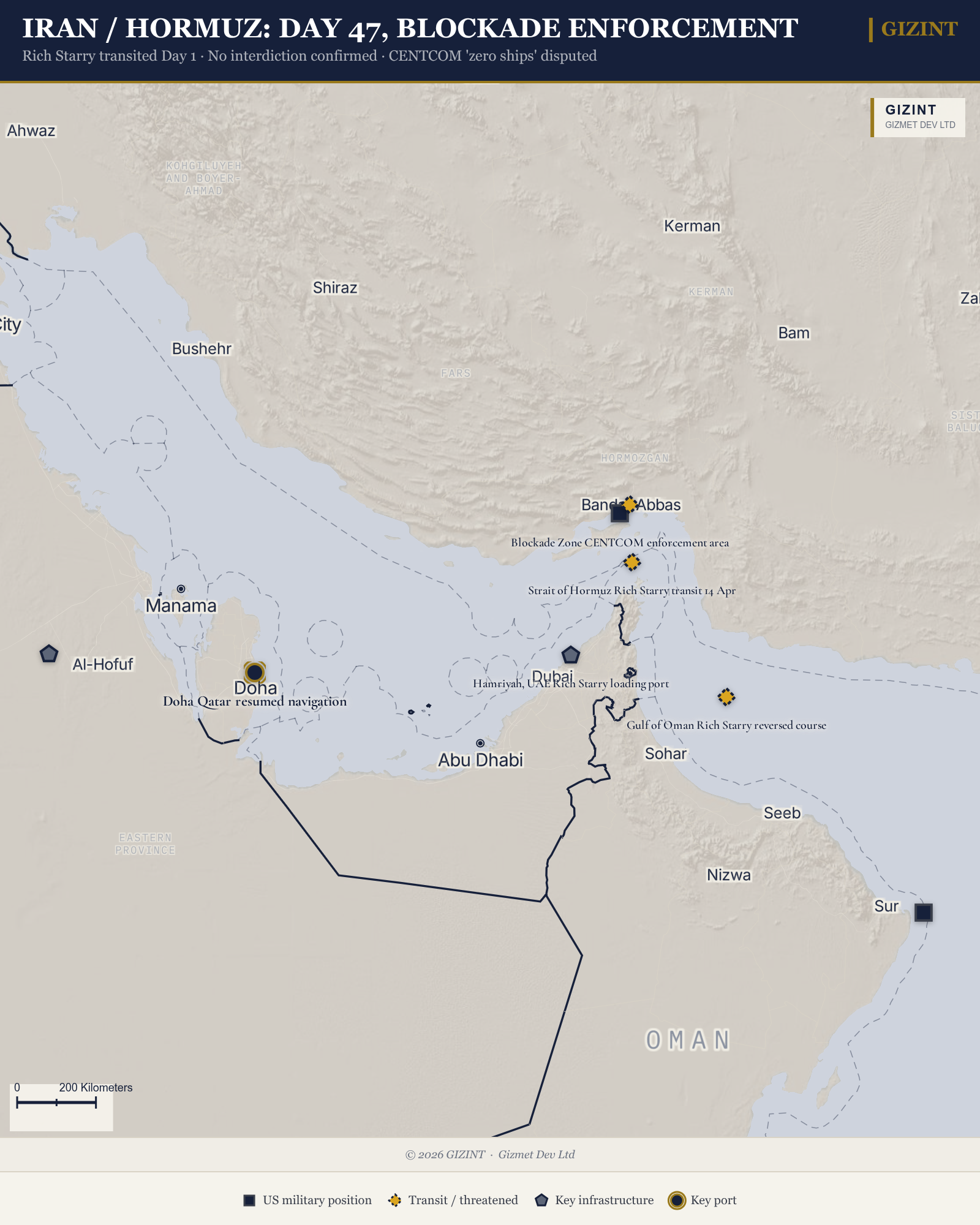
More than 20 commercial ships transited the Strait of Hormuz in the past 24 hours with US naval support, the highest traffic volume since the war began (WSJ, 14 Apr, citing US officials). US forces are actively supporting transit to and from non-Iranian ports. CENTCOM confirmed "zero ships" reached Iranian ports and reported 6 merchant vessels directed to turn back (CENTCOM, 14 Apr). The blockade of Iranian ports is functioning; the Strait itself is partially reopening for commercial traffic.
The enforcement gap is real but narrower than the blockade-failure framing of early reporting. The US-sanctioned Chinese tanker Rich Starry (formerly Full Star; Shanghai Xuanrun Shipping, OFAC-designated), carrying approximately 250,000 barrels of methanol loaded at Hamriyah, UAE, transited the Strait on 14 April without US interdiction, subsequently reversing course in the Gulf of Oman (Bloomberg, 14 Apr; Al Jazeera, 14 Apr; MarineTraffic data). Two additional sanctioned tankers, Murlikishan and Panama-flagged Peace Gulf, also transited (Al Jazeera, 14 Apr). BBC Verify confirmed 4 Iran-linked vessels crossed Blockade Day 1; 2 reversed. The blockade targets "vessels of all nations entering or departing Iranian ports" (CENTCOM; Critical Threats Project / Institute for the Study of War (CTP-ISW), 13 Apr). Rich Starry departed a UAE port, not an Iranian port, exploiting a definitional gap between blockade scope and the broader sanctions regime.
Chinese Defence Minister Admiral Dong Jun made the challenge explicit on 13 April: "Our ships are moving in and out of the waters of the Strait of Hormuz. We have trade and energy agreements with Iran. We will respect and honor them and expect others not to meddle in our affairs. Iran controls the Strait of Hormuz, and it is open for us" (Common Dreams, 14 Apr). China imports 1.4 million barrels per day of Iranian crude, over 80% of Iran's seaborne oil exports (Al Jazeera, 14 Apr). Chinese MFA spokesman Guo Jiakun characterised the blockade as "dangerous and irresponsible behaviour" (CNBC, 14 Apr).
Iran is building a parallel enforcement mechanism. Reports indicate Iran has begun collecting transit fees from commercial vessels, with at least one vessel paying $2 million (Lloyd's List via Newsweek, 14 Apr). A sanctions-focused analyst estimated blockade enforcement would cost Iran approximately $435 million per day, with approximately 13 days of onshore oil storage capacity before field shutdowns cause long-term reservoir damage (CTP-ISW, 13 Apr).
Trump (14 Apr, Truth Social): vessels coming "anywhere close" to the blockade "will be immediately ELIMINATED." The White House simultaneously confirmed "future talks are under discussion, nothing scheduled" (Time, 14 Apr). Brent retreated 4.6% as markets priced deal optimism over blockade enforcement (assessed in Section V).
The effectiveness test under the San Remo Manual's blockade provisions is met for Iranian ports: CENTCOM turned back 6 vessels and zero reached their destination. The test remains open for sanctioned vessels bound elsewhere. The Cuban quarantine established credibility by boarding the Marucla within 48 hours; the US has not yet boarded a sanctioned vessel. We assess the blockade is effective against Iranian port traffic but permissive toward sanctioned vessels exploiting the definitional limitation. The critical escalation trigger remains: a Chinese-flagged vessel heading directly to an Iranian port, which would force a confrontation Washington has so far avoided.