GIZINT — The Daily Brief | Issue 037
We assess the Iran campaign has completed its phase transition: 85% of the defence industrial base is destroyed. The GL-U expiry on 19 April is the forcing function; the mediation corridor is the only off-ramp.
We assess the Iran campaign has completed its phase transition: 85% of the defence industrial base is destroyed (CTP-ISW, 14 Apr), and Treasury's "Economic Fury" designations have shifted the mechanism from who can sail through Hormuz to who can clear payment afterwards. The GL-U expiry on 19 April is the forcing function; the mediation corridor that assembled in 72 hours is the only off-ramp.
- Financial warfare activated: Treasury broke its 48-day SDN gap with "Economic Fury" designations targeting the Shamkhani shipping network (50+ entities, 50+ vessels); GL-U non-renewal on 19 April creates a hard cliff for ~140M barrels at sea.
- Surveillance gap widens: The House delayed the FISA 702 vote to 16 April after a conservative revolt; four days remain before carriers halt collection during the most active Iranian offensive cyber campaign of the war.
- Mediation outpaces the military: Pakistan's Army Chief Asim Munir arrived in Tehran with a "new message from Washington" while a four-country FM coordination framework assembled in 72 hours at the Antalya Forum (17-19 April).
Blockade Day 3: Naval Deterrence Works, Financial Warfare Begins
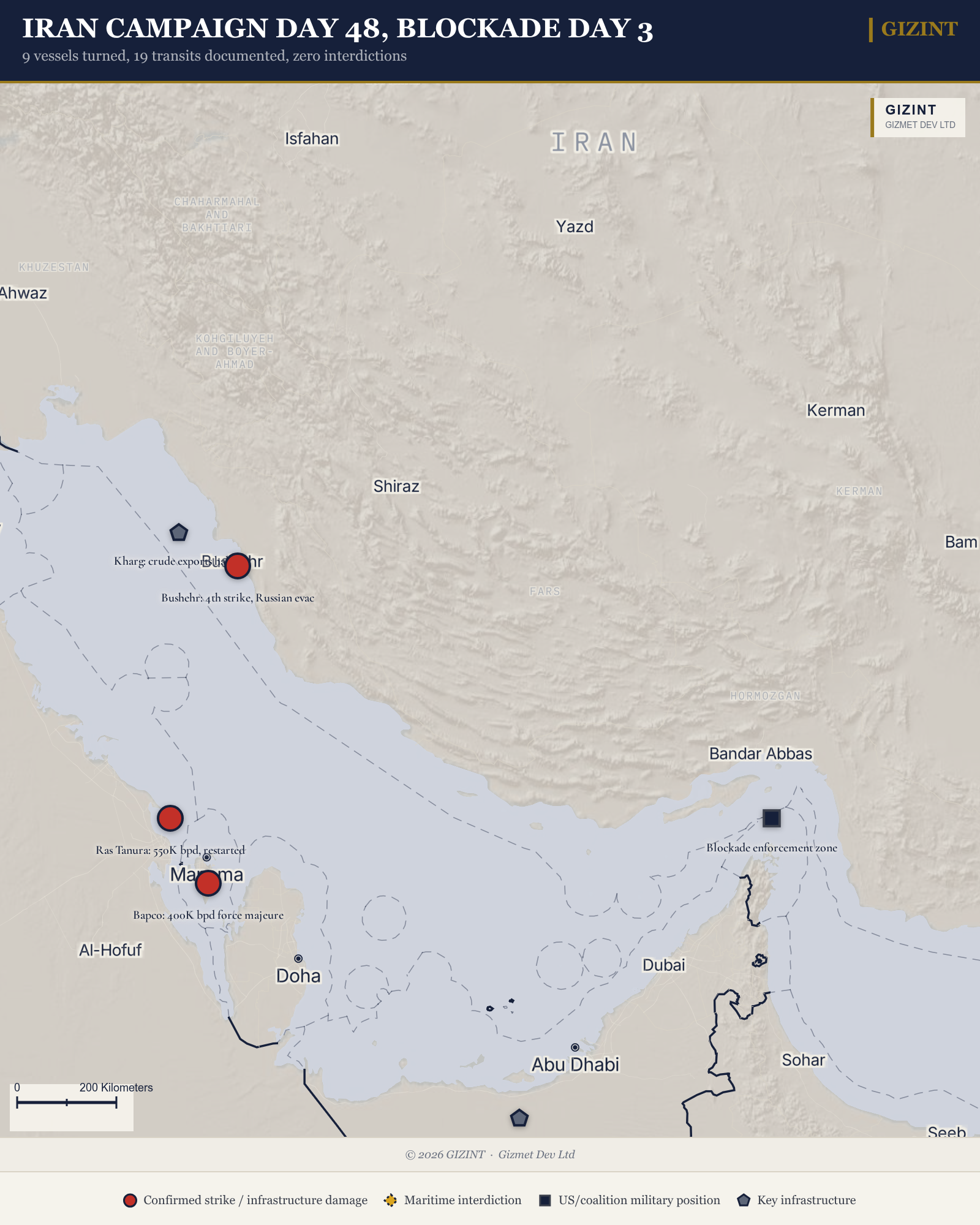
The blockade deters compliant traffic but is physically porous against determined transit, and Treasury has activated the financial instrument that may matter more.
Changed from prior assessment: 6 vessels turned, zero interdictions, OFAC SDN gap at 48 days. Now: 9 vessels turned, zero interdictions, Windward confirms 19 transits with evasions; OFAC gap broken, GL-U non-renewal confirmed.
CENTCOM Adm. Brad Cooper stated on 15 April that the blockade is "fully implemented" with 9 vessels turned in 48 hours (CENTCOM, 15 Apr). No boarding or physical interdiction has occurred. The Critical Threats Project / Institute for the Study of War (CTP-ISW) assessed the blockade has "no defined geographic boundary," with enforcement possible "almost anywhere in international waters" (CTP-ISW, 14 Apr). A US destroyer intercepted two tankers departing Chabahar Port on the Gulf of Oman, confirming enforcement extends beyond the Strait (Reuters, 15 Apr).
However, Windward documented 19 vessel transits on 14 April (14 outbound, 5 inbound), including confirmed evasions via false flagging, AIS blackouts, and Iranian territorial waters (Windward, 15 Apr). The blockade operates on three tiers: crude tanker traffic is halted, sanctioned vessels are testing limits, and small cargo plus pre-positioned non-crude vessels continue transiting. CENTCOM's "completely halted all economic trade" is accurate for crude but overstated for the full picture.
OFAC broke its 48-day SDN gap on 15 April with "Economic Fury" designations targeting the Shamkhani shipping network: 50+ entities, 50+ vessels (OFAC, 15 Apr). Treasury confirmed GL-U will not extend past 19 April, creating a hard cliff for approximately 140 million barrels of crude at sea valued at $14-16 billion (Reuters, 14 Apr). Trump posted on Truth Social that he is "permanently opening" the Strait and that China "agreed not to send weapons to Iran"; Xi responded via Xinhua that China would play a "constructive role" (Truth Social/Xinhua, 15 Apr). First public Trump-Xi exchange on Iran, 26 days before the summit.
Iran is considering pausing shipments (Bloomberg, 14 Apr). CTP-ISW assessed 13 days of onshore storage before field shutdown, though FGENexant estimates 90M barrels total capacity (potentially two months); the discrepancy resolves if storage is near-full, which is unverifiable under the blackout. Maj. Gen. Abdollahi warned Iran will shut down Red Sea, Persian Gulf, and Sea of Oman shipping if the blockade continues; Arab officials told WSJ that Iran is pressuring Houthis to close Bab al-Mandeb (Middle East Eye/WSJ, 14-15 Apr).
We assess the mechanism has shifted. The Shamkhani designations close the Rich Starry definitional gap from the financial side: even if a vessel transits Hormuz unimpeded, the companies that own, operate, and insure it are now designated. The question is no longer who can sail through but who can clear payment afterwards.