

The Opening Dossier: Fifty Days That Rewired the World
Iran’s military seized the negotiating table. The insurance market closed Hormuz before any navy did. Three legal clocks expire the same week. Gold told you before anyone else did.

GIZINT is only possible with your support. We have no corporate sponsors and no donors. We are dependent on you, our inspired patrons, for our ability to deliver unbiased assessment. This is the founding edition.
Right, let’s get to it.
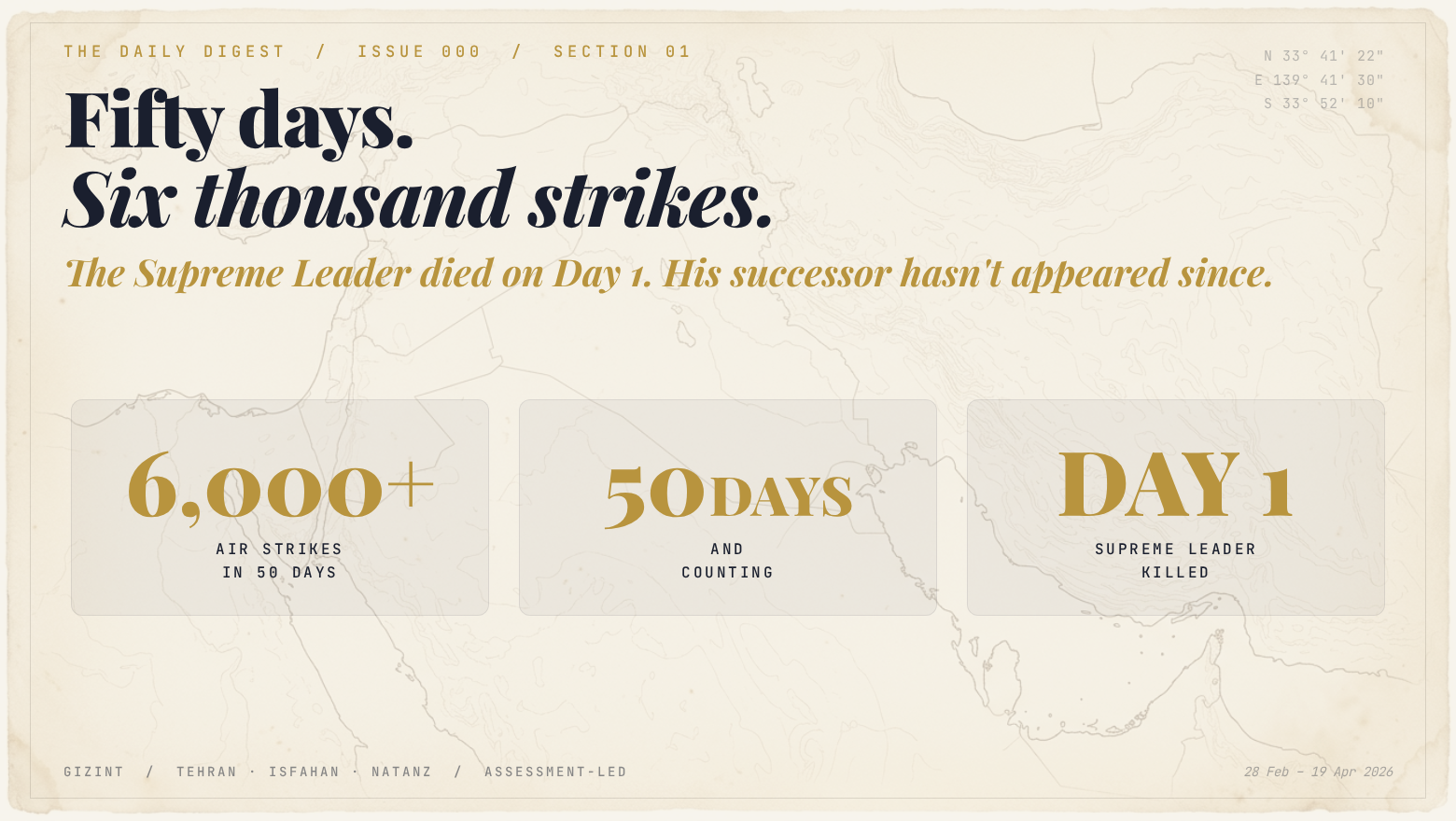
On 28 February 2026, the United States and Israel bombed Iran. Not a base. Not a convoy. The country. Nuclear sites, missile depots, air defence networks, Revolutionary Guard command posts, and the Supreme Leader’s compound in central Tehran. The Supreme Leader died in the first strike. His son survived, barely, and hasn’t been seen in public since.
Nobody asked Congress.
What followed took 50 days and involved, in no particular order: a naval blockade, a dead French peacekeeper, an insurance committee in London that shut down global shipping before any navy bothered, a Pakistani intelligence chief who became the world’s most important diplomat, a gold market that kept being right when everyone else was wrong, an Iranian foreign minister who announced the Strait of Hormuz was open and was contradicted by his own military before breakfast, and a series of legal deadlines all expiring in the same week, like someone synced the timers.
If you’re just arriving, this is how 50 days rewired the world. If you’ve been reading since Day 1, this is where it all connects.

The first strikes hit before dawn. US and Israeli forces targeted enrichment facilities, air defence networks, missile sites, and Revolutionary Guard command infrastructure across Iran. By the end of the first week: over 2,000 strikes. By 10 March: over 5,000. By the 12th: 6,000. This was not a single night of shock and awe. It was a sustained air campaign, closer in tempo to Iraq 2003 than to anything since. The difference: Iran is bigger, more defended, and nobody voted for this.
The most consequential strike happened in the first hours. A combined force strike on the Pasteur neighbourhood in central Tehran killed Supreme Leader Ayatollah Ali Khamenei. Iran’s Supreme National Security Council confirmed his death on 1 March. His son Mojtaba, wounded and reportedly disfigured in the same strike, was named successor.
But the new Supreme Leader has not appeared in public. No fatwa, the religious decrees a Supreme Leader uses to govern. No Friday prayer message. No update from the Supreme Leader's official website in over seven weeks. When the institutional centre of a country’s government is killed on Day 1, everything that follows is a succession crisis with missiles.
A succession crisis with missiles.
Iran hit back immediately. Iran’s retaliatory operation, codenamed True Promise IV, struck US installations across the region on 28 February; missile debris injured 16 people in Qatar alone. Iranian-linked forces struck Erbil airport the next day. On 5 March, an unmanned surface vessel, essentially a drone boat packed with explosives, hit the tanker Sonangol Namibe. Iran was spreading the cost: you bomb us, everyone pays.
The friction wasn’t just between Iran and the US. By 9 March, Israeli strikes on fuel depots “went far beyond what the US expected.” The Americans wanted a targeted military campaign. Israel wanted to hit the economy. On 17 March, the campaign killed Ali Larijani, the highest-ranking Iranian official to die since the Supreme Leader. On 18 March, the Israeli military targeted dozens of vessels at Bandar Anzali Port on the Caspian Sea. The Americans had not anticipated that either.
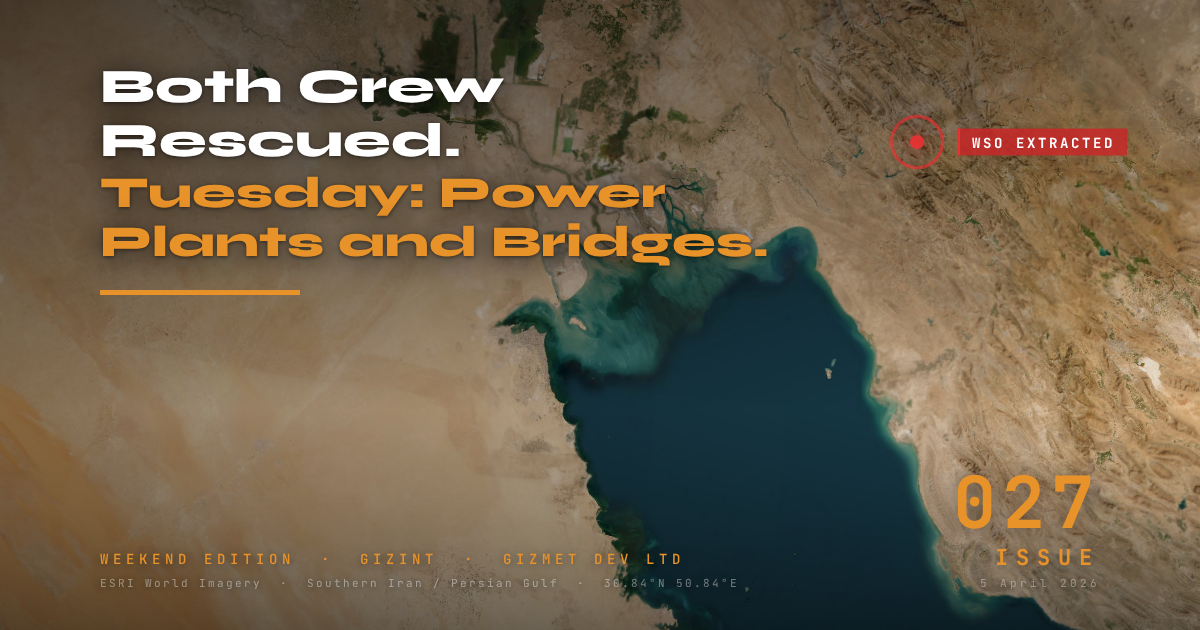
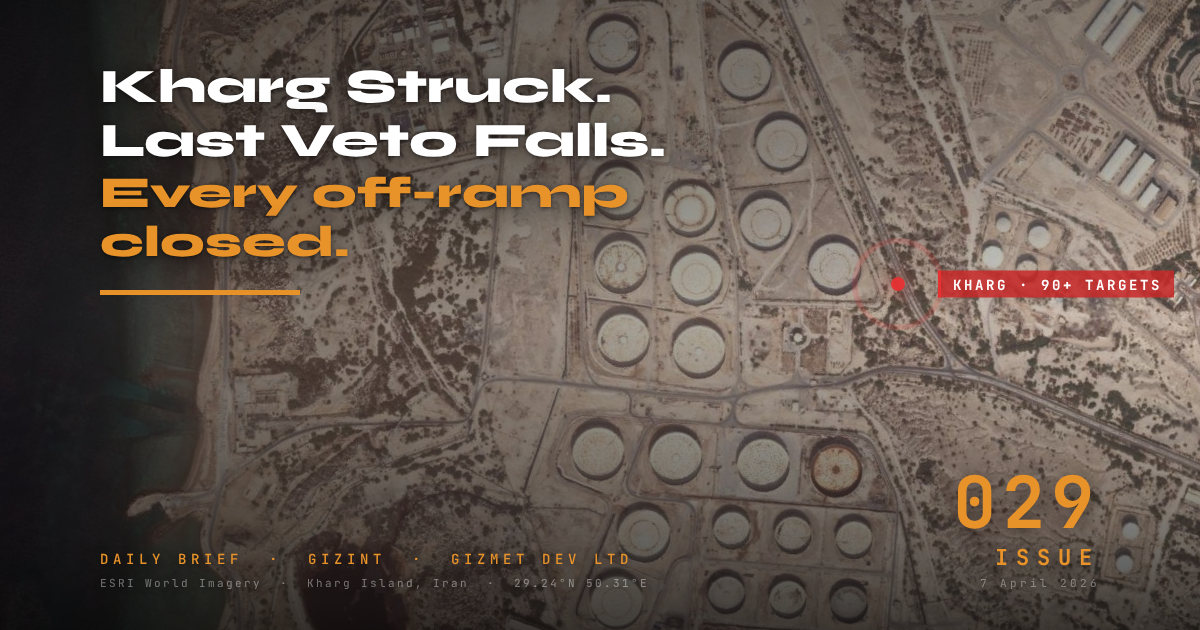
By the sixth week, strikes inside Iran paused. The fighting continued at sea. Kharg Island, which handles the majority of Iran’s oil exports, had already been hit with strikes against 90-plus military targets. The campaign shifted: maintain pressure at sea while pulling back from the most escalatory strikes on Iranian soil. Whether that was restraint or political necessity ahead of the War Powers deadline, the legal clock that limits how long a president can fight without congressional approval, nobody said. The effect was the same.
And then the Revolutionary Guard closed the Strait of Hormuz.

If you want to understand why the world’s most important shipping lane stopped working, forget the gunboats. Look at the insurance.
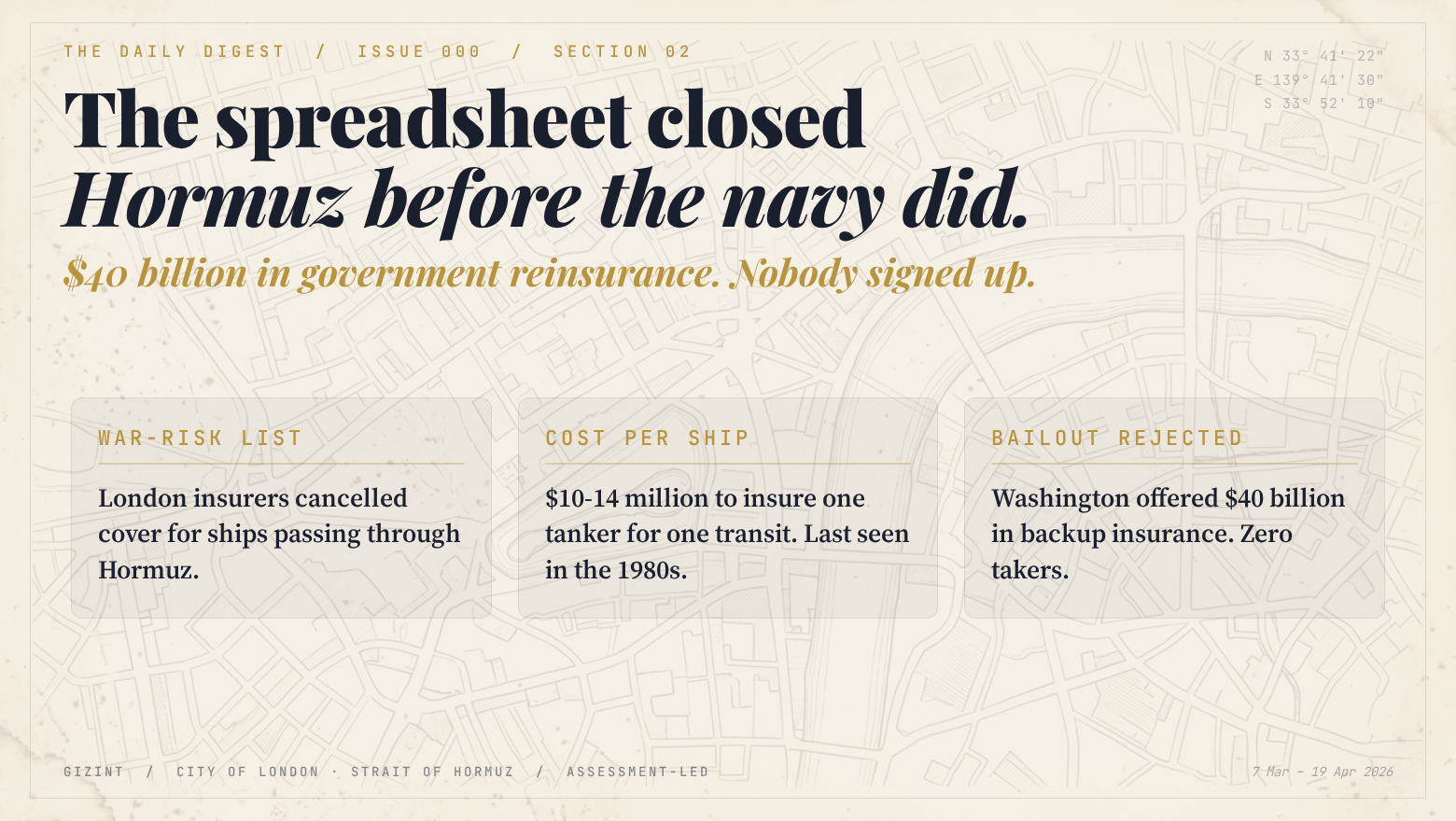
Three days after the first bomb dropped, a committee of underwriters in the City of London cancelled war-risk cover for ships transiting the Strait of Hormuz. That committee, the Joint War Committee, publishes something called JWLA-033. Getting your waters on that list means: no insurance, no port entry, no crew willing to sail. The US Navy has aircraft carriers. Lloyd’s of London has a spreadsheet. The spreadsheet closed Hormuz first.
By mid-March, insuring a single tanker for one Hormuz transit cost between $7.5 and $14 million, roughly 5% of hull value. The last time rates hit that level, Ronald Reagan was president and Iraqi jets were dive-bombing Iranian oil tankers. That war lasted eight years. The insurance market eventually priced the strait as uninsurable. Same market, same math, same answer. We’re back there.
Washington tried to fix it. The Development Finance Corporation, a government agency that usually funds water treatment plants in developing countries, offered $20 billion in reinsurance. Nobody signed up. It expanded to $40 billion, brought in Chubb, one of the world’s largest insurers. Still nobody. The insurance market had done its own maths, and wasn’t buying what Washington was selling.
The US Navy has aircraft carriers. Lloyd’s of London has a spreadsheet.
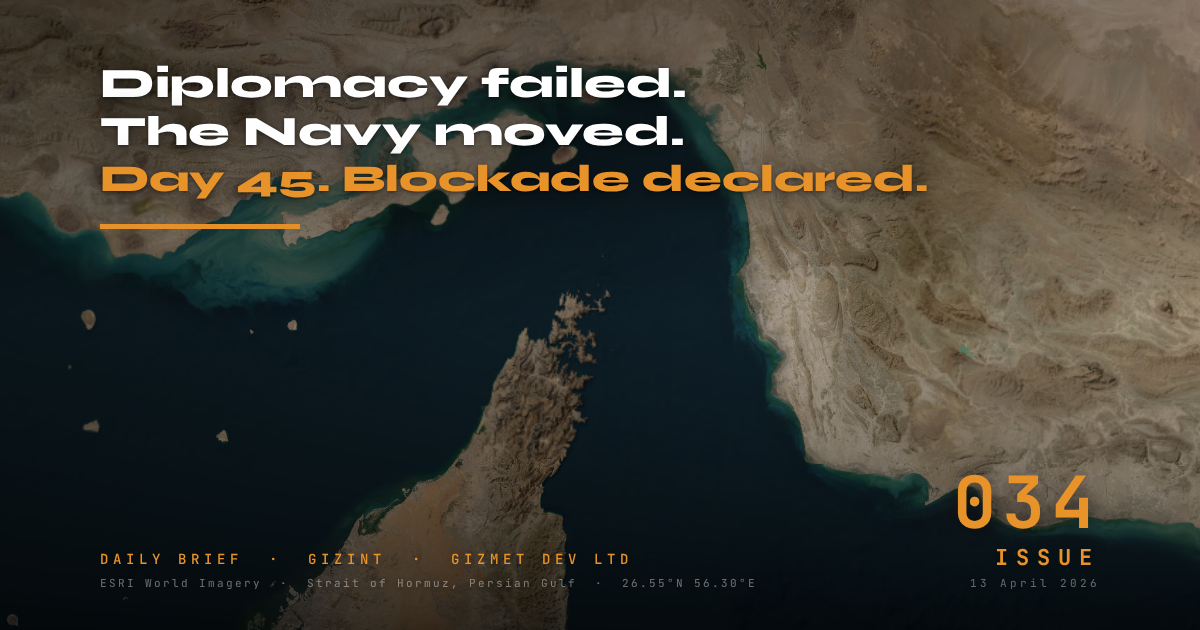
When the Revolutionary Guard formally declared the strait closed on 27 March, ships had already stopped transiting. The declaration was theatre built on top of a fact. On 12 April, Trump declared a “complete blockade.” By the 13th, the US Navy was enforcing it. A blockade under international law is an act of war.
Five days later, Iran’s foreign minister Abbas Araghchi said on social media the strait was “completely open.” By the next morning, the Revolutionary Guard reversed him, reclosed the strait, and sent gunboats after a tanker called the Sanmar Herald. The Sanmar Herald had clearance from Iran’s own port authority. The gunboats didn’t radio a warning. They just fired. The Guard declared anyone approaching the strait was “cooperating with the enemy.” Not enemy ships. All ships.
On 19 April, the US Navy intercepted the TOUSKA, an Iranian-flagged cargo ship, in the Gulf of Oman. The USS Spruance fired into the engine room. Central Command confirmed the boarding and released video. First direct US naval engagement with an Iranian-linked vessel since the campaign began.

The Sanmar Herald wasn’t a miscommunication. On 1 March, Araghchi told Al Jazeera that “military units are independent and acting on general instructions.” He said this out loud, on camera. Seven weeks later, the Sanmar Herald is what that sentence looks like when it hits the water.
The Islamic Revolutionary Guard Corps is a parallel armed force with its own navy, air force, intelligence service, and economic interests. It reports to the Supreme Leader, not the president. When the Supreme Leader is killed and his successor is incapacitated, the question becomes: who actually runs the country?
The Guard doesn't negotiate through diplomats.
By early April, the IRGC military council had taken de facto control. Ahmad Vahidi, formally appointed IRGC commander-in-chief; Mohammad Bagher Ghalibaf, parliament speaker and public face; Mohsen Rezaei, former IRGC Commander-in-Chief. Mojtaba Khamenei had the title of Supreme Leader but could not appear in public, participated only via audio, and was being managed by the people supposed to answer to him. On 10 April, Kamal Kharrazi, head of the Strategic Council on Foreign Relations, died from injuries sustained in a 1 April strike on his Tehran residence. The campaign was dismantling Iran’s senior leadership layer.
Araghchi and Ghalibaf tried to reassert civilian authority on 10 April. It lasted about a day. The Critical Threats Project at the Institute for the Study of War (CTP-ISW), a Washington research group that tracks Iran’s military in real time, documented the fragmentation: civilian versus military, and the military was winning.
This changes the fundamental question. When people ask “will Iran negotiate,” they’re asking about the wrong institution. The foreign ministry doesn’t control the response. The Guard does. And the Guard doesn’t negotiate through diplomats.

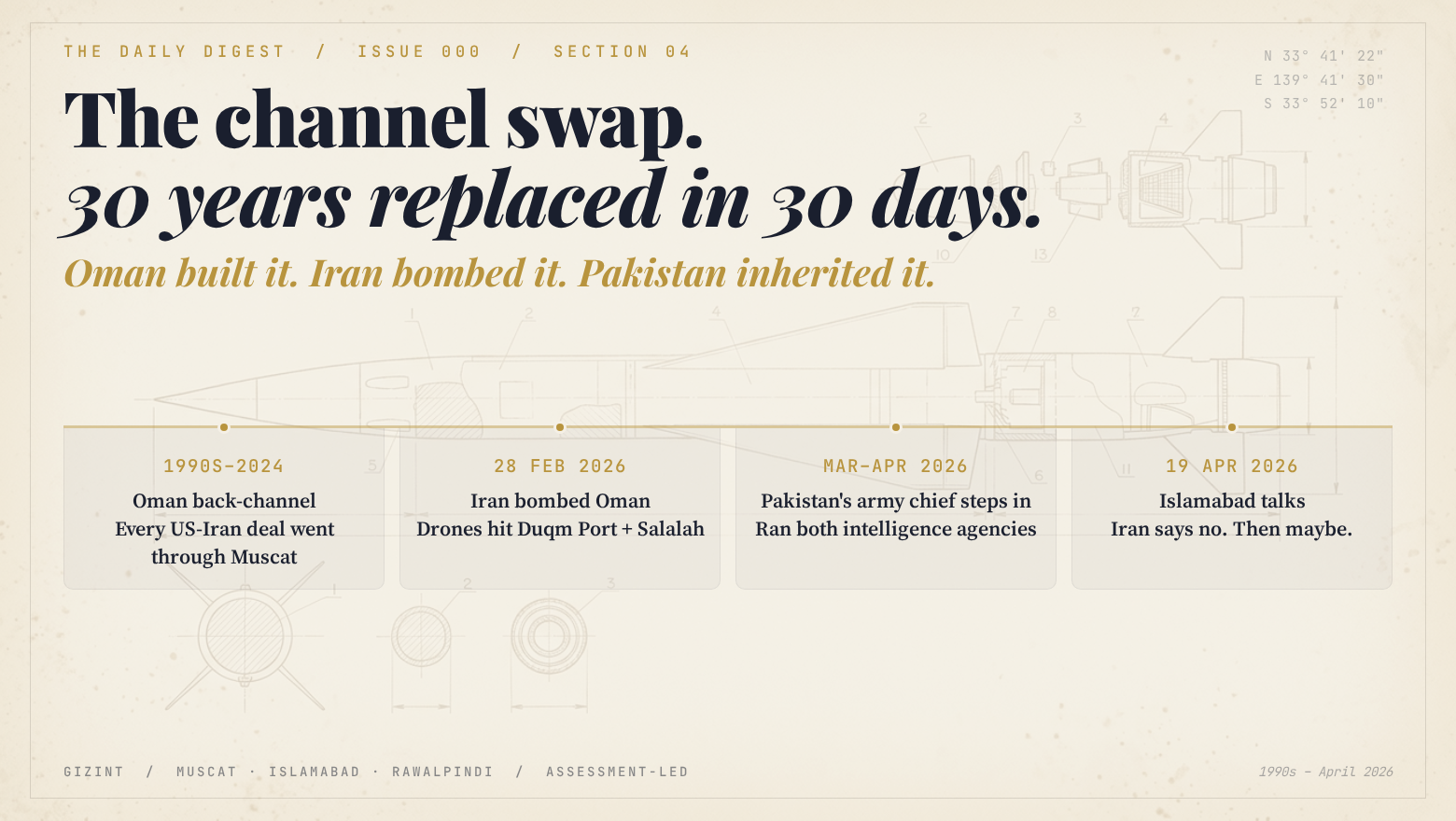
For 30 years, Oman ran the back-channel between the United States and Iran. Every major diplomatic opening since the 1990s went through Muscat, including the nuclear deal in 2015.
That channel broke when Iran bombed the mediator’s country. Iranian drones hit Duqm Port and Salalah, both in Oman. You cannot run a back-channel through a country you’ve just bombed. By early April, Oman’s foreign minister al-Busaidi was posting ceasefire appeals on X.
The White House designated a replacement. Not a country. A man. Field Marshal Asim Munir, Pakistan’s army chief, the only Pakistani military chief in history to have run both Military Intelligence and the Inter-Services Intelligence directorate, Pakistan's main spy agency. The swap connects directly to the IRGC takeover: Omani diplomats never had credibility with the Guard. Munir, with his dual intelligence background, speaks the Guard’s institutional language. He was delivering US proposals through the Supreme National Security Council, the military body that actually decides, not the foreign ministry.
You cannot run a back-channel through a country you've just bombed.
When you replace a 30-year diplomatic channel with a military-intelligence one, you’re acknowledging who holds power on the other side. The Guard doesn’t take the foreign minister’s calls. They’ll take Munir’s. But Pakistan has never brokered a peace deal. Oman has. The new channel has the right phone number but no track record of anyone picking up and saying yes.
Turkey and Pakistan both pushed for a 45-to-60-day ceasefire extension. Pakistan launched the “Islamabad Process.” By 19 April, no Iranian interlocutor had accepted terms. The Guard controls the answer. The Guard has said no.

While the world watched the Gulf, something happened in the Black Sea that most people missed.
The same week the Iran campaign began, Ukraine launched drone strikes against Russia’s naval base at Novorossiysk and the Sheskharis oil terminal. Novorossiysk handles roughly one-fifth of Russia’s seaborne crude exports. The strikes didn’t stop. By mid-April, Reuters reported exports had fallen over 40%. That isn’t a disruption. That’s barely functioning.
Russia’s daily oil revenue funds its war. Cut the revenue, cut the sustainment. The results showed up inside Russia. The governor of Leningrad Oblast, the region around St Petersburg, publicly called his own region a “frontline oblast,” a combat zone. St Petersburg is closer to Helsinki than to the Ukrainian border. When a governor 800 kilometres from the front calls his region a combat zone, the war has changed shape.
When a governor 800 kilometres from the front calls his region a combat zone, the war has changed shape.
Putin’s approval dropped for the sixth consecutive week, to 66.7% according to Russia’s main state-run pollster. The Levada Center reported 61% of Russians had a negative view of the political situation. Nine percent called it “critical and explosive.” Those numbers don’t mean revolution. They mean the Kremlin is losing the ability to pretend the war is going well. The last time they let polling look this bad was September 2022, two weeks before the “partial mobilisation,” a nationwide call-up that sent 300,000 men to the front. Russian elites reportedly face increasing demands to fund the war directly. The oligarch class is being squeezed. And Russia is massing troops near Vovchansk for a push toward a river crossing on the northern front.
The two wars feed each other directly. In January 2025, Putin and Iran’s President Pezeshkian signed a strategic partnership treaty with cyber cooperation provisions. Iran exports drone designs to Russia. Russia sends tactical lessons back. Both depend on Chinese components. A Ukrainian innovation against Russian air defence shows up, adapted, in Iranian countermeasures in the Gulf. A Russian electronic warfare technique appears in IRGC operations at Hormuz. Real-time arms development loop between two simultaneous wars.

Here is the thing nobody in the news puts together, because each deadline gets its own story and they never appear in the same paragraph.
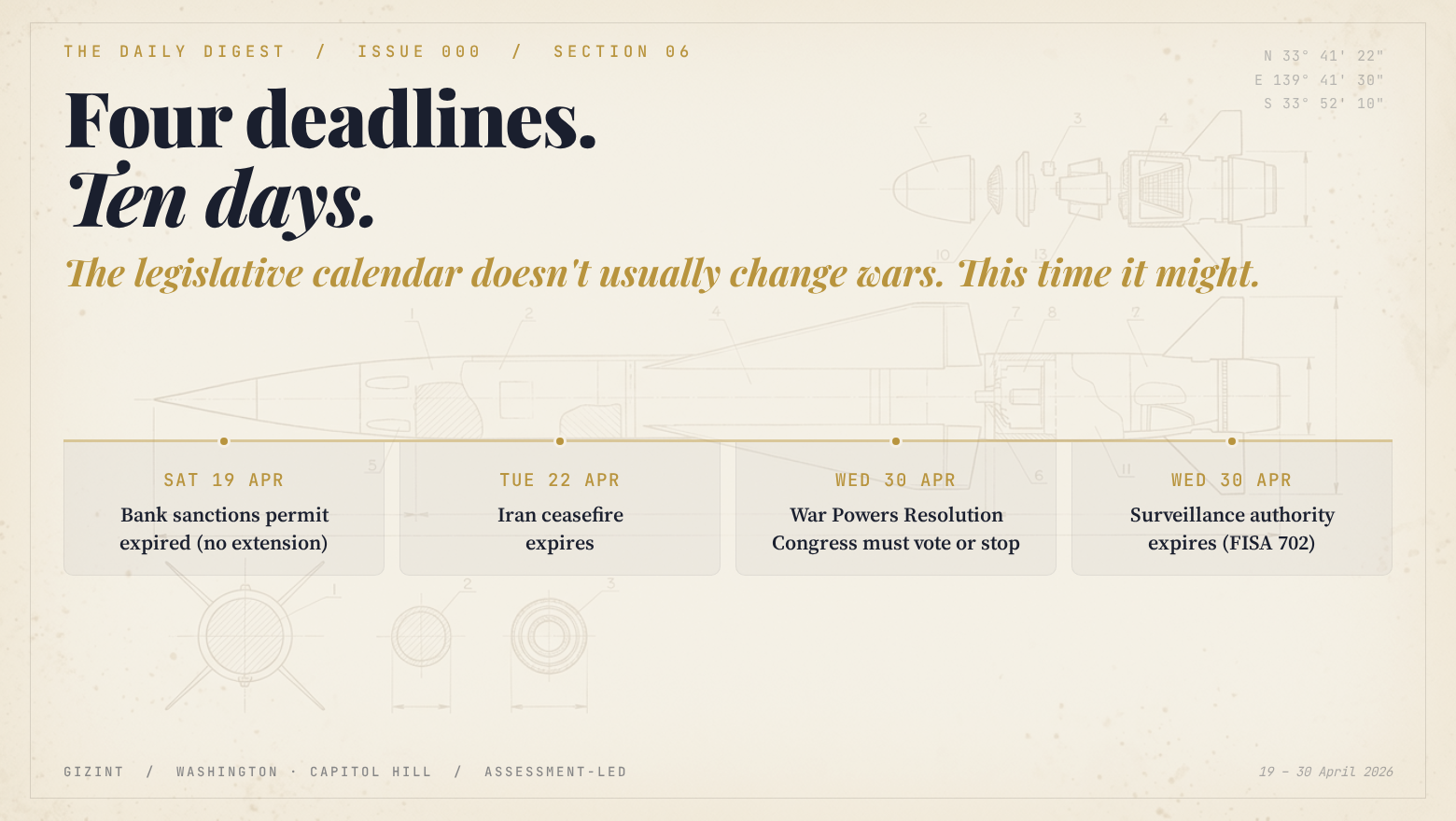
The Iran ceasefire expires on 22 April. If it isn’t renewed, both sides can resume operations.
Congress’s 60-day War Powers clock runs out at the end of April. The War Powers Resolution, passed in 1973 after Vietnam, says the president can use military force for 60 days without congressional approval. After that, Congress has to vote to authorise it or the operation is supposed to stop. The formal notification to Congress was filed on 2 March. Sixty days from that date lands on 1 May. Multiple votes to challenge it have failed, but Senator Curtis of Utah has said publicly he won’t back military action past the deadline. Schumer committed to bringing a War Powers vote to the Senate floor when Congress returns. Under Senate rules, that vote jumps the queue.
$14 to $16 billion in Iranian crude is on the water with no legal cover.
FISA Section 702 expires on 30 April, after Congress passed a ten-day emergency extension on 17 April. Section 702 is the law that lets US intelligence agencies intercept foreign communications passing through American servers. Without it, the National Security Agency loses the legal basis for most overseas surveillance. During an active military campaign against Iran, the people planning strikes would lose a major source of the intelligence those strikes depend on. FISA reauthorisation and a War Powers vote are both privileged, both guaranteed floor time, and both competing for the same compressed window after Congress returns.
And one more clock, already gone off. General License U, a Treasury sanctions permit for banks processing payments on Iranian crude already at sea, expired 19 April. The Treasury didn’t extend it. Didn’t offer a grace period. They almost always do. Did it for Venezuela. Did it for Russia. Not this time. Roughly $14 to $16 billion in Iranian crude is on the water with no legal cover. When banks aren’t sure whether a payment is legal, they freeze everything.
All four deadlines land in the same ten-day window. The legislative calendar is not usually something that changes wars. This time it might.

If you only track one number, track gold.
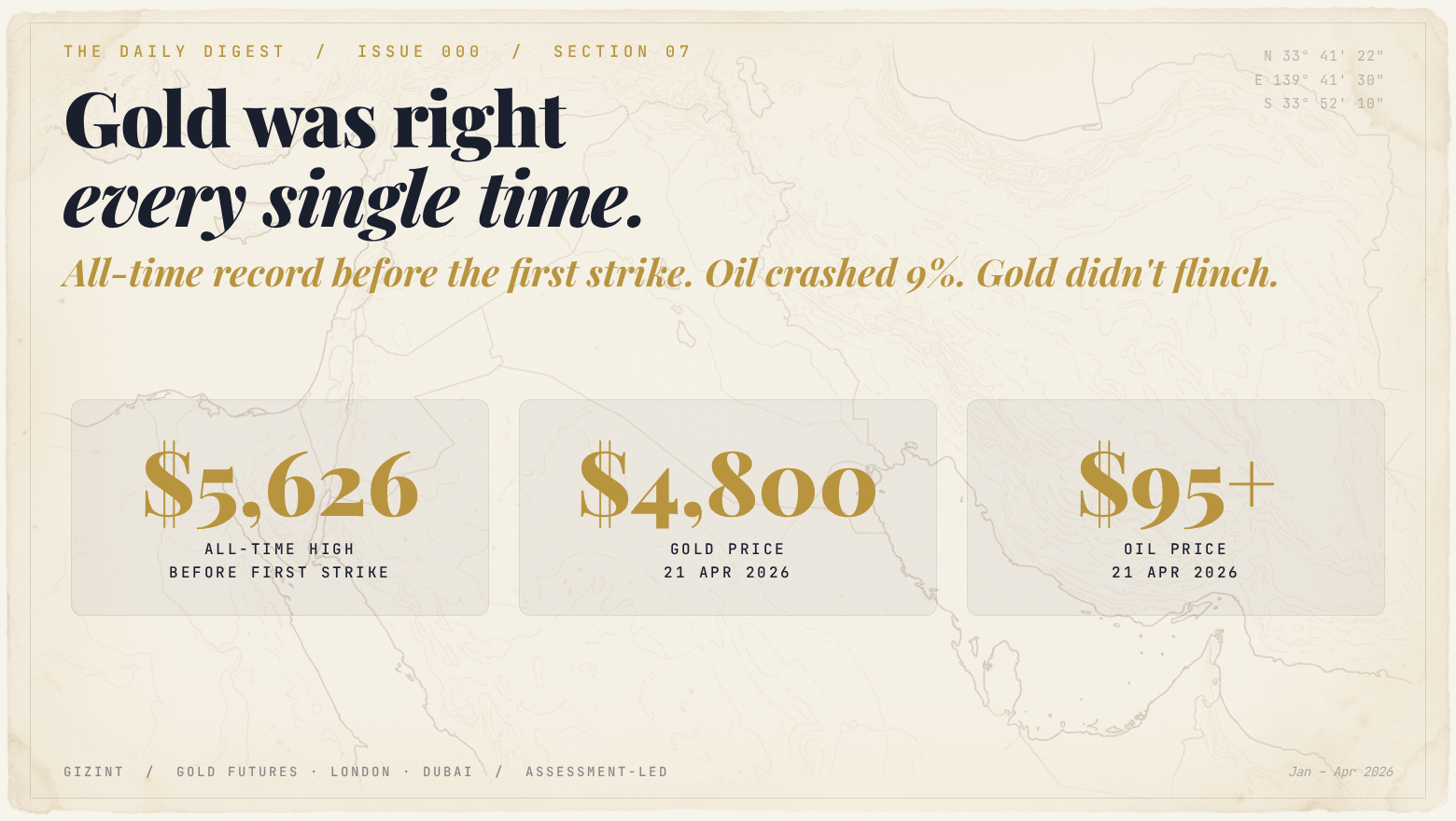
Gold hit a record $5,626 on COMEX, the exchange where gold futures trade, in late January, weeks before the first strike. By mid-April it had settled between $4,742 and $4,865. The signal was in the moves within that range. When ceasefire cycles generated hope, gold dipped. When the ceasefire failed, gold recovered. Every single time.
On 17 April, oil crashed 9% after Araghchi announced the strait was open. Normally when oil crashes that hard, gold gets sold too. This time? Gold held above $4,850. Didn’t flinch. Big money didn’t believe the reopening was real. It lasted less than a day. They were right.
They were right.
The gold-oil divergence has been the most reliable signal of the crisis. Over 50 days, gold has been right more often than any analyst, any diplomat, and any official statement. The insurance market tells the same story. Premiums haven’t budged. The underwriters aren’t watching press conferences. They’re watching claims.
Monday's markets delivered the verdict. Brent held above $95 per barrel. Gold dropped 2% to around $4,800 as the Hormuz escalation pushed oil higher and inflation fears dragged gold lower. The weekend had piled up: strait reclosed, gunboats firing, Iran rejected a uranium proposal, Trump threatened to cancel the ceasefire, and the “cooperating with the enemy” declaration dropped. The market priced all of it at once.
Four central banks meet in the next ten days. If Brent jumps above $100, it sets off a chain: the European Central Bank probably raises rates, which pushes the euro up against the dollar, which rattles yen carry trades. Carry trades are the vast pool of money that investors borrow cheaply in Japan and park elsewhere; when the dollar wobbles, that money moves, and Japan’s central bank has to decide whether to intervene. The last link in the chain is global dollar supply, which tightens. In 2020, the Federal Reserve stepped in to break exactly this kind of sequence by flooding markets with cheap dollars. Right now, with US inflation still above the Fed’s 2% target, doing the same thing would pour fuel on prices that are already too high. They’re stuck.

India tried to stay neutral. It lasted about three weeks.
India is chairing BRICS this year, the economic bloc that includes Brazil, Russia, India, China, and South Africa. In late March, India was on a list of “friendly” countries allowed through the strait. Several Indian ships crossed in late March using a back-channel deal with Tehran. The position was: this is an American problem, not ours.
Seventeen days later, the Revolutionary Guard was shooting at ships carrying crude for Indian refineries. The Sanmar Herald had clearance from Iran’s own port authority. India’s foreign secretary responded with two words: “deep concern.” India’s foreign ministry picks its language like a bomb disposal team.
India’s foreign ministry picks its language like a bomb disposal team.
”Deep concern” is the register New Delhi reserves for situations one step from crisis. After the Galwan valley border confrontation with China in 2020, India used similar language. Then it sent troops.
India is the only country to have lost mariners in attacks on merchant shipping during this crisis. The TOUSKA boarding added another problem: any ship using India’s bilateral workaround with Tehran could now run into the US Navy.
The bloc has no expulsion mechanism. India gets to chair a summit where one of the members is shooting at Indian ships. Try writing that agenda.

Lebanon is the conflict everyone keeps forgetting until someone dies.
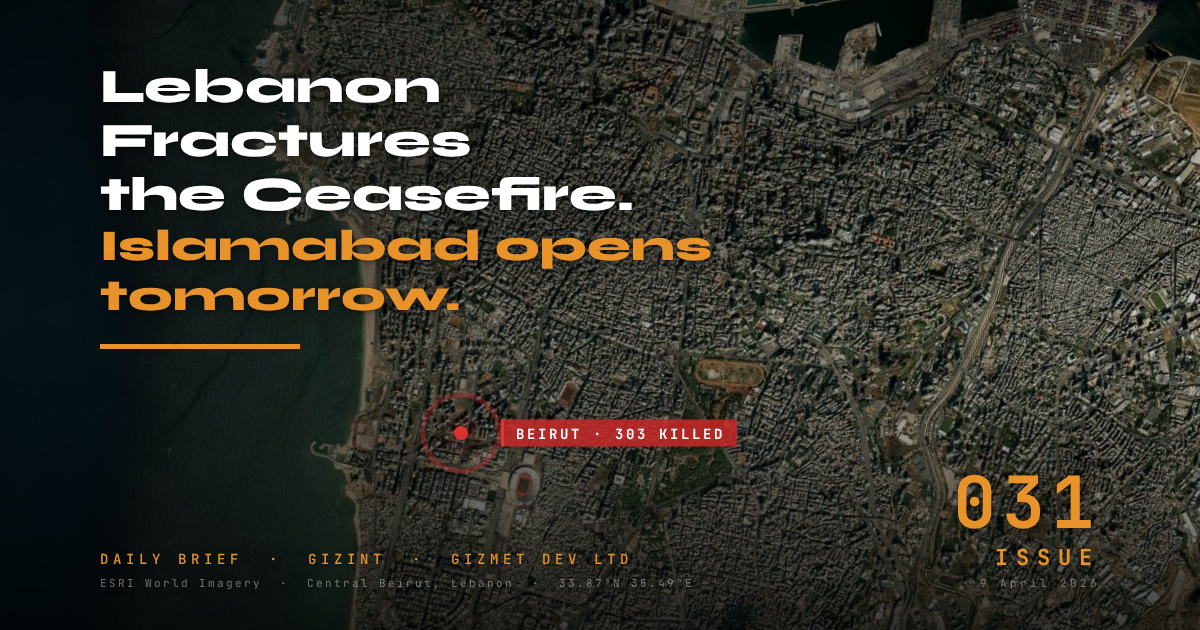
On 18 April, Staff Sergeant Florian Montorio of the French 17th Parachute Engineer Regiment was killed at Ghandouriyeh in southern Lebanon. First Western soldier killed since the truce took effect. Between 29 and 30 March, three Indonesian United Nations peacekeepers were killed in separate incidents. The peacekeeping force is being attacked by both sides.
The Lebanon ceasefire and the Iran ceasefire are structurally entangled. France, the UK, and Germany, the “E3,” the three European powers that usually act together on Iran, co-chair the Hormuz maritime response. But they can’t agree on what it should do. Germany rejected the military component. France conditioned its participation on Lebanon’s inclusion. The UK stayed with the US. The same three countries that triggered the JCPOA snapback mechanism in August 2025, reimposing UN nuclear sanctions by late September cannot agree on the shipping lane those sanctions helped close.
Netanyahu reportedly found out from the news.
Macron went to Nicosia with a dead peacekeeper and had to choose: Lebanon or Hormuz. He can’t do both with the same forces.
Trump posted on Truth Social that Israel is “PROHIBITED” from bombing Lebanon. The ceasefire text says the opposite. Netanyahu reportedly found out from the news. Hours later, Israeli forces hit the town of Kounine. One killed, three wounded. The town where the French soldier died is 12 kilometres away. Nobody knows which document holds until the next test.
That fragmentation extends into Europe. For months, Hungary’s Viktor Orban had been Russia’s most reliable institutional veto inside the European Council, the body where EU member states set foreign policy by consensus. One objection blocks everyone. When that veto was removed in mid-April, Russia lost its ability to block European policy through Budapest. The E3 split may start closing. But no European government has a plan for what happens if the ceasefire lapses and the strait stays closed.
At the UN Security Council, Russia’s counter-draft resolution failed 4-2-9, four votes for, two against, nine abstentions. The council is deadlocked. There is no multilateral framework for ending this campaign.

While two major wars dominate the headlines, the world’s largest humanitarian crisis is in Sudan. Fifteen million people displaced. The civil war has been running since April 2023. Both the UN's humanitarian office and the World Food Programme call it the world’s largest humanitarian emergency.
Sudan gets a paragraph in most coverage. It deserves a book.
On 19 April, an Iranian national was arrested at LAX, charged with brokering over $70 million in Iranian-manufactured drones, bomb fuses, and ammunition to Sudan. The Iran campaign and the Sudan civil war are not separate crises. They share an arms pipeline. The Hormuz closure is making it worse: humanitarian logistics through the Gulf are disrupted.
Sudan gets a paragraph in most coverage. It deserves a book. But the world's attention bandwidth has a hard limit, and two nuclear-armed standoffs are consuming it.

Step back from the daily noise and there is a shape to these 50 days.
A military operation became an insurance event, a constitutional crisis, a diplomatic puzzle, a financial shock, and a sovereignty problem for every non-aligned state with ships in the Gulf. Each layer built on the last. None has been resolved. They’re all heading into a week where the ceasefire expires, Congress reconvenes, and the legal authority for the entire operation comes under review.
What governments tell their own populations tells you what they’re about to do. Iranian state media shifted through three phases: defiance, then legitimacy for the IRGC, then victimhood framing. Each shift preceded a strategic decision. Russian state media buried Novorossiysk’s export collapse and redirected to US overreach. Every week that Iran consumes global attention is a week where Ukraine gets less coverage, less political capital, and eventually less ammunition.
The layers don’t resolve sequentially. They compound.
Reuters/Ipsos puts Trump’s approval at 36%, a second-term low. A separate Ipsos survey (10-12 April) found only 24% of Americans think military action in Iran has been worth it; 51% say it has not, 22% are unsure.
On Kalshi, a prediction market where people bet real money on political outcomes, the odds of the 25th Amendment being invoked, the constitutional mechanism for removing a sitting president, rose from 28.6% to 35.1%. The legal deadlines converging this week require political will, and political will runs on approval ratings.
That’s where we are. That’s how we got here.
Fifty days ago, this was a military operation with a defined target set. Today it is a constitutional crisis, an insurance market event, a diplomatic breakdown, a humanitarian emergency, and a global economic threat, all running at the same time. The layers don’t resolve sequentially. They compound.
The Daily Digest will be here every day to tell you what happens next.
The Digest is built on the same analytical engine behind the Daily Brief: 42 issues, zero retracted assessments. Track record. If you want the raw analysis, that's where it lives.
GIZINT has no corporate sponsors and no donors.
That's not a limitation. It's the point.
Corporate reporters need steady paychecks from people who get to lean on the reporting. We chose a different model: crowdfunded by readers, accountable to nobody else. $7 a month keeps it that way.
Every subscription is a vote for reporting that doesn't have to embellish the truth.
The Digest runs daily. $7/month.
GIZINT Daily Digest. Assessment only. No editorial line. corrections@gizmet.dev