


GIZINT — The Daily Brief | Issue 040
We assess Friday's diplomatic opening collapsed within 24 hours: Khatam al-Anbiya reversed the Hormuz reopening, Iran's MFA rejected uranium transfer, GL-U expired, and IRGC gunboats fired on Indian vessels holding prior Iranian clearance.
We assess Friday's diplomatic opening collapsed within 24 hours: Khatam al-Anbiya reversed the Hormuz reopening, Iran's MFA rejected uranium transfer, GL-U expired, and IRGC gunboats fired on Indian vessels holding prior Iranian clearance. Back-channel activity continues, but the Sanmar Herald override indicates command fragmentation beyond coordinated pre-negotiation pressure.
- Hormuz reversed: Khatam al-Anbiya reclosed the Strait within 24 hours of Araghchi's reopening, and IRGC gunboats fired on Indian-flagged vessels carrying Iraqi crude despite prior Iranian clearance.
- Ceasefire fracturing: French UNIFIL soldier SFC Montorio killed in Hezbollah-attributed ambush on Day 2 of the Lebanon ceasefire; Trump declared Israel "PROHIBITED" from striking Lebanon and Israel struck anyway.
- Four mechanisms failing: GL-U expired with no wind-down, Hormuz reclosed, Lloyd's JWC has not delisted, Iran rejected uranium transfer; Monday opens with the most compressed risk accumulation since the war began.
24-Hour Collapse: Military Command Reverses Diplomatic Opening, Four Mechanisms Snap Shut
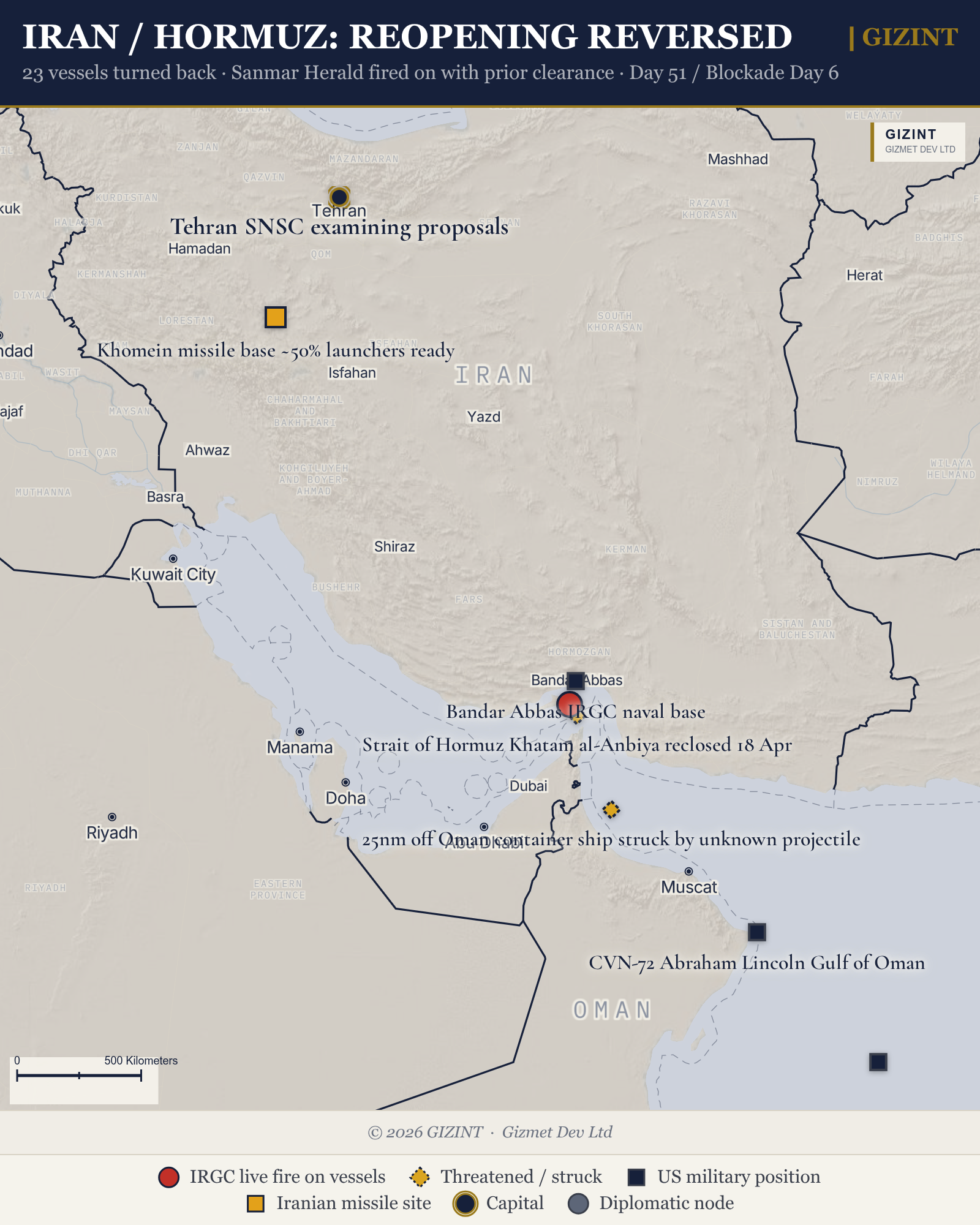
Iran's joint military command Khatam al-Anbiya reversed the MFA's Hormuz reopening within 24 hours, IRGC gunboats fired on neutral commercial shipping, Iran's MFA rejected uranium transfer, and GL-U sanctions expired simultaneously, collapsing the diplomatic framework ahead of Islamabad Round 2.
Araghchi declared Hormuz "completely open" on 17 Apr under IPMO-coordinated conditions (PressTV, Bloomberg, 17 Apr). By 18 Apr, Khatam al-Anbiya spokesperson Zolfaghari announced "control of the Strait of Hormuz has returned to its previous state under strict management and control of the armed forces" (PressTV, NBC, 18 Apr). Iran's navy broadcast on VHF: "No vessel of any type or nationality is allowed to pass" (Reuters via Military Times, 18 Apr).
IRGC gunboats fired on two Indian-flagged vessels, the VLCC Sanmar Herald (carrying approximately 2 million barrels of Iraqi crude) and the Jag Arnav, between Qeshm and Larak Islands without VHF warning (UKMTO warnings 037-26 and 038-26, 18 Apr). A third vessel, a container ship, was struck by an unknown projectile 25 nautical miles off Oman. The Sanmar Herald had received prior Iranian clearance to transit. Foreign Secretary Misri conveyed "grave concern" (Indian MEA, 18 Apr), the same register India used after the Galwan clash (2020, China), signalling New Delhi views this as a near-crisis rather than a routine diplomatic objection. CENTCOM deployed AH-64 Apaches for overwatch (The Aviationist, 18 Apr). Vessels turned back reached 23, up from 14 (CENTCOM via secondary sources, 18 Apr).
Three further mechanisms closed simultaneously. MFA spokesman Baghaei declared enriched uranium "as sacred to us as Iranian soil" and stated it "will not be transferred anywhere under any circumstances" (multiple wires, 18 Apr), contradicting the Axios-reported $20B-for-stockpile MOU. Parliament Speaker Ghalibaf posted on X that Hormuz "will not remain open" under blockade. OFAC General License U expired at 00:01 EDT 19 Apr with no wind-down, removing the legal channel for $14-16B in Iranian-origin crude in transit (OFAC GL-U text; Bessent via Reuters, 14 Apr). Lloyd's JWC has not delisted the Gulf.
The back-channel evidence is substantial. Iran's SNSC confirmed it is "examining new US proposals" delivered via Pakistani army chief Field Marshal Asim Munir during his Tehran visit (PressTV, 18 Apr). Munir is the only Pakistani chief to have headed both MI and ISI; the IRGC negotiates through military-intelligence structures, not the MFA, and Munir's background gives him interlocutor credibility civilian diplomats lack. This mirrors the 2012-13 Oman back-channel, where US-Iran talks ran through Sultan Qaboos's intelligence apparatus. CNN reported technical teams expected in Islamabad before the 22 Apr ceasefire expiry (Iranian sources, 18 Apr). Trump described the deal as "very close" (CBS, 17 Apr) while warning aboard Air Force One: "Maybe I won't extend. We'll have to start dropping bombs again" (AP/Newsweek, 18 Apr).
We assess Iran is running dual-track messaging: maximalist public positioning while technical engagement continues through back-channels. The three-branch pattern is a known Iranian sequence: during 2013-15 JCPOA negotiations, the Majlis declared enrichment non-negotiable, IRGC insisted on deterrent capability, and the MFA simultaneously tabled technical proposals in Vienna. Baghaei's "framework precondition" language narrows the door rather than closing it.
The critical distinction is between the coordinated-pressure reading and the command-fragmentation hypothesis. The Sanmar Herald clearance-override is evidence for fragmentation: the IRGC commander fired on a vessel holding IPMO clearance, suggesting the enforcement layer operates independently of the coordination mechanism. The closest precedent is USS Vincennes downing Iran Air 655 in July 1988: a civilian aircraft on a scheduled corridor destroyed because the tactical engagement layer operated on assumptions that contradicted the coordination mechanism. Vincennes was catastrophic error; the Sanmar Herald override suggests the IRGC enforcement arm does not recognise IPMO clearances as binding by design. If fragmentation, the diplomatic track faces a counterparty whose military arm cannot be bound by its negotiators.
Changed from prior: Araghchi conditional reopening with hedge intact. Now: reopening reversed within 24 hours; all four mechanisms lean escalation; command fragmentation evident.
What changes if this assessment is wrong: What changes if wrong: If the three-branch rejection is genuine rather than tactical, Islamabad Round 2 either does not convene or produces no framework, and the 22 Apr expiry becomes a resumption trigger. If the Sanmar Herald firing was authorised at the coordination level, the IRGC is deliberately widening the maritime conflict to include neutral states as leverage.