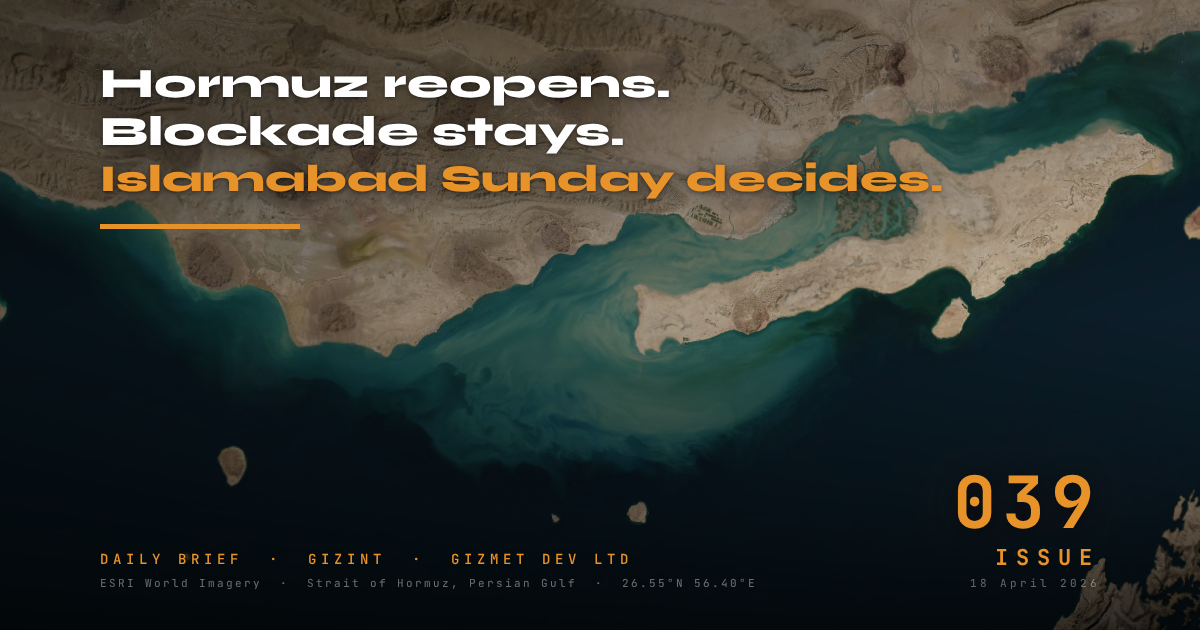
GIZINT — The Daily Brief | Issue 039
Hormuz reopened conditionally (Araghchi, 17 Apr); GL-U expires 19 Apr; Lloyd's unmoved; three-page US-Iran MOU trading $20B frozen funds for uranium stockpile in-flight. Islamabad Round 2 Sunday is the hinge: success extends Iran ceasefire past 22 Apr; failure snaps back 19-26 Apr.
Service notice: GIZINT infrastructure is undergoing unscheduled maintenance from Saturday 18 April through Monday 20 April, possibly extending to Tuesday 21 April. Daily Brief publication may be delayed or abbreviated during this window. Normal schedule resumes on restoration. Subscribers will be notified by email of any extended delay.
The Hormuz reopening is the first visible tranche of a four-mechanism deal: Volume is cashed (Araghchi, 17 Apr), Payment goes live at GL-U expiry 19 Apr, Insurance has not reversed, and a three-page MOU trading $20B in frozen Iranian funds for the enriched-uranium stockpile is reportedly in-flight (Axios, 17 Apr). We assess Sun 19 Apr Islamabad Round 2 is the hinge: success extends Iran ceasefire past 22 Apr; failure snaps all four mechanisms back together inside 19-26 April.
- MOU visible: Three-page US-Iran framework, $20B frozen Iranian funds for the enriched-uranium stockpile, 20yr/5yr moratorium gap, heads to Islamabad Sun 19 Apr (Axios, 17 Apr).
- UK takes operational lead: Starmer-Macron launched the Strait of Hormuz Maritime Freedom of Navigation Initiative the same day FCDO Permanent Under-Secretary Robbins was sacked; follow-up at PJHQ Northwood next week.
- Six cliffs inside 19-30 April: GL-U 19 Apr, Iran ceasefire 22 Apr, ICC Duterte 22 Apr, Lebanon ~26 Apr, WPR clock 29 Apr, FISA 702 patch 30 Apr stack inside one block.
Trump-Tehran MOU Visible: $20B for Uranium, Sun 19 Apr Islamabad Decides
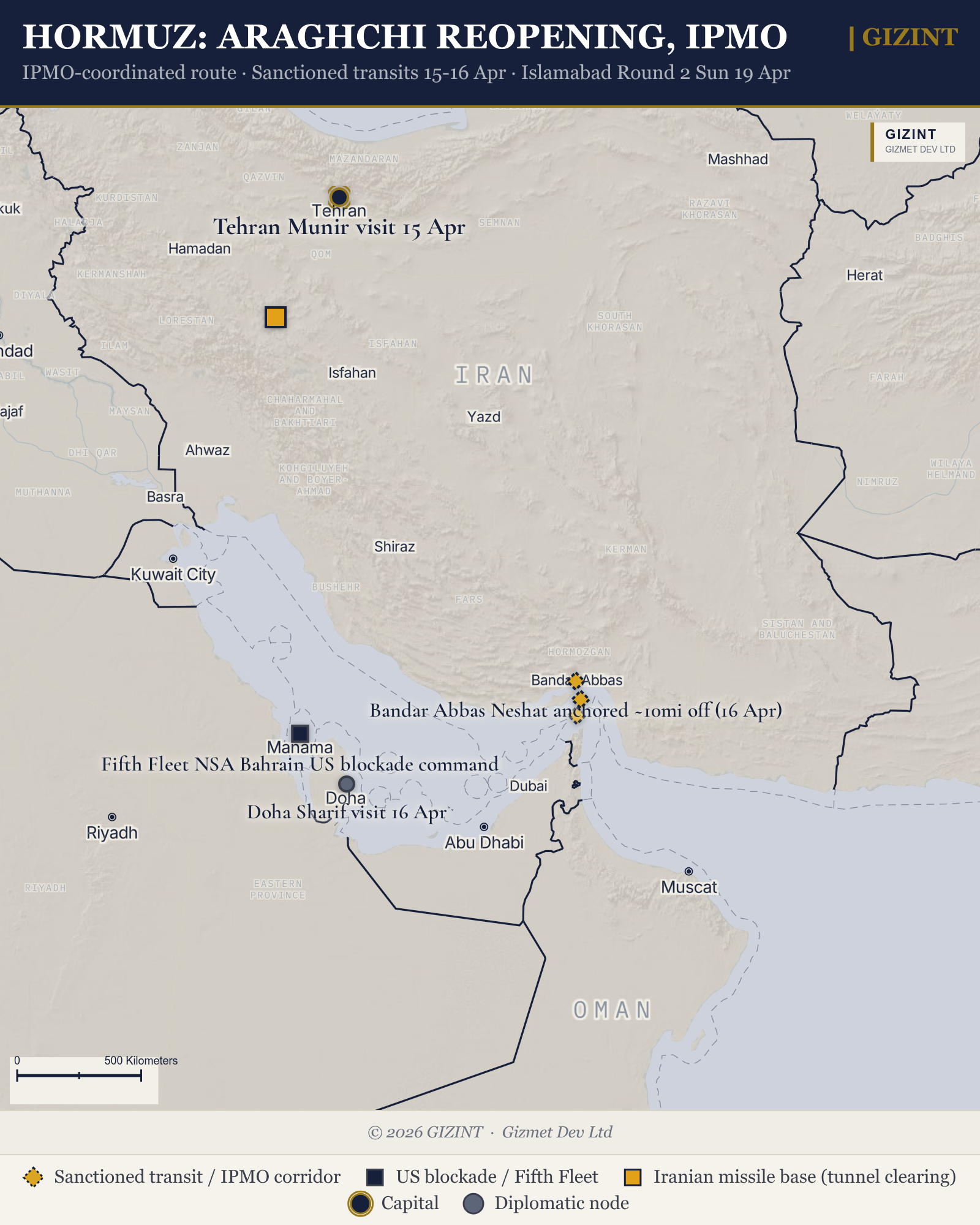
A three-page US-Iran framework trading $20B in frozen Iranian funds for Iran's enriched-uranium stockpile is reportedly in-flight (Axios, 17 Apr, two US officials plus two additional sources); Islamabad Round 2 confirmed for Sun 19 Apr; Trump on record that "we are very close to making a deal; if no deal, fire resumes."
The MOU sits on four mechanisms on four calendars. Volume cashed ~1030 EDT 17 April when FM Abbas Araghchi declared the Strait of Hormuz "completely open for the remaining period of ceasefire, on the coordinated route as already announced by Ports and Maritime Organisation of the Islamic Rep. of Iran" (Araghchi X post, 17 Apr): triple-stacked as ceasefire-tied, route-coordinated (IPMO corridor), belligerent-excluded (US and Israel-linked vessels barred). Payment goes live 00:01 EDT 19 April when Treasury's General Licence U expires (Bessent confirmed non-renewal 15 Apr); ~$14-16B of Iranian-origin crude at sanctions jeopardy. Insurance has not moved: Lloyd's JWC listed areas not delisted through 17 April; Hafnia and Torm "do not plan to return to the Gulf in the near term" (Gibson Shipbrokers via Hellenic Shipping News, 15 Apr). Negotiation terms: US releases ~$20B (Qatar ~$6B, OFAC accounts, South Korea residuals); Iran surrenders the enriched-uranium stockpile via compromise split (third-country shipment plus in-country down-blending). Moratorium gap: US 20yr, Iran 5yr. We assess the maximum binding duration a Pezeshkian government can deliver is 5-7 years; under Articles 77, 110(1) and 125 of the 1979 Constitution with the rahbari in transitional status post-28 February, no current Iranian institution can bind a 20-year posture. Hegseth on record that "Iran must hand over enriched uranium or US reserves right to remove it" (ABC7, 16 Apr).
Venue choice is itself the structure of commitment. Doha would have brought GCC ownership; Geneva would have placed the MOU under E3-compatible cover; Islamabad keeps it inside a single-mediator structure with Egypt and Turkey supporting rather than cosigning. Kissinger's 1973-75 Sinai I/II and the 2020 Abraham Accords succeeded as single-mediator instruments; JCPOA 2015 was P5+1 precisely because durability was the design requirement. Single-mediator MOUs sign fast and fracture post-signature. A Sunday framework is a 12-18 month instrument optimised for speed, not the 10-20 year structure the US text asks for.
The binding constraint on US Iran posture through Q3 is not Hormuz diplomacy; it is the PAC-3 MSE integration line at Camden. 402 interceptors fired in the first 16 days of Epic Fury equals a ~25-per-day engagement rate; GCC pre-war inventory of ~2,800 reads as roughly 400 on hand, or sixteen days of tempo at zero further use. The 10 April $4.76B Pentagon-Lockheed contract triples production to 2,000/year by end-2030, but the >2-year replenishment horizon stands. The same Camden line serves CENTCOM GCC resupply, Germany's €3.2B GEM-T, and Ukrainian demand. A second Epic Fury tempo before Q4 2027 forces a three-way force-generation allocation the Pentagon cannot resolve with money, only by de-prioritising one theatre. The MOU is magazine-depth-first, not diplomacy-first.
Trump stated the US blockade "will remain in full force until peace deal" (Truth Social, 17 Apr); boarding authority "regardless of location" (Bloomberg, 16 Apr) remains live. Planet Labs imagery (CNN, 10-15 Apr) shows tunnel clearance at Khomein and South Tabriz: active reconstitution, not damage assessment. US intelligence estimates ~50% of launchers remain operationally ready (CNN, 2-3 Apr). The ceasefire is the reconstitution window; the blockade's operational purpose is to deny export-funded rearmament during it.
What changes if this assessment is wrong: What changes if wrong: If Sunday collapses, launcher readiness ~50%, reconstitution clocks in days, continuous CENTCOM laydown, and Hezbollah with Paveh stockpile intact favour a 48-hour restart decision. The J3 planning horizon for a collapsed-MOU scenario is days, not weeks. If Islamabad produces a dated Round 3 framework and Iran ceasefire extends past 22 Apr, Hormuz reopening reads as durable and the boarding question slips past the 29 April WPR expiry.
Changed from prior assessment: the "hinge window" frame resolved through a visible MOU. Islamabad Round 2 is the single event on which all four mechanisms converge, and Trump's willingness to extend the ceasefire (Axios, 17 Apr) is on the record for the first time.