GIZINT Daily Digest — 21 April 2026
Right, let’s get to it. It’s the 21st of April. Here’s what you need to know.
Right, let's get to it.
It's the 21st of April. Here's what you need to know.
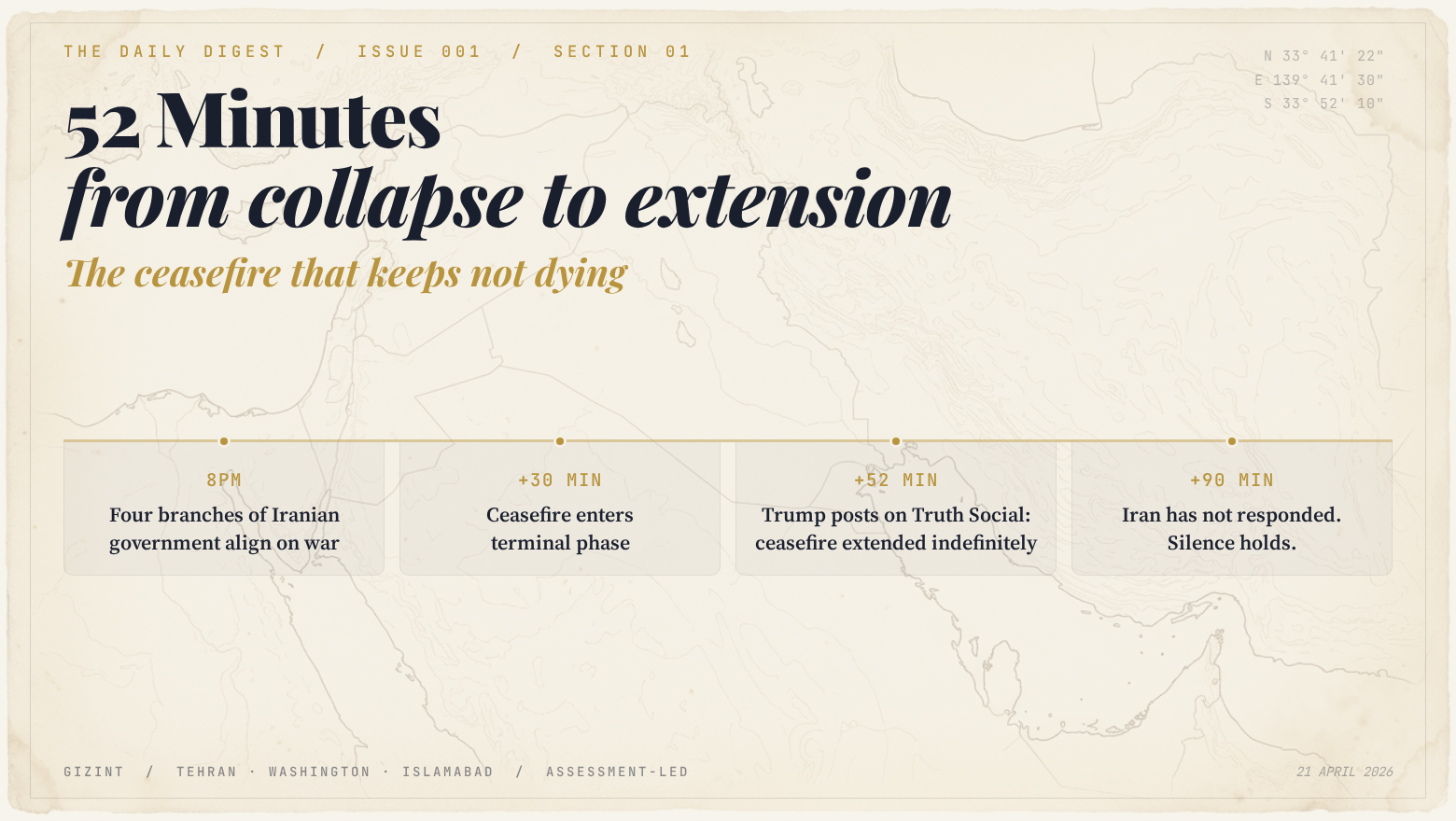
At 8pm London time tonight, every institutional voice in Iran was saying the same thing: war. By 9pm, Trump extended the ceasefire indefinitely. The blockade continues. Ukraine hit Russia's biggest southern oil refinery for the second time in four days. A French peacekeeper is dead in Lebanon, Hezbollah is firing rockets during a ceasefire, and Thursday's talks in Washington are the last chance before the whole thing collapses. Two legislatures on opposite sides of the world are simultaneously tying their own governments' hands. And the head of the world's leading energy watchdog just said this is the biggest energy crisis in recorded history.

This morning, every signal pointed one direction. Iran's foreign minister, Abbas Araghchi, posted that the US blockade of Iranian ports is "an act of war and thus a violation of the ceasefire." That matters because he was the last holdout. Iran's Revolutionary Guard, the country's most powerful military force, had been saying it for weeks. Parliament Speaker Ghalibaf said Iran was "prepared to reveal new cards on the battlefield." President Pezeshkian's office dismissed the negotiations. Major General Ali Abdollahi declared forces "fully aligned with the directives of the Supreme Leader."
Four branches of the Iranian government, all saying the same thing at the same time. That almost never happens. Iran's politics are defined by institutional competition between the military, the diplomatic corps, parliament, and the presidency. When all four align, it is either genuine consensus or maximum-pressure theatre designed to extract a concession.
At around 9pm London time, roughly 52 minutes after the ceasefire appeared terminal, Trump posted on Truth Social, his own social media platform. The ceasefire is extended indefinitely, at the request of Pakistan's Prime Minister Sharif and Field Marshal Asim Munir. The condition: Iran must submit a "unified proposal." The blockade continues. The military stays ready.
Here's what that phrasing tells you. Trump described the Iranian government as "seriously fractured." CTP-ISW and other public assessments since March suggest that IRGC Commander Ahmad Vahidi is the only person with direct access to Supreme Leader Mojtaba Khamenei. US officials told Axios (20 April): "We aren't sure who's in charge and neither do they." If those assessments are correct, the people who negotiate do not control the outcome, and the people who control the outcome are not at the table. Round 1 of talks ran without agreement because, Axios reported, the negotiating team lacked the authority to close. The IRGC then recalled the delegation for exceeding its mandate.
The "unified proposal" Trump demands is exactly what the IRGC's veto prevents. The indefinite extension buys time. It does not fix the structural problem: the government of Iran cannot produce a unified proposal because it is not unified.
As of 10pm London time, Iran had not publicly responded to the extension. That silence is itself a data point.

The ceasefire extension will be reported as a de-escalation signal. The reality is that none of the five mechanisms choking global oil trade reverses because of it.
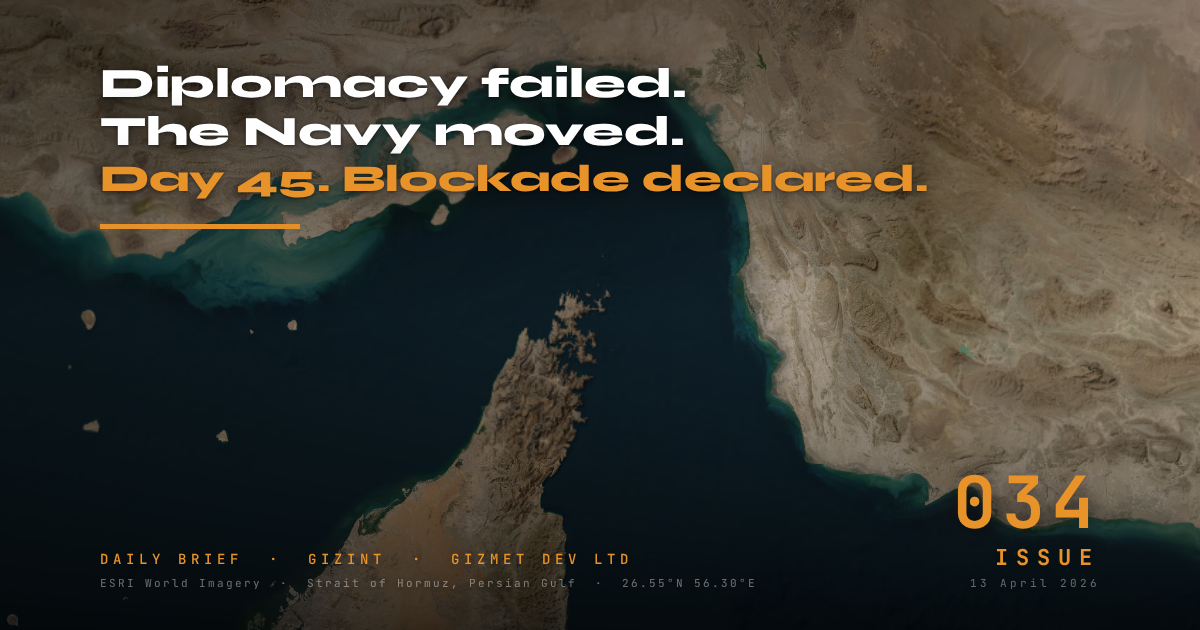
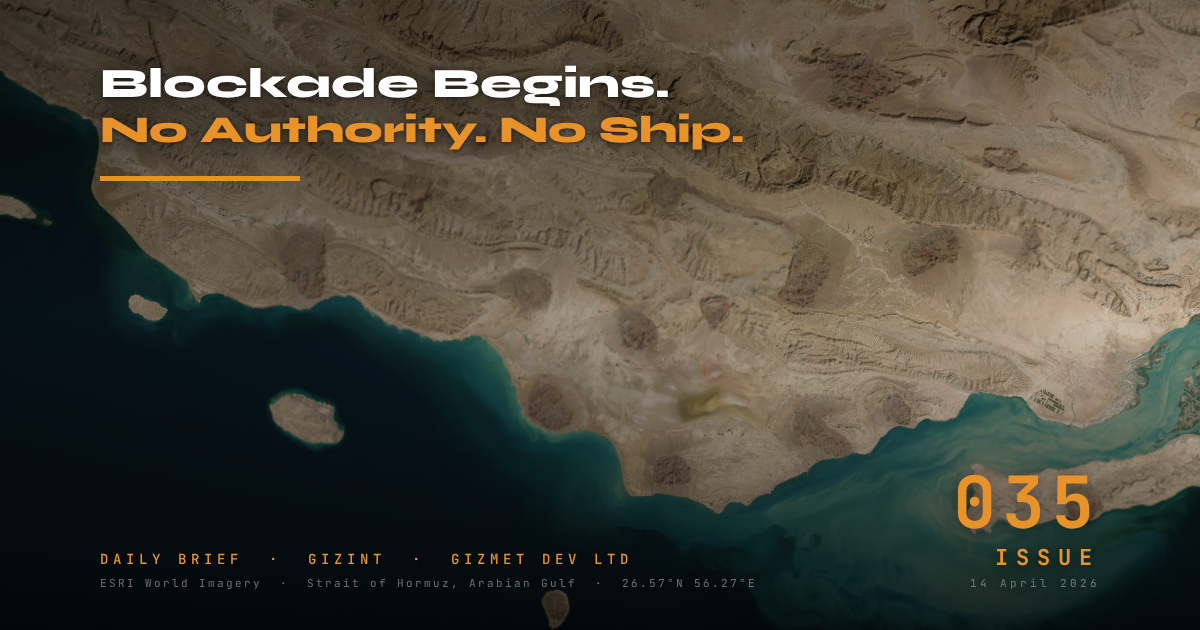
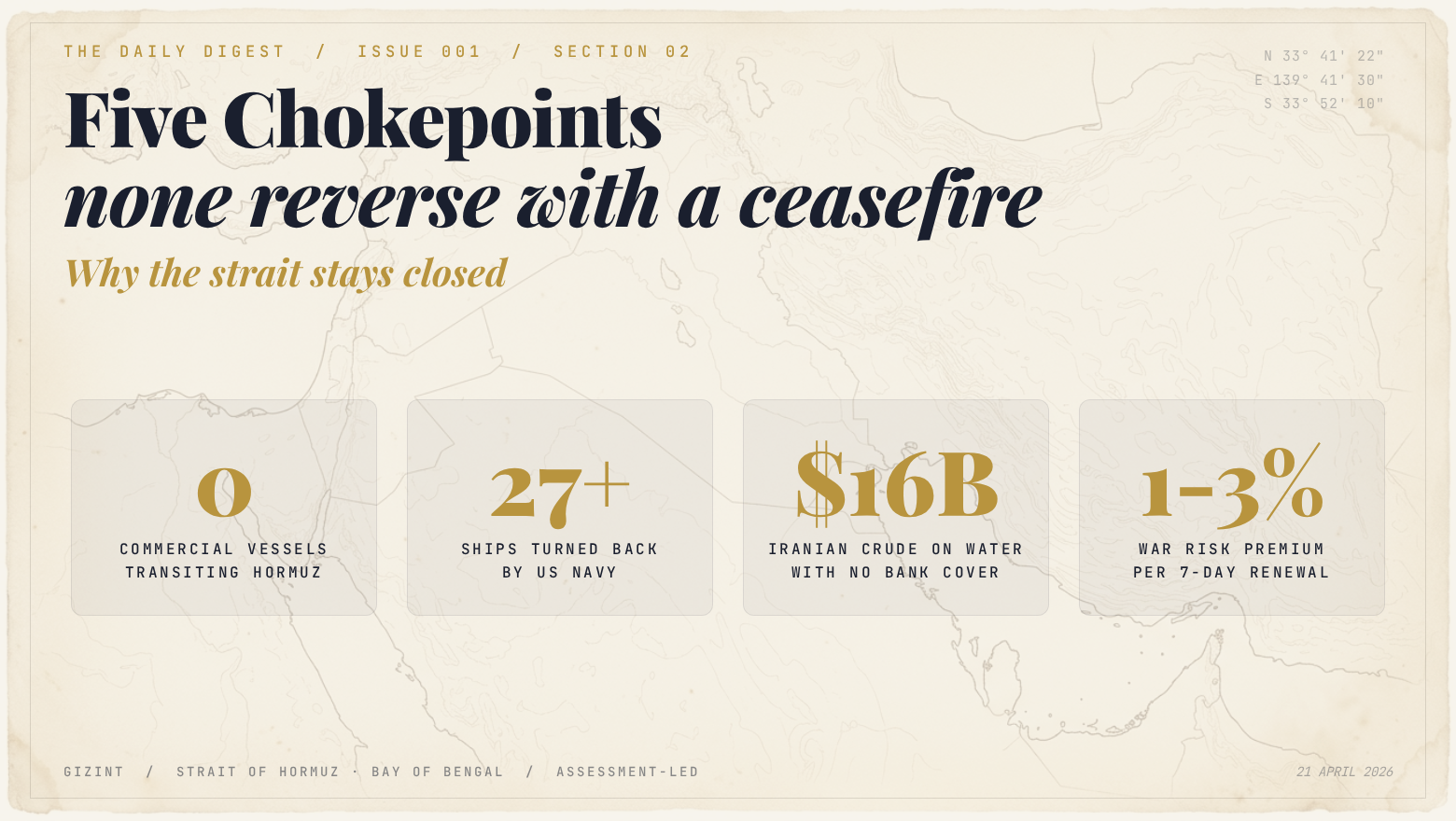
First, volume. The Strait of Hormuz is fully closed under a Revolutionary Guard order. The US Navy has turned back at least 27 vessels (CENTCOM, 20 Apr). Maersk, the world's largest shipping company, has told all its ships to avoid the strait entirely. Marine traffic tracking shows zero commercial vessels transiting.
Second, payment. A US sanctions permit called General License U expired on Sunday. It was the permit that allowed banks to process payments for Iranian oil already on ships. The US Treasury did not extend it. Did not offer a grace period. By some estimates, $14 to $16 billion in Iranian crude is on the water with no legal cover for the banks handling the money.
Third, insurance. Lloyd's of London, the world's largest insurance marketplace, designated the entire Gulf as a war risk zone in early March. War risk premiums jumped from a fraction of a percent of a ship's value to 1-3% per seven-day renewal. Several major insurers suspended Gulf coverage entirely. Insurance markets operate on claims data measured in months, not diplomatic announcements. Even if fighting stopped tomorrow, it would take quarters to restore coverage.
Fourth, gunfire. The IRGC's navy declared that any ship approaching the strait is "cooperating with the enemy" and will be targeted. They fired on two Indian-flagged vessels, including a supertanker carrying 2 million barrels of Iraqi crude. Not Iranian crude. Iraqi.
Fifth, and this is the new one: global enforcement. The Pentagon confirmed it boarded the oil tanker Tifani in the Bay of Bengal. That is the first interdiction outside the Middle East theatre. The Bay of Bengal falls under the US military's Pacific region command, not the Middle East command that has been running the blockade. The Pentagon made clear that international waters would not provide refuge for sanctioned vessels.
The ceasefire extension does not delist the war risk zone. It does not reinstate the expired sanctions permit. It does not restore insurance coverage. It does not stop gunboats firing. It does not reverse the global enforcement posture. It took days to close these channels. It will take months to reopen them. The insurance market, not the negotiating table, controls the reopening clock.

Day 5 of the Lebanon ceasefire, and it is degrading from both sides at once.
Hezbollah launched rockets and a drone at Israeli positions on Tuesday, wounding five soldiers, one seriously, in the most significant exchange of fire since the ceasefire began on 16 April. Israel had already struck three targets on the 19th and 20th. The ceasefire text gives Israel the right to "take all necessary measures in self-defence, at any time." There is no equivalent provision for Lebanon.
Staff Sergeant Florian Montorio of France's 17th Parachute Engineer Regiment was killed on the 18th near Ghandouriyeh during an explosives clearance mission. Three of his comrades were wounded. At least four UN peacekeepers have been killed since 2 March. The prior casualties were Indonesian. A French death changes the calculus: France is a permanent member of the Security Council, a nuclear power, and now has a dead soldier in a conflict where it is supposed to be keeping the peace.
Macron met Lebanon's Prime Minister Salam in Paris on Tuesday evening and confirmed France would maintain military presence when the current UN mandate expires at the end of the year.
Hezbollah's leadership has hardened. Secretary General Naim Qassem said his fighters are "in the field with fingers on the trigger" and called the ceasefire text "an insult to our country." A senior official, Mahmoud Qammati, told Al-Jadeed TV: "This time we will not practice the strategic patience policy."
The death toll since 2 March: 2,454 killed and 7,658 wounded in Lebanon, per the country's disaster management unit. Ambassador-level talks resume Thursday in Washington. They are the only remaining mechanism before the ceasefire expires around 26 April. If they produce an extension, the ceasefire survives into May. If they fail, both sides have already stated their intentions.

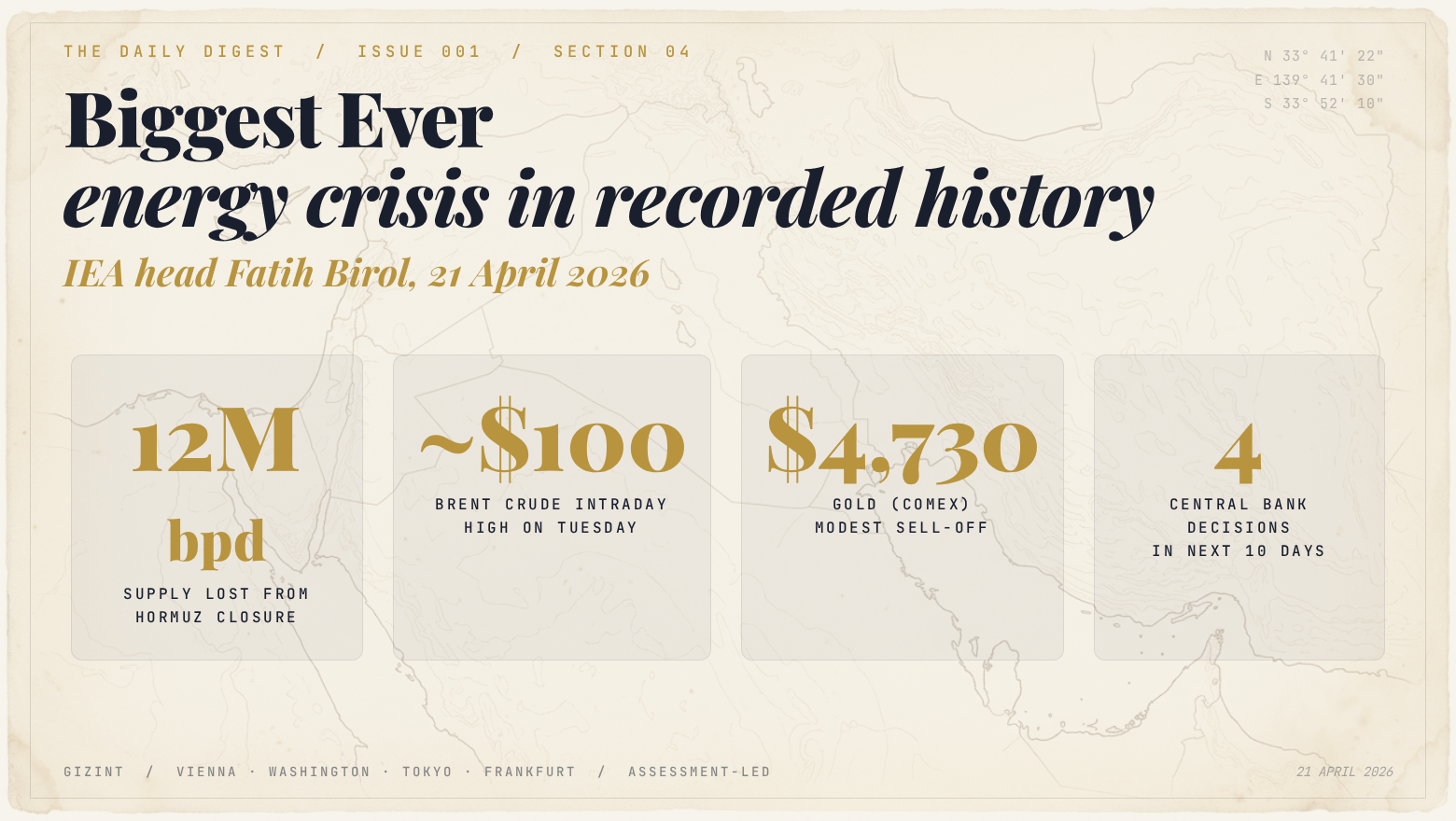
The head of the International Energy Agency (IEA), Fatih Birol, said it out loud on Tuesday: this is "the biggest energy crisis in history." The IEA estimates 12 million barrels per day have been lost from the Hormuz closure. The 1973 Arab oil embargo removed about 5 million. The 1979 Iranian Revolution removed about 5 million. This crisis exceeds any two prior shocks combined.
Brent crude, the global oil price benchmark, briefly touched near $100 during Tuesday's trading when it looked like talks were collapsing, before pulling back after the extension announcement. Gold dropped to $4,730, but that drop tells you something: when oil falls, investors usually sell gold harder to cover losses elsewhere. Gold's sell-off was modest. The big money isn't convinced the relief is real.
When the world's leading energy watchdog declares a crisis of this magnitude, it enables coordinated government responses: strategic oil reserve releases, emergency production increases, central bank flexibility on inflation targets. Gulf media amplified the declaration without qualification, which historically signals Gulf capitals are preparing to increase oil production.
Meanwhile, the US Treasury announced fresh sanctions against Iranian drone and missile supply chain entities, including Mahan Air and its board. Sanctions are building during the ceasefire, not after it.
As we flagged in our opening edition, four central banks meet in the next ten days. The European Central Bank's March projections assumed oil at around $80. Reality is $95. The Federal Reserve meets 28-29 April, boxed by stagflation, the combination of rising prices and stagnant growth that leaves central banks with no good options, and almost certainly holding. The Bank of Japan decides on the 28th. Three rate decisions land in the same 72-hour window as the US War Powers deadline.

This one is invisible in the news because you have to read both at once.
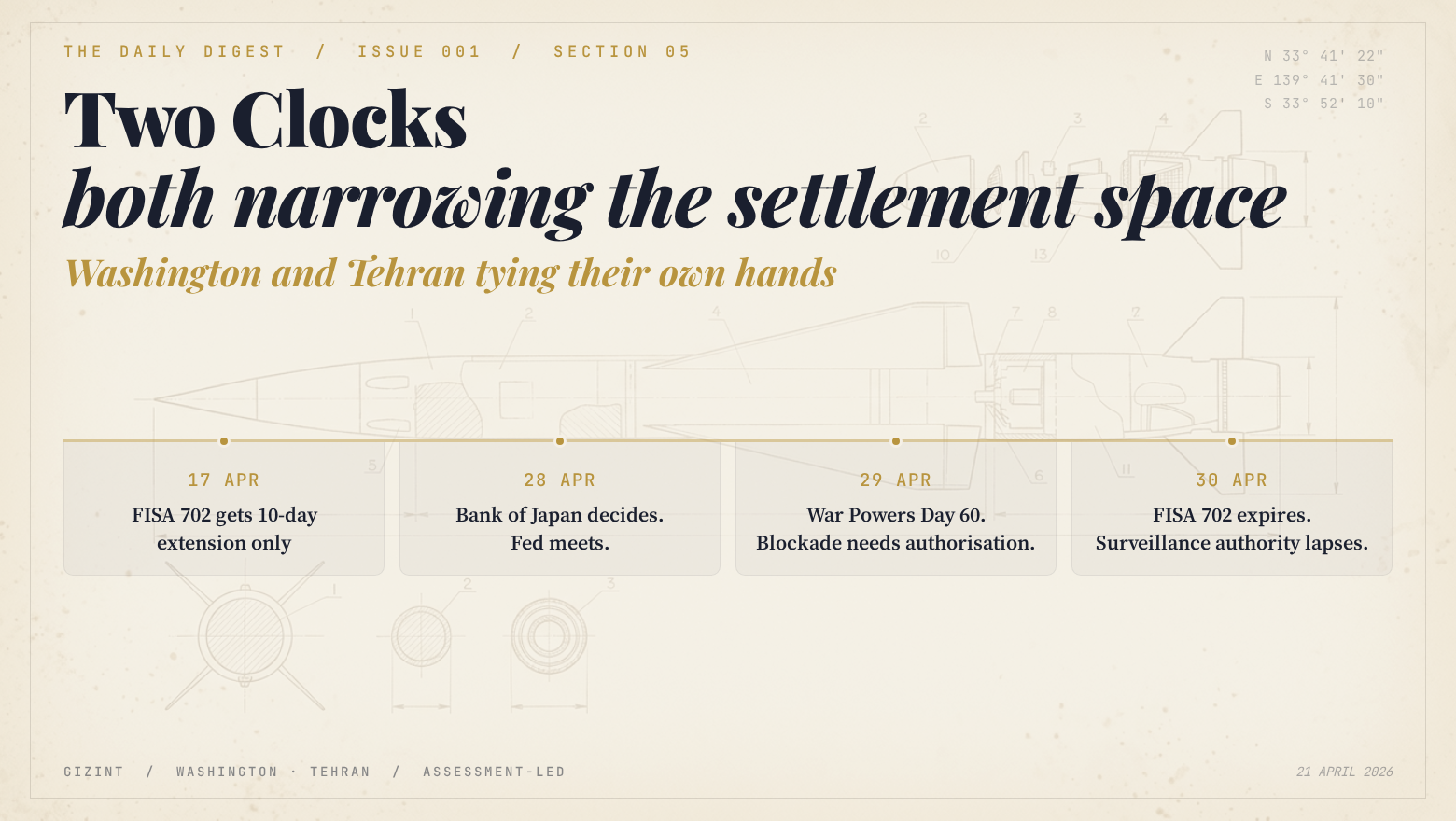
In Washington, the legal clock for the Iran campaign is ticking. Under the War Powers Resolution, the president can use military force for 60 days without congressional approval. Day 60 is 29 April. Senator Collins of Maine said publicly: "If this conflict exceeds the 60 days, Congress should have to authorize those actions." Senator Tillis of North Carolina signalled the same. No formal authorisation text has been filed. The ceasefire extension does not pause this clock. The blockade is a military operation, and it continues.
In Tehran, Iran's parliament is drafting legislation to extend the Hormuz closure it codified into law in late March. The bill would ban Israeli-linked vessels, require approval from Iran's top security body for any ship from a "hostile" state, and impose transit fees in rials or cryptocurrency. If the Guardian Council, the body of clerics and jurists that must approve all Iranian legislation, approves it, reopening the strait as a concession in negotiations would require repealing a law, not just rescinding a military order.
Both legislatures are simultaneously constraining their executives' freedom to negotiate. Collins and Tillis want authorisation that limits what the president can do. Iran's parliament wants codification that prevents any future president from offering what the Americans are asking for. The settlement space is narrowing from both ends. Neither side seems to know.
The 29 April deadline collides with another: FISA Section 702, the law that allows US intelligence agencies to intercept foreign communications passing through American servers, expires on 30 April. Congress passed a 10-day extension on the 17th, but longer-term renewal failed. A War Powers vote jumps the queue ahead of everything under Senate rules, including surveillance reauthorisation. If Section 702 lapses alongside a War Powers challenge, the legal framework underpinning the entire Iran campaign narrows from both sides simultaneously.

This one gets buried under Iran, but it shouldn't.
Ukrainian forces struck the Tuapse oil refinery for the second time in four days. It is a facility owned by Rosneft, Russia's state oil company, on the Black Sea coast that processes 12 million tons of crude per year. The refinery and the export pier are a single complex. Hit one, you degrade both. Six major energy and port targets in 15 days.
Russia tried to kill one of Ukraine's top defence advisors. Four jet-powered Shahed drones targeted Serhiy Beskrestnov's home in Kyiv Oblast (Kyiv Independent, 20 Apr). One wall survived. He posted from hospital: "I am in a cast and it seems I will be for a long time yet."
Here's the detail that connects Ukraine to everything else. Swedish military intelligence assessed this week that Russian inflation is actually running at about 15%, not the official 5.86%. The budget deficit is understated by $30 billion. And Moscow needs oil prices above $100 per barrel, sustained for at least a year, to stabilise its fiscal position. The Urals benchmark, the price marker for Russian crude, crossed $100 in April for the first time since the post-invasion spike.
The Hormuz crisis is delivering exactly what Russia needs: elevated oil prices funding its war effort. Russia broke nine cycles of silence on the Iran ceasefire when Foreign Minister Lavrov publicly urged ceasefire maintenance. The fiscal incentives point the other way: a prolonged standoff that keeps oil above $100 serves Russian fiscal recovery better than a rapid resolution. Ukraine's refinery campaign is a direct strike on that windfall.

India’s bilateral workaround with Iran, which kept Indian ships transiting Hormuz when almost nobody else could, collapsed last week after the IRGC fired on two Indian-flagged vessels. Since then, it has got worse.
The US sanctions permit that allowed banks to process payments for Iranian oil expired on Sunday with no replacement. Indian refiners now face secondary-sanctions exposure, meaning the US could penalise Indian banks for handling Iranian oil payments, with a deadline approaching Wednesday. India is being squeezed from both directions at once: Iran is shooting at its ships and America is cutting off its payment channels.
India is the only founding member of BRICS, the bloc of major emerging economies, that has not condemned the American strikes on Iran. The middle ground India occupied for 40 days has disappeared underneath it.
What to watch: Iran's silence on the extension is the first signal. If Tehran responds with even conditional engagement in the next 24 hours, the "unified proposal" path is alive. If silence holds, the IRGC veto has absorbed the extension into the standoff. Thursday's Lebanon talks in Washington determine whether that ceasefire survives the week. And watch the oil price when Asian markets open tonight: if Brent holds above $95 despite the extension, the market is telling you the five chokepoints matter more than the diplomatic headline.
The full analytical picture, including the IRGC's reported influence over access to the Supreme Leader, the air defence picture, the Five Eyes cyber conference in Glasgow, and the ICC jurisdiction precedent being set tomorrow, is in today's Daily Brief.
GIZINT has no corporate sponsors and no donors.
That's not a limitation. It's the point.
Corporate reporters need steady paycheques from people who get to lean on the reporting. We chose a different model: you. $7 a month keeps it that way.
The full Daily Brief: Read today's.
The Digest: $7/month.
GIZINT Daily Digest. For informational purposes only. No editorial line. No advocacy. Assessment only. Errors: corrections@gizmet.dev