



GIZINT — The Daily Brief | Issue 043
We assess the Iran ceasefire is entering its terminal phase: no delegation has departed, all four branches of the Iranian state have now converged on escalatory framing, and the first boarding outside CENTCOM signals global enforcement.
We assess the Iran ceasefire is entering its terminal phase: no delegation has departed, all four branches of the Iranian state have now converged on escalatory framing, and the first boarding outside CENTCOM signals global enforcement. FM Araghchi's public declaration that the blockade constitutes "an act of war" and "a violation of the ceasefire" eliminates the last institutional voice that was preserving diplomatic optionality.
POST-PUBLICATION UPDATE (2109Z 21 APR)
President Trump announced on Truth Social that the ceasefire has been extended “until such time as [Iran’s] proposal is submitted, and discussions are concluded,” at the request of Pakistan’s PM Sharif and Field Marshal Asim Munir. The blockade continues; the military remains “ready and able.” The terminal-phase assessment below is overtaken: the ceasefire survives, but the structural constraints identified in PI-1 — Iran’s internal fracture (confirmed by Trump: “seriously fractured”), the IRGC veto, and the absence of a unified Iranian negotiating position — remain unchanged. The extension buys time without resolving the underlying dynamics. Full analysis in tomorrow’s brief.
- Ceasefire dying: All four branches of Iran's government have converged on escalatory messaging, with FM Araghchi calling the blockade "an act of war" (X, 21 Apr), while neither delegation has departed and the Pakistani ceasefire clock may expire before anyone arrives.
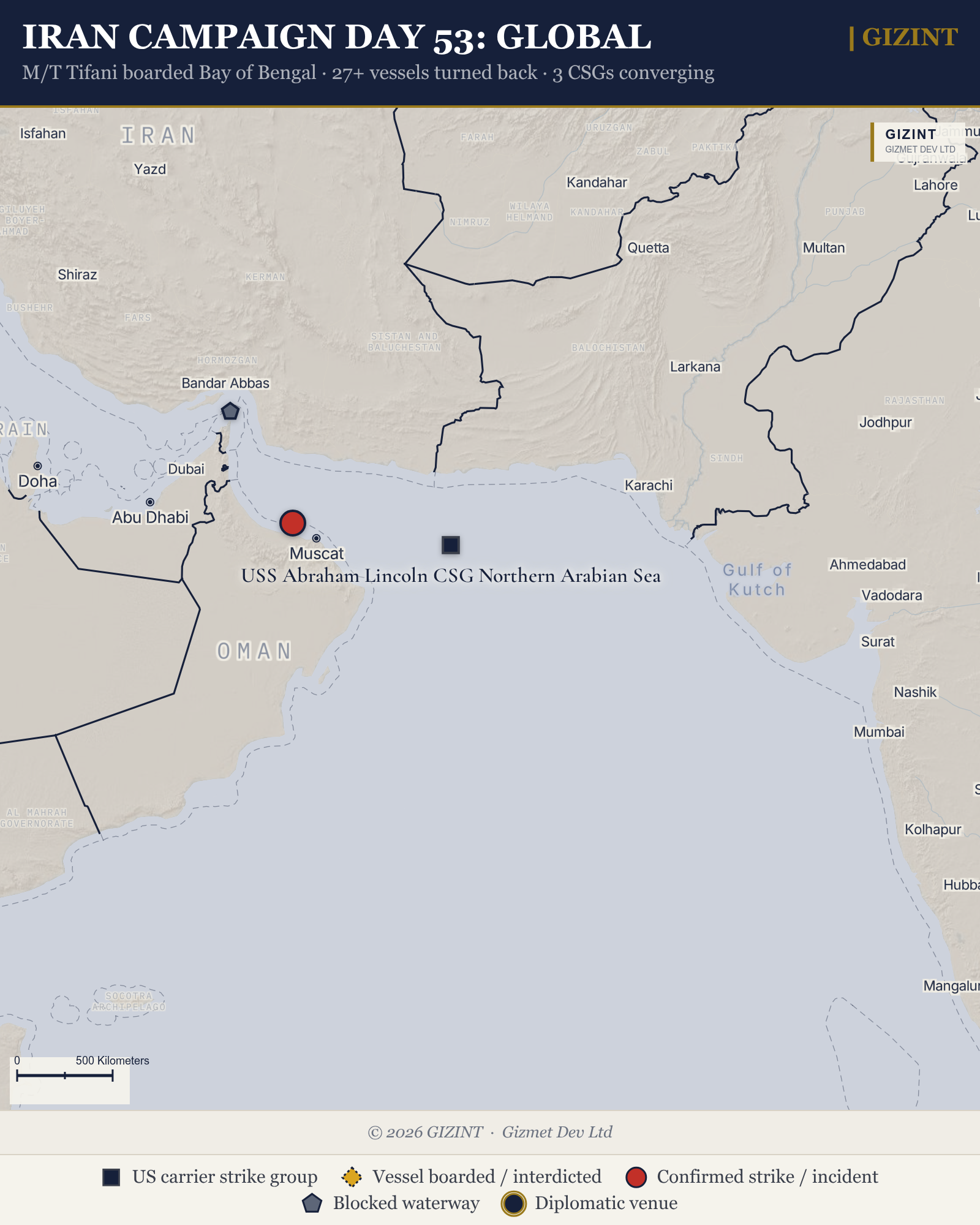
- Global blockade: The M/T Tifani boarding in the Bay of Bengal marks the first US interdiction outside CENTCOM, the EU agreed to widen sanctions to target Hormuz obstruction, and OFAC's silence on GL-U Day 3 is hardening the financial chokepoint into permanence.
- Lebanon degrading: Hezbollah rockets wounded five IDF soldiers during the ceasefire, a French UNIFIL peacekeeper was killed, and the death toll rose to 2,454; Thursday's Washington talks are the last bridging mechanism before the ~26 Apr expiry.

Ceasefire Terminal Phase; No Delegation, Competing Clocks, Global Enforcement
The Iran ceasefire expires as early as tonight under Pakistan's reading of the instrument, with no confirmed Iranian delegation for Islamabad Round 2, while the US expanded the blockade to a global interdiction campaign.
Changed from prior assessment: ceasefire under maximum stress but not formally dead. Now: terminal phase with structural barriers to extension multiplying on both sides.
The ceasefire announced 7 April expires with incompatible timelines. Trump told CNBC it ends "Wednesday evening Washington time"; Pakistan's Information Minister Tarar stated 4:50am PKT Wednesday, which is 7:50pm EDT Tuesday. This is roughly a 24-hour gap: either the instrument is ambiguous or the parties have fundamentally different readings. If the Pakistani clock is correct, expiry falls during Asian trading hours tonight, before either delegation arrives.
VP Vance is expected to depart Tuesday evening with Witkoff and Kushner (Axios, 21 Apr); a White House official told Reuters he had not departed as of late afternoon. IRIB confirmed no Iranian delegation has travelled and the Foreign Ministry stated "no final decision" on participation. Iran will send Ghalibaf only if Vance attends; the White House is waiting for an Iranian signal before confirming. Neither delegation will arrive before the ceasefire may have already expired.
The Critical Threats Project / Institute for the Study of War (CTP-ISW) reported on 20 April that IRGC Commander Maj Gen Ahmad Vahidi is reportedly the sole conduit to Supreme Leader Mojtaba Khamenei. US officials told Axios: "We aren't sure who's in charge and neither do they." The IRGC told the Round 1 delegation that they "don't speak for" the IRGC; Axios reported on 20 April that former IRGC Intelligence Organisation Chief Hossein Taeb recalled the delegation after it exceeded its mandate. We assess any deal reached at R2 faces the same ratification problem as R1: the people at the table do not control the outcome.
FM Araghchi completed Iran's four-branch convergence: "Blockading Iranian ports is an act of war and thus a violation of the ceasefire. Striking a commercial vessel and taking its crew hostage is an even greater violation" (X, 21 Apr). This is the strongest MFA framing of the campaign, collapsing the last institutional holdout into the war preparedness consensus. Ghalibaf separately stated Iran has "prepared to reveal new cards on the battlefield" (21 Apr). The JCPOA precedent of last-minute participation remains available, but the MFA's "act of war" shift narrows the space for reversal.
The M/T Tifani boarding in the Bay of Bengal (Pentagon, 21 Apr) is the first interdiction outside CENTCOM's area of responsibility, signalling global enforcement. CENTCOM counts at least 27 vessels turned back (20 Apr). The IEA's Executive Director declared this "the biggest energy crisis in history" (France Inter, 21 Apr), with the agency estimating 12 million barrels per day lost from Hormuz, exceeding the 1973, 1979 and 2022 crises combined (IEA, Apr 2026).
What changes if this assessment is wrong: If Iran dispatches a delegation to Islamabad within 12 hours and the ceasefire receives even a 72-hour verbal extension, the terminal-phase framing reverses and the market reprices rapidly. The IRGC veto through Vahidi remains the structural constraint on any deal regardless.