





























GIZINT — The Daily Brief | Issue 048
Iran's last off-ramp closed: the decoupled proposal was rejected, GRU chief Kostyukov's presence signals Moscow owns the file, and binding constraints price reopening in 2027.
We assess Iran's last diplomatic off-ramp closed today: the decoupled proposal was rejected, GRU chief Kostyukov's presence at the Putin-Araghchi meeting signals Moscow has taken operational ownership of the file, and the binding constraints now price Hormuz reopening in 2027 regardless of what any negotiator offers. The convergence of FISA 702 expiry, WPR Day 60, and CISA's emergency device-reset directive between Thursday and Friday creates the most compressed simultaneous test of Article I, Article II, and executive emergency authority in recent legislative memory, while Congress hosts the British monarch on the one day the House needs to advance surveillance reauthorisation.
Diplomatic closure: Iran's decoupled proposal rejected; Trump: "not enough." GRU chief Kostyukov at the Putin-Araghchi bilateral signals Moscow owns the operational file. Hull war reinsurance and mine clearance price reopening in 2027, not diplomacy. Lebanon fracture: President Aoun accused Hezbollah of treason; Hezbollah declared readiness for "martyrdom squads"; UNIFIL KIA now 7 including 2 French soldiers; IDF's "Yellow Line" has no ceasefire-text authority. Four-day convergence: FISA 702 expires Thursday midnight, WPR Day 60 hits Friday, CISA hard-reset deadline Thursday; CISA at 38% staffing with no director; King Charles addresses Congress Tuesday on the one day the House needs to advance FISA; NPT Review Conference opens today.

Iran's Last Off-Ramp Rejected; Kostyukov's Presence Signals Moscow Owns the File
Changed from prior assessment: decoupled proposal was a live diplomatic track. Now: rejected. GRU principal at the bilateral confirms Moscow holds the operational file, not the diplomatic one. No alternative path to reopening exists within the insurance and mine-clearance timelines.
Iran's decoupled proposal would separate Hormuz reopening from nuclear negotiations (Axios, 27 Apr). Trump: "not enough." The proposal was structurally costless to Tehran: every phase Iran controls precedes the nuclear file Washington needs. The rejection closes the last channel that could have bypassed the binding constraints.
GRU chief Kostyukov sat with Putin for the Araghchi meeting (Al-Monitor, 27 Apr). Putin uses the GRU principal when a file has operational-military equities, not diplomatic ones. The intermediary channel is exhausted; bilateral direct contact remains, conditional on movement Washington cannot offer. Germany's Merz stated he cannot see a convincing US strategy for ending the war (DPA via Al Jazeera, 27 Apr); we assess this is among the sharpest such rebukes by a NATO Chancellor in decades.
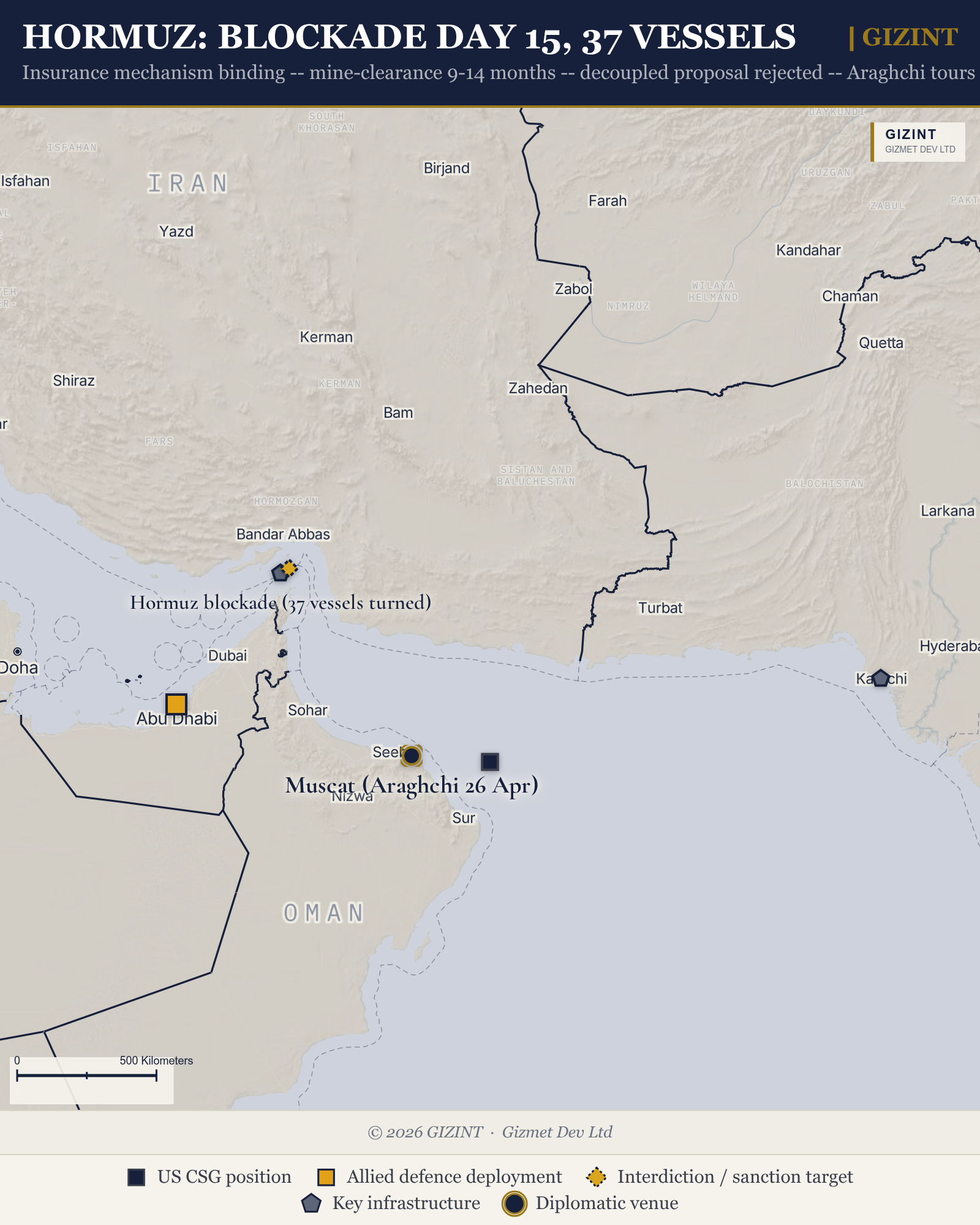
The binding constraints are now deterministic. The International Group of P&I Clubs collectively withdrew coverage on 5 March; war-risk premiums rose from approximately 0.25% to 2.5-7.5% of hull value. Hull war reinsurance treaties renew 1 January and 1 April; even a ceasefire would not reset premiums until the 1 January 2027 cycle. Twenty-plus mines require 9-14 months to clear. Brent closed $108.11 on 27 April (Trading Economics), up from Friday's $105.30; the oil price is not the reopening constraint.
Germany is preparing to deploy minesweeper Fulda, contingent on a cessation of hostilities, the first European mine-clearance commitment. CENTCOM reported 37 vessels redirected since blockade inception on 13 April (CENTCOM, 25 Apr).
Day 59 of the Iran campaign (count from 28 February). Blockade Day 15 (count from 13 April).
What changes if this assessment is wrong: If individual syndicates re-enter the Gulf war-risk market before the 1 January 2027 cycle, VLCC operators find workaround coverage and the supply shock becomes a spike, not a structural repricing.