










GIZINT — The Brief | Issue 051
We assess the next 24 hours constitute the sharpest decision point of the Iran campaign: CENTCOM briefs Trump today on three strike options including a Hormuz takeover while three legal pillars underpinning US military and intelligence operations degrade overnight.
We assess the next 24 hours constitute the sharpest decision point of the Iran campaign: CENTCOM briefs Trump today on three strike options including a Hormuz takeover while three legal pillars underpinning US military and intelligence operations degrade overnight.
Strike briefing today: CENTCOM presents three Iran options including a Hormuz seizure; Oman's rejection of Iran's toll proposal removes the last off-ramp; Brent spiked to a wartime high of $126.41 and is trading near $125. Ceasefire collapsed: One IDF soldier killed, thirteen wounded in two Hezbollah drone attacks; Israel asked Washington not to extend past 17 May; IDF Northern Command says forces 10km inside Lebanon will not withdraw. Legal framework fracturing: FISA 702 lapses at midnight (Senate blocked by CBDC rider); WPR Day 60 tomorrow with the ceasefire-clock theory no statute supports; CISA hard-resets federal firewalls at 38% staffing.
CENTCOM Briefs Strike Options as Hormuz's Last Off-Ramp Closes
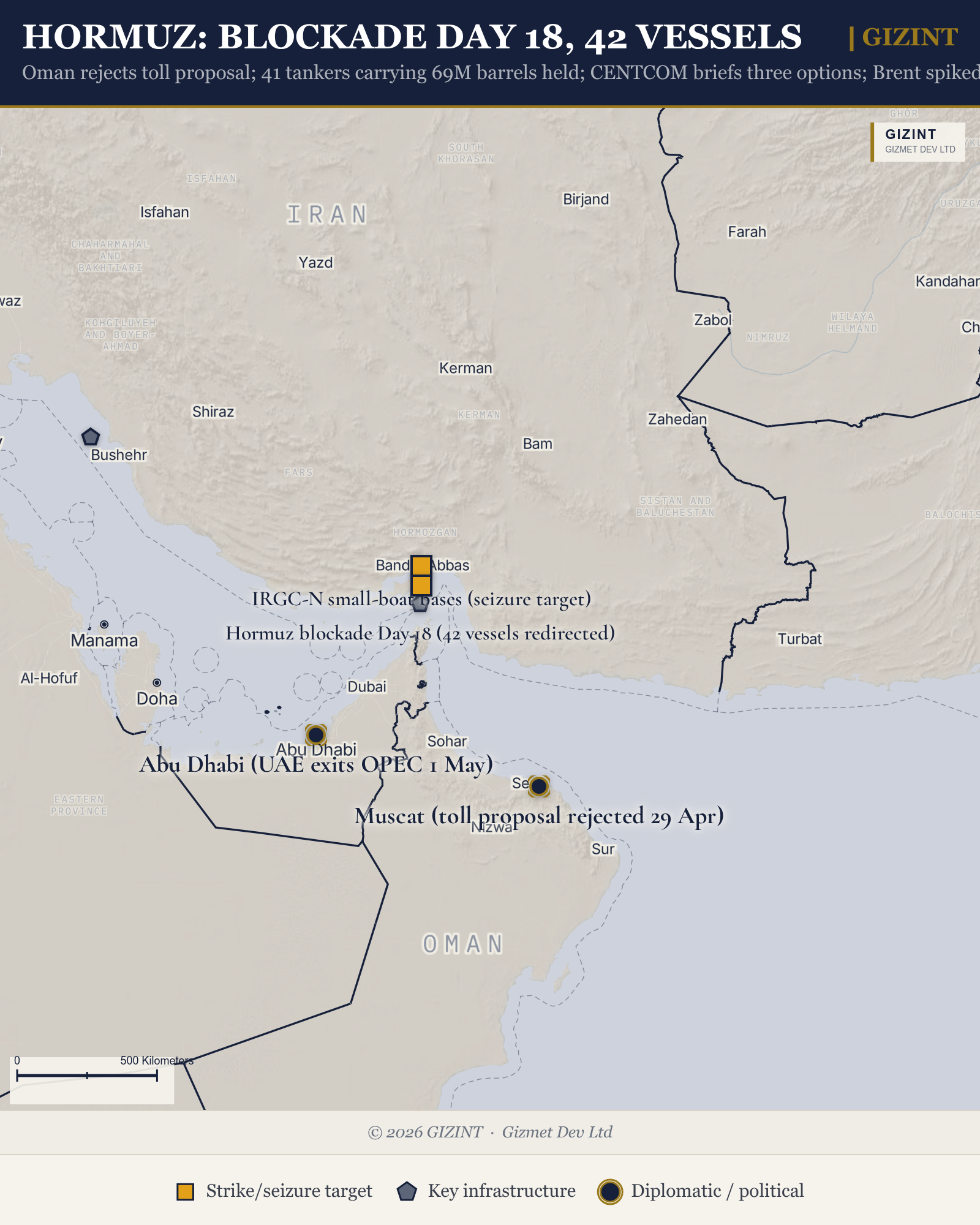
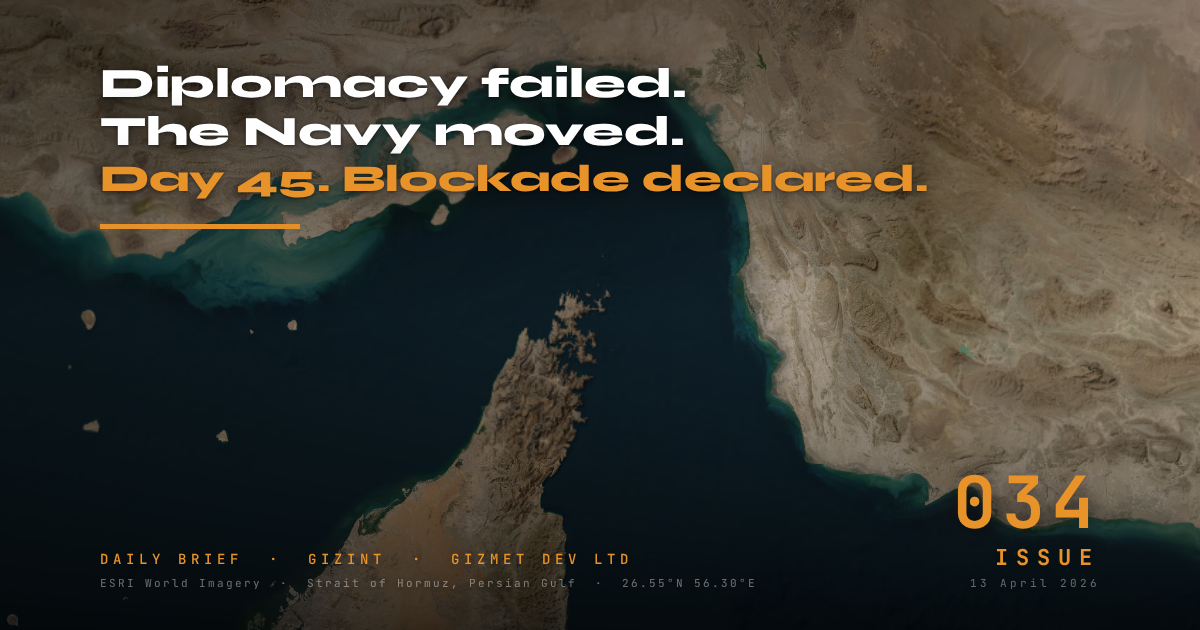
The CENTCOM commander and chairman of the Joint Chiefs will brief Trump today on three military options against Iran (infrastructure strikes, a forcible Hormuz strait seizure, and a special forces operation to secure enriched uranium) at the precise moment the last diplomatic off-ramp has closed (Axios, 30 Apr; CNN, 30 Apr). A Hormuz seizure is a concurrent force package: SEAD against the IADS on Qeshm and Larak, amphibious lift to take and hold the IRGC-N small-boat bases at Bandar Abbas, and mine countermeasures during the fight, not after. Available reporting indicates CENTCOM has limited Avenger-class MCM assets forward-deployed (Navy Times, 12 Mar); mine countermeasure capacity, not strike capacity, is the binding constraint. No post-WWII US operation maps cleanly onto this scope.
Oman rejected Iran's toll-sharing proposal on 29 April, removing Tehran's best option for presenting a "new proposal" without concessions (NY Post, 29 Apr via Critical Threats Project / Institute for the Study of War (CTP-ISW), 29 Apr). The IMO Secretary-General confirmed there is "no legal basis" for tolling Hormuz transit under UNCLOS (IMO, 27 Apr). CENTCOM has redirected 42 vessels since blockade inception, holding 41 tankers carrying 69M barrels worth over $6B (Admiral Cooper, CENTCOM, 30 Apr). Brent reached a wartime high (ICE, 30 Apr).
WPR Day 60 falls tomorrow. Defence Secretary Hegseth told the SASC today the 60-day clock "pauses or stops" during the ceasefire (CSMonitor, 30 Apr); Senator Kaine rejected it on the record. Every US administration since the WPR's 1973 enactment has treated the 60-day clock as absolute, pausable only by withdrawal or congressional action. Reagan's 1982 Lebanon deployment ran past Day 60 only after S.J. Res. 159; the 2011 Libya operation relied on Krass OLC redefining "hostilities." Hegseth's tolling theory is structurally weaker. "The clock paused" is not the same legal basis as "this isn't hostilities."
Inside Iran, CTP-ISW assessed (29 Apr) that IRGC Major General Vahidi maintains near-exclusive access to Supreme Leader Mojtaba Khamenei and has consolidated the hardline position. With Vahidi as sole conduit, Tehran's maximalist register is structural; no moderating second channel exists. The rial hit a record low; the SNSC convened on protest risk. Iran is regenerating missile and drone forces during the ceasefire, though factories and logistics remain difficult to reconstitute rapidly.
We assess the Hormuz takeover option is most likely actioned if Iran does not present a new proposal within 72 hours; it resolves the dual-closure stalemate.
Changed from prior: diplomatic tracks remained open through Pakistan and Oman. Now: all four tracks stalled or narrowing; Oman channel narrowed after toll rejection.
What changes if this assessment is wrong: If Iran tables a credible revised proposal before the weekend, or the briefing produces a decision to extend the blockade without escalation, the strike-option window closes.