


GIZINT — The Daily Brief | Issue 049
We assess the UAE's unilateral exit from OPEC, announced without consulting Riyadh hours before a GCC emergency summit, is the clearest signal that the Hormuz crisis is disaggregating Gulf institutions faster than any diplomatic process can repair them.
We assess the UAE's unilateral exit from OPEC, announced without consulting Riyadh hours before a GCC emergency summit, is the clearest signal that the Hormuz crisis is disaggregating Gulf institutions faster than any diplomatic process can repair them. Brent breached $111 on the same day three US institutional deadlines converge in 72 hours with no resolution mechanism.
- OPEC fractured: The UAE quit OPEC effective 1 May, stripping the cartel of its third-largest producer and driving Brent to $111; the GCC emergency summit in Jeddah is damage control for a fracture that already happened.
- Lebanon eroding: Israel expanded strikes to the Bekaa Valley and issued 12+ new evacuation orders on Ceasefire Day 13, with UNIFIL documenting 299 incidents of Israeli fire since 16 April; Hezbollah called the ceasefire "meaningless."
- 72-hour crunch: FISA 702 expires Thursday midnight, WPR Day 60 arrives Friday, and CISA's hard-reset directive requires federal Cisco firewall reports by tomorrow and physical power-cycling by Thursday, while Congress cannot address all three.

UAE Quits OPEC as Hormuz Blockade Fractures Gulf Consensus
The UAE announced withdrawal from OPEC and OPEC+ effective 1 May, stripping the cartel of its third-largest producer and driving Brent to $111, a three-week high (ICE, 28 Apr).
Abu Dhabi did not consult Riyadh (Bloomberg, Al Jazeera, 28 Apr). The exit landed hours before a GCC emergency summit in Jeddah. Anwar Gargash had called the GCC response "the weakest in history" 24 hours earlier (The National, 27 Apr). The UAE absorbed 550+ missiles and 2,200+ drones since 28 February; OPEC offered neither production flexibility nor security coordination. This is the first member departure in OPEC history during an active supply crisis, and the first without secretariat coordination; Indonesia (2008/2016) and Qatar (January 2019) left in peacetime with months of notice. We assess the exit is the fiscal-political prerequisite for prolonged conflict posture, not a commercial grievance.
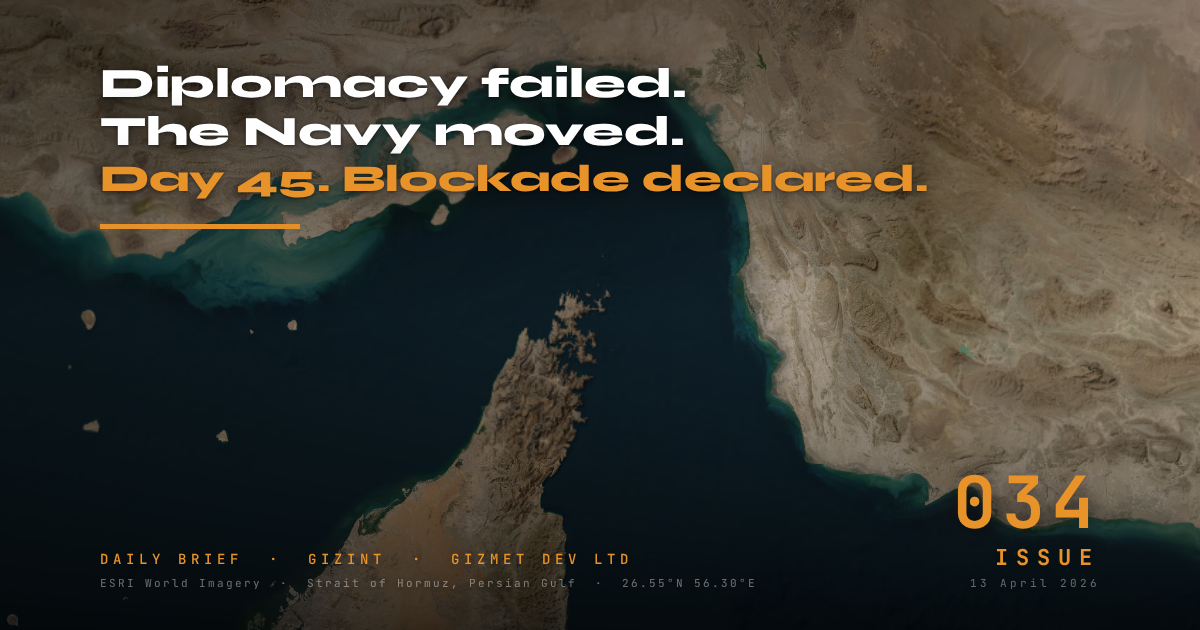
Near-term supply impact is limited; freed capacity cannot reach market while the strait remains closed (7 vessels/day versus 140 pre-war; MarineTraffic, 28 Apr). The structural consequence: the exit reduces OPEC swing capacity by approximately 1M bpd. The Iron Dome battery deployed to the UAE (Axios, 26 Apr), the first Israeli system abroad, is the bilateral alternative made concrete.
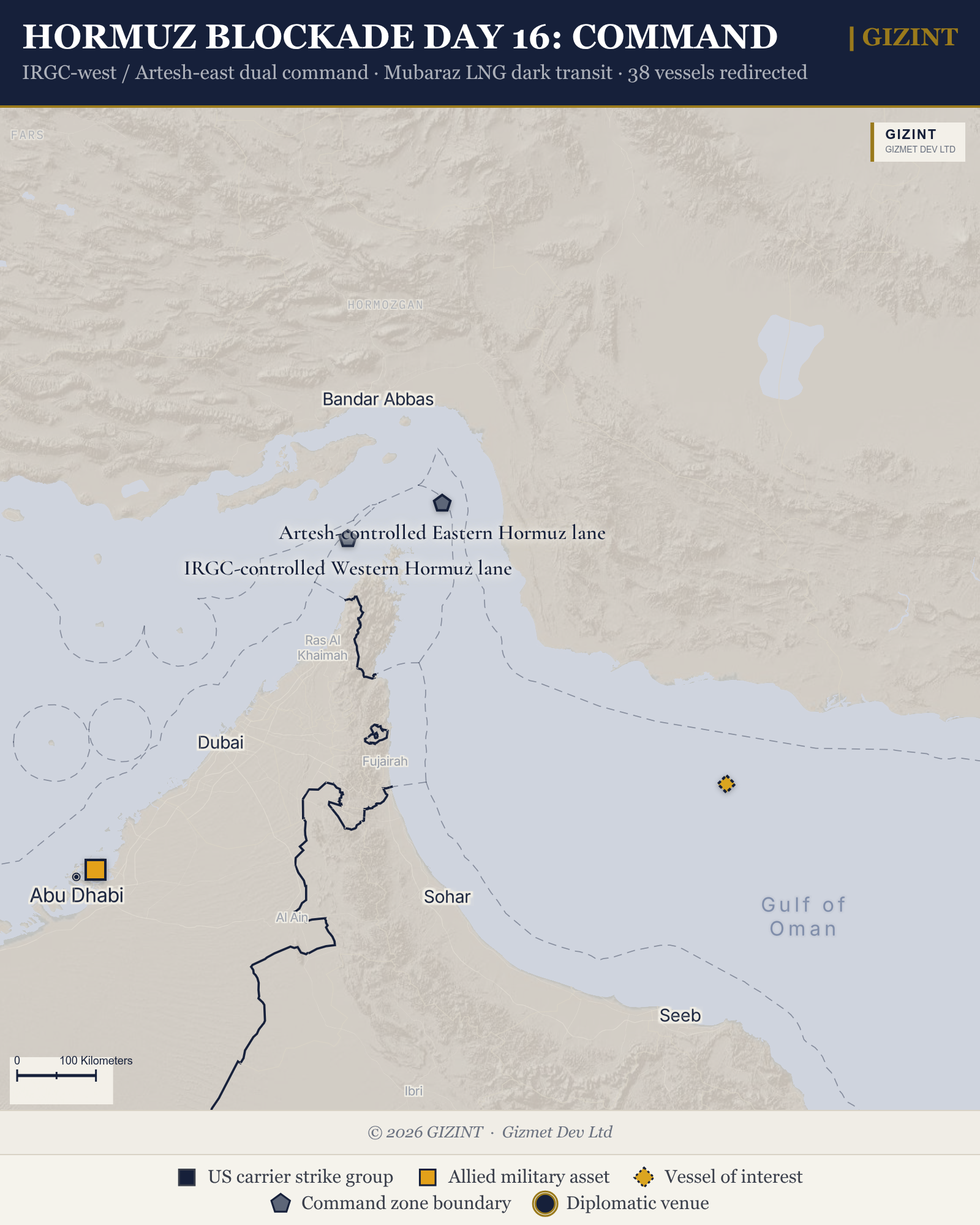
The first LNG tanker since 28 February crossed Hormuz. The ADNOC vessel Mubaraz reappeared off India's west coast signalling a Chinese port for mid-May delivery after AIS dark-running through the strait (ICIS LNG Edge, MarineTraffic, 28 Apr). As reported by Al Jazeera (28 Apr), an Iranian army spokesman stated that the IRGC controls the western portion of Hormuz and the Artesh (regular army) controls the eastern portion. IRGC and Artesh have shared responsibility for the strait since a 2007 reorganisation; the new element is the explicit geographic delineation. Two prior Qatari LNG attempts through the western lane failed; the Mubaraz transit through the strait during the blockade is a single event, not evidence of systematic reopening. The 1986-88 EARNEST WILL precedent demonstrated that IRGC engagements could provoke US responses the Artesh could not constrain; dual-command arrangements at Hormuz reproduce this dynamic.
Trump posted on Truth Social (28 Apr) that Iran was "in a State of Collapse." An Iranian military spokesman responded within hours that "the situation is still considered wartime." CENTCOM: 38 vessels redirected (27 Apr).
Changed from prior assessment: blockade as insurance mechanism enforcing closure. Now: the crisis is disaggregating collective institutions (OPEC, GCC) through commercial pressure before diplomacy can respond.
What changes if this assessment is wrong: If the GCC summit produces a joint defence communique with specific military commitments and OPEC maintains quota discipline at the 3 May meeting, the fracture is contained and the UAE exit is an isolated grievance.