





GIZINT Daily Digest — 22 April 2026
Right, let’s get to it. It’s the 22nd of April. Here’s what you need to know.
Right, let's get to it.
It's the 22nd of April. Here's what you need to know.
Iran's Revolutionary Guard seized two European-flagged container ships about nine hours after Trump declared the ceasefire "open-ended," and the ceasefire never had a second signature. A second French soldier died today in France from wounds sustained in last week's Lebanon ambush. Ukraine's deep strikes have, by Reuters estimate, knocked roughly 300,000 to 400,000 barrels a day out of Russia's oil production. Germany halved its 2026 growth forecast, the first real-economy price tag on the war. A Washington research body published what it calls the first direct evidence of UAE involvement in a mercenary operation in Sudan. And a 72-hour Boko Haram deadline on 416 Nigerian women and children passed with no government response.

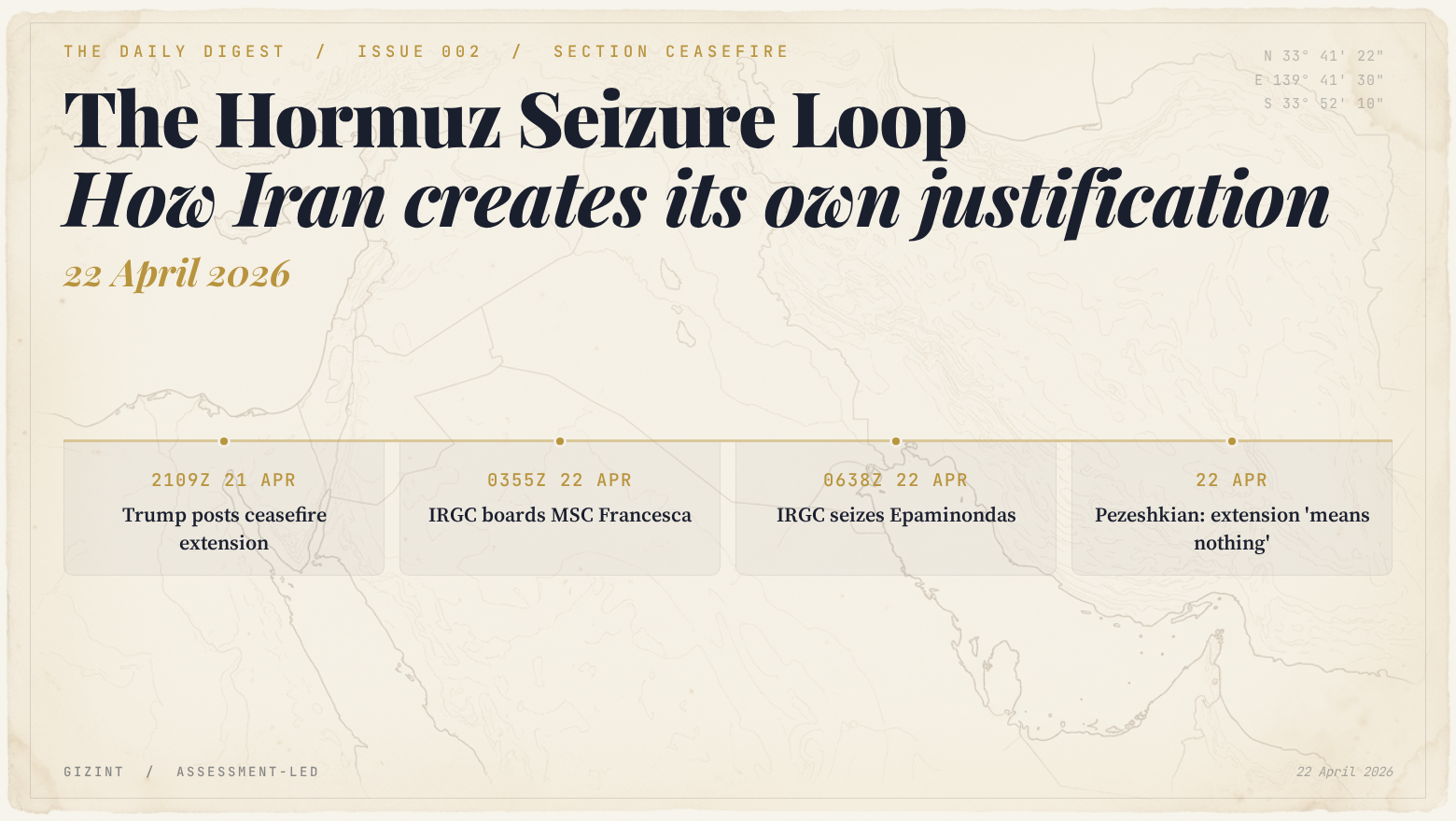
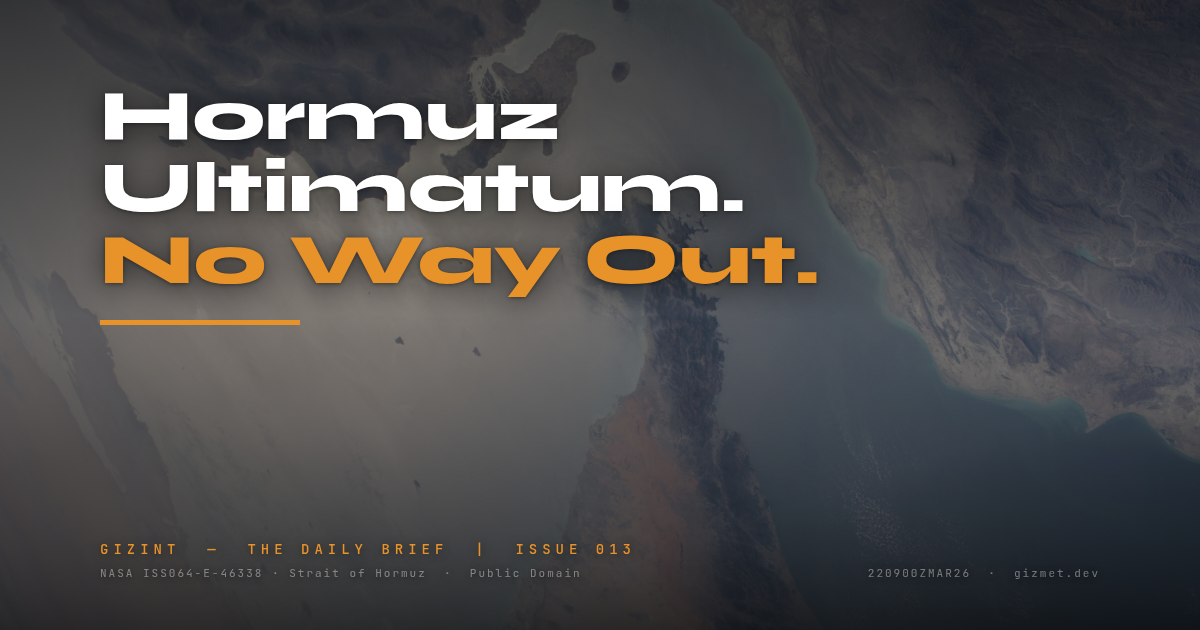
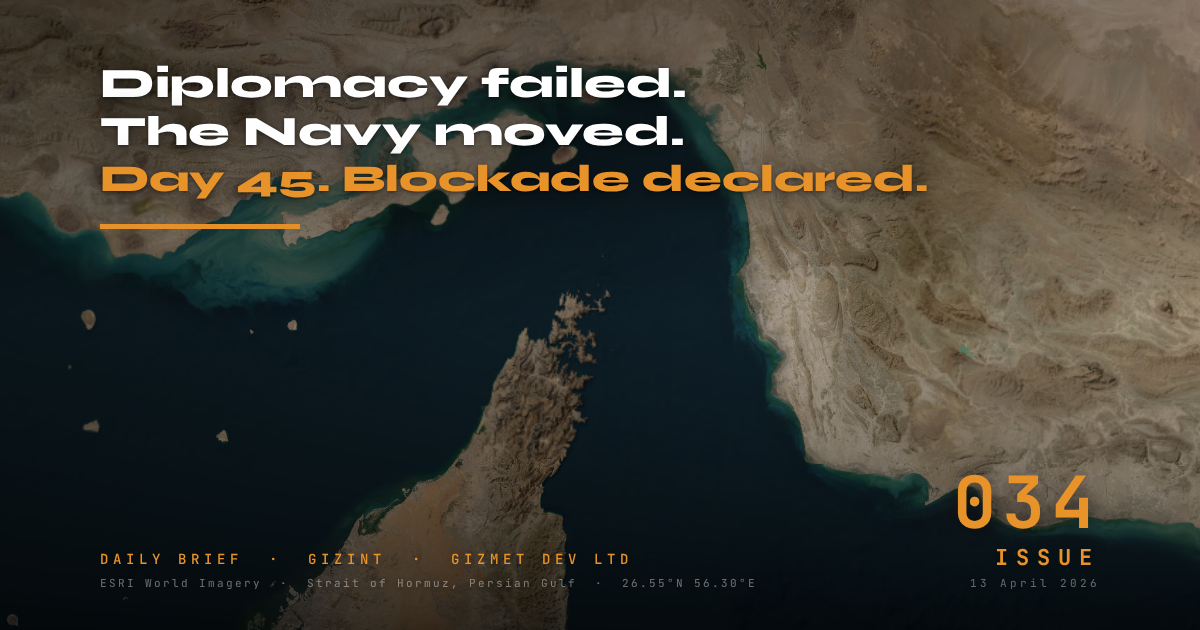
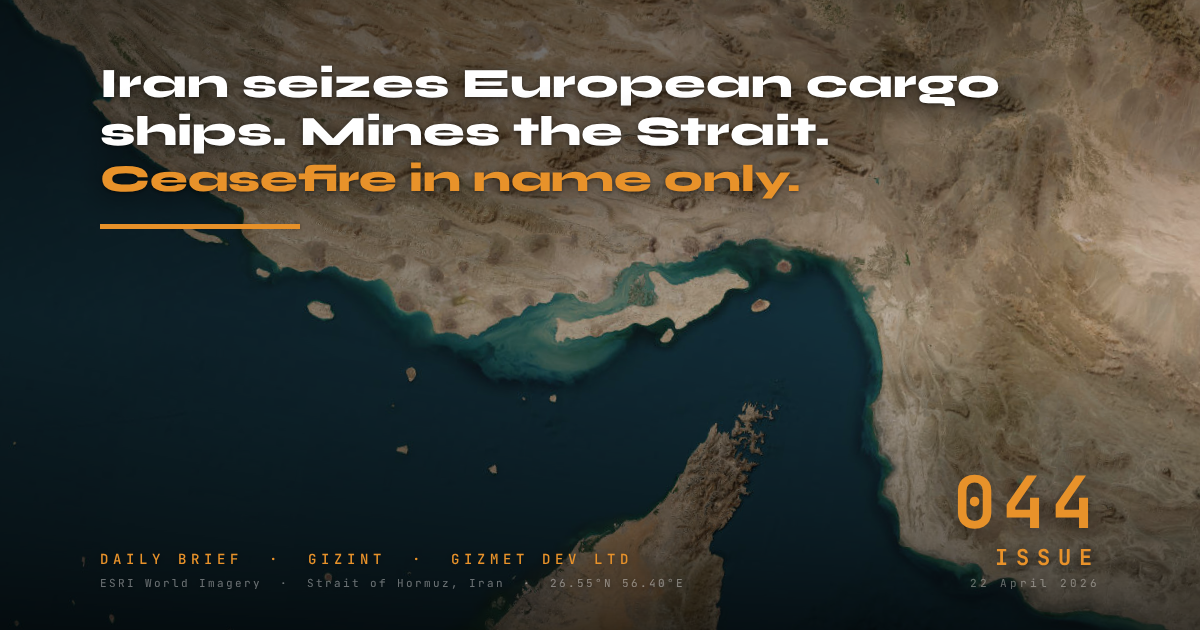
At 2109Z last night, Donald Trump posted that the ceasefire with Iran was being extended "indefinitely." Roughly nine hours later, between 0355Z and 0638Z this morning, the Islamic Revolutionary Guard Corps Navy boarded and seized two commercial container ships in the Strait of Hormuz. The MSC Francesca, Panama-flagged. The Epaminondas, Liberia-flagged, Greek-owned. Fars news agency reported a third vessel, the Euphoria, came under fire. The Epaminondas had confirmed permission from the UK Maritime Trade Operations centre to transit. The IRGC accused the Epaminondas of "tampering with navigation systems" and claimed the MSC Francesca had "links to Israel."
This is worth slowing down on. Windward, a maritime intelligence firm, has documented over 1,650 ships affected by GPS and AIS jamming in the Gulf since February, traced to an IRGC exercise called "Smart Control of the Strait of Hormuz." The shipping-data firm Tradlinx estimates AIS signals in the strait now underreport actual traffic by roughly half, because ships turn their transponders off to avoid being targeted. So the sequence is: Iran degrades the satellite navigation, ships go dark to protect themselves, Iran then cites "going dark" as grounds for seizure. It's a closed loop. Masters and insurers should treat any Hormuz transit as carrying standing seizure risk, on grounds the IRGC itself is generating.
The wider point is that the ceasefire Trump extended last night does not exist on the other side of the table. President Pezeshkian said today that "breach of commitments, blockade and threats are main obstacles to genuine negotiations." Foreign Minister Araghchi called the US blockade "an act of war." A senior Iranian official told Time magazine the extension "means nothing." Vice President Vance's delegation to Islamabad collapsed when Iran refused to confirm attendance. The ceasefire exists on one side of the table.
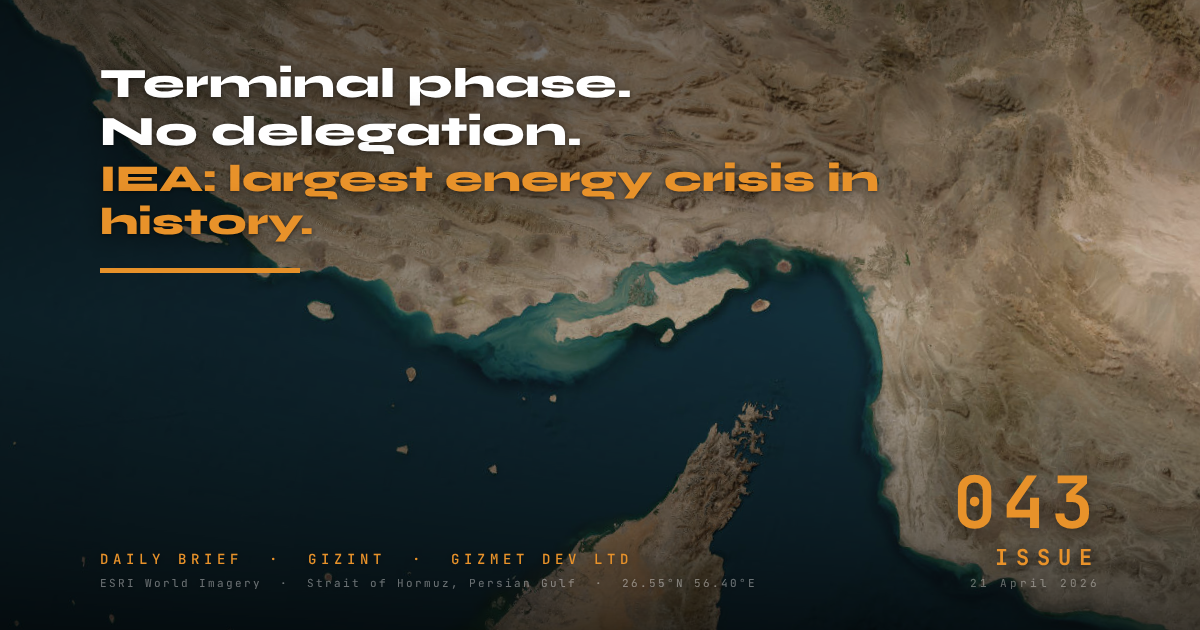
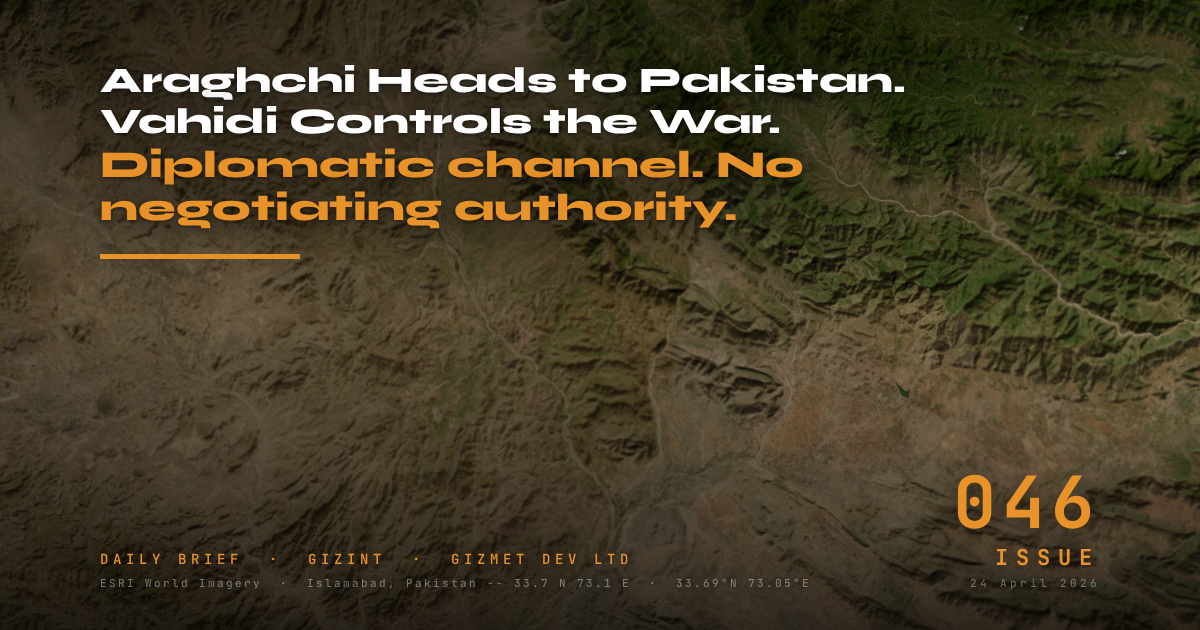
And here is the structural bit the Critical Threats Project at the Institute for the Study of War (CTP-ISW) flagged yesterday. IRGC Commander-in-Chief Ahmad Vahidi has made lifting the US naval blockade a precondition for any talks at all. Parliamentary speaker Ghalibaf and the pro-talks clerics want negotiations. They have clerical and institutional backing. The reporting suggests Vahidi holds the operational veto. A ceasefire needs two parties. Right now the United States has no negotiating counterparty on the other side of the ceasefire it just extended.

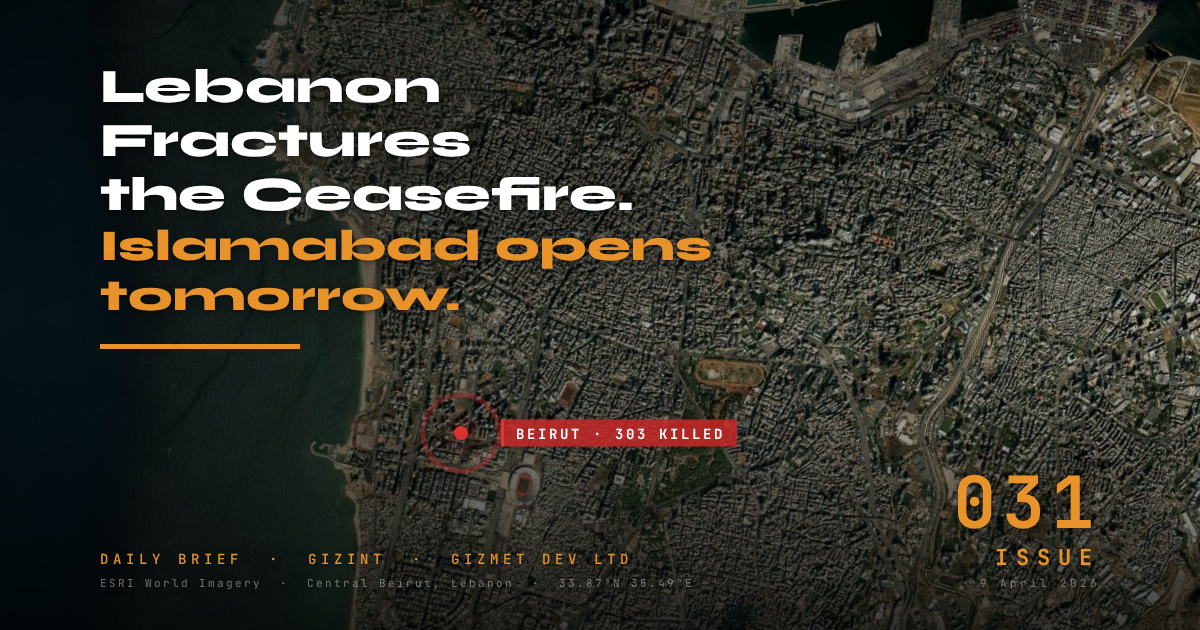
A second French soldier died today from wounds sustained in last week's Lebanon ambush. The Lebanon ceasefire hit Day 7 today, four days short of its scheduled 26 April expiry. Thursday's talks in Washington are the last bridge before it lapses.
The operational backdrop. Overnight, Israeli strikes killed four people in southern Lebanon; one hit a car in at-Tiri village killing two, a follow-up strike on the same village wounded several journalists. Earlier, Hezbollah launched a drone at an Israeli artillery position, which the Israel Defense Forces intercepted, the latest Hezbollah strike in a week of cross-truce fire that included a rocket barrage at Kfar Giladi the day before wounding five Israeli soldiers. The IDF also disclosed that its 769th "Hiram" Brigade conducted a raid on the village of Dibbine, hitting 70 sites and killing more than 20 people.
Then, today, a second French coffin. Caporal-chef Anicet Girardin of the 132nd Cynotechnical Infantry Regiment at Suippes, the French army's dog-handling unit, died today in France from wounds sustained in the 18 April ambush at Ghandouriyeh. Staff Sergeant Florian Montorio of the 17th Parachute Engineer Regiment was killed outright in the same ambush. Macron announced Girardin's death today. UNIFIL's killed-in-action total now stands at five: three Indonesian peacekeepers killed in late March, and two French soldiers in April. Three additional French peacekeepers from the same patrol remain seriously wounded.
Thursday's meeting is meant to produce a one-month extension. Lebanon wants more time. Israel is bringing three conditions: a buffer zone to the Litani river, continued operational freedom, and Hezbollah disarmament. None of those conditions are in the text of the current ceasefire. They're new asks. Hezbollah is not at the table. The negotiation is about whether Israel's asks, which Lebanon cannot deliver and Hezbollah will not consent to, can be made to fit into a 30-day extension paper. If Thursday produces nothing, the truce expires Sunday, three days before the European Central Bank, the Bank of England, the Federal Reserve, and the War Powers clock all land in the same 72-hour window.

While everyone watched Hormuz, Ukraine did something precise on the northern front.
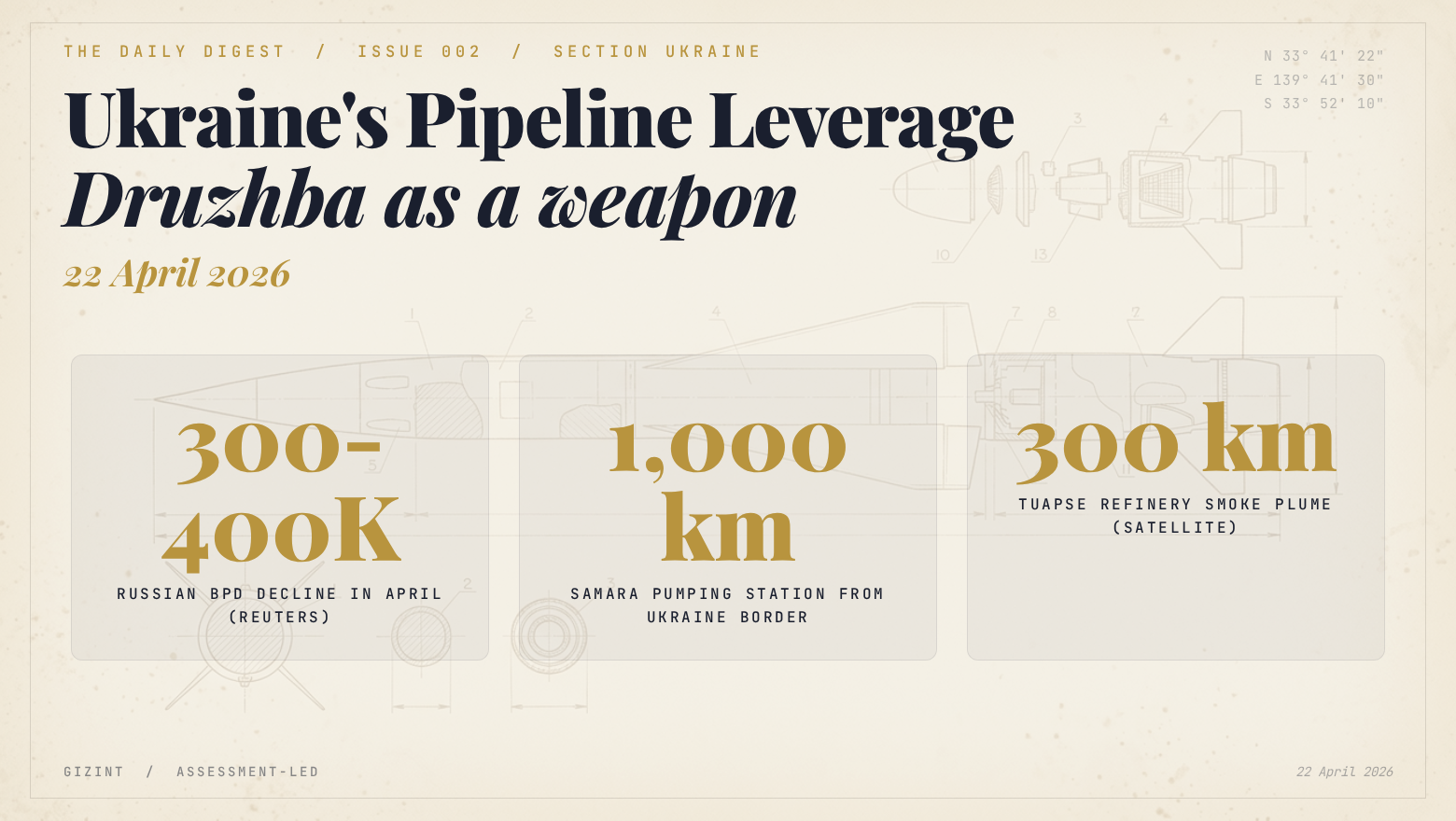
Ukraine's Security Service hit the Samara pumping station of the Druzhba pipeline overnight 20-21 April, about 1,000 kilometres from the Ukrainian border. This is the first deep-strike to threaten Druzhba's southern branch, which supplies Hungary, Slovakia, and the Czech Republic with Russian crude and which is specifically exempt from European Union sanctions. Hungary and Slovakia have spent months blocking EU aid packages for Ukraine, citing energy security. Today Ukraine demonstrated, with one strike, that it can turn the tap off.
Then, according to CNN and Moscow Times reporting, Ukraine announced it had completed earlier pipeline repairs and was ready to resume pumping. Hungary and Slovakia had been publicly accusing Kyiv of stalling those repairs. The timing was not subtle. The signal to Budapest and Bratislava is that Ukraine now treats the southern Druzhba branch as reversible leverage: fix when aid flows, break when it stalls. Unblock the aid package.
That sits on top of a broader campaign that has now produced a measurable result. Reuters reported yesterday that Russian crude production fell by an estimated 300,000 to 400,000 barrels per day in April, the sharpest monthly decline since 2020. NASA satellite imagery of the Tuapse refinery strike on 20 April shows a 300-kilometre smoke plume. Tuapse is one of Russia's top ten refineries.
The compounding matters. Brent is above $100 partly because Iranian exports are constrained by the US blockade. But Russia can't fully capitalise on those prices because Ukraine is shrinking Russia's sellable output at roughly the same speed. Any windfall Russia might have expected from the Iran-driven oil premium is being offset by Ukrainian strikes on refining capacity.

The continent produced two stories today that deserve a proper look.
First, Sudan. The Conflict Insights Group, a Washington-based research body, published what its director Justin Lynch told the BBC is "the first research where we can prove UAE involvement with certainty" in the Rapid Support Forces' war against Sudan's army. The method is the thing. CIG tracked the phones of more than 50 Colombian mercenaries between April 2025 and January 2026 using commercial advertising-technology data, flight records, and satellite imagery. The data placed the mercenaries in the United Arab Emirates during transit, then in RSF-controlled territory in Sudan. The mercenary unit styled itself the "Desert Wolves" brigade. Its drone operations coincided with the siege of El Fasher, which fell in October 2025 and which United Nations investigators have said bears hallmarks of genocide. The UAE has previously rejected such allegations as "false and unfounded." Colombian President Gustavo Petro called the mercenaries "spectres of death." A parallel UN Panel of Experts report in the Washington Post yesterday added Libya as a transit channel.
Second, Nigeria. On Sunday 19 April, Boko Haram released a video giving the Nigerian government 72 hours to pay 5 billion naira for 416 women and children abducted from Ngoshe in Gwoza, Borno State, during a 4 March attack on a military base. It is the largest Boko Haram kidnapping in recent years. The deadline has passed. There is no confirmed payment, no confirmed mass killing, and no public statement from the Nigerian government. The silence is the story. Two years ago a deadline like this would have produced immediate international attention. This one did not.
Meanwhile the Alliance of Sahel States, the confederation of Mali, Burkina Faso, and Niger that broke from ECOWAS, raised its unified force target to 15,000 troops at a military chiefs' summit in Ouagadougou on 16 and 17 April. Vladimir Putin sent an envoy to Lomé on 18 April to invite the AES to the Russia-Africa summit. The African security order is reshuffling, against a silence on Nigerian hostages and fresh allegations of UAE material support for the Sudanese armed group that UN investigators say committed acts bearing hallmarks of genocide.

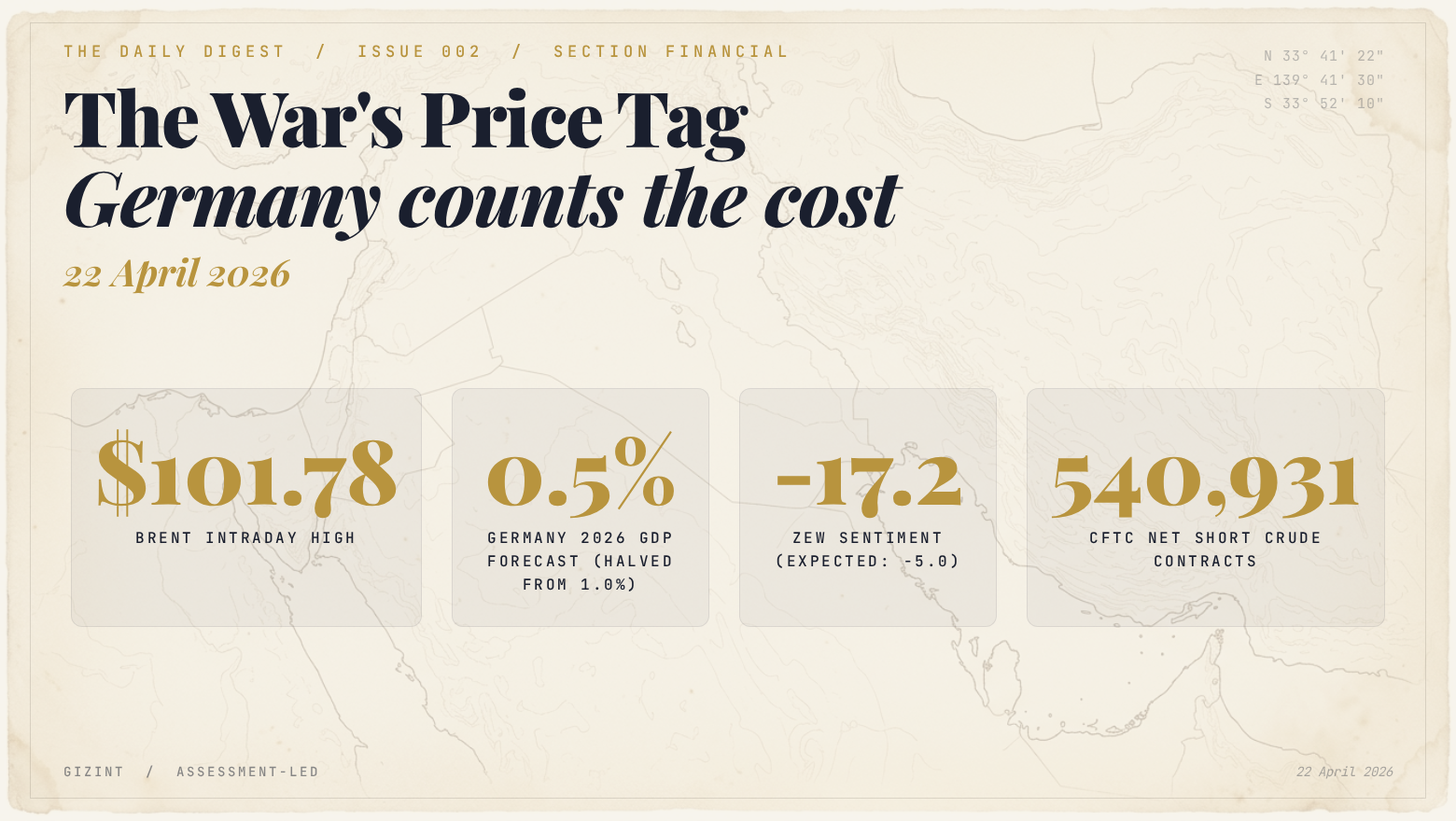
Brent breached $100 intraday again today, at $101.78, not the first crossing since mid-March. The underlying drivers have not changed since last week. What changed is that Berlin has now put a number on what the war is costing the real economy.
The German government halved its 2026 GDP growth forecast from 1.0% to 0.5% and cut 2027 from 1.3% to 0.9%. Economy Minister Katherina Reiche cited the war's impact on energy and shipping as a direct drag on the economy. The ZEW investor sentiment index, Germany's forward-looking confidence gauge of financial professionals, collapsed to minus 17.2, against an expected minus 5.0. This is the first concrete European quantification of what the war is costing a real economy. Germany is Europe's largest. The CFTC shows 540,931 net short crude contracts outstanding, which is a lot of traders betting oil will fall. If a tanker is seized in the strait, forced short-covering in an illiquid physical market can compound any price move; that dynamic contributed to Brent's jump from roughly $97 to $139 in two weeks after Russia's February 2022 invasion of Ukraine.
That puts the European Central Bank in a bind at its 30 April meeting. Energy-driven inflation argues for holding or hiking; collapsing business confidence argues for cuts.
And the sanctions regime is pulling in four directions. Treasury Secretary Scott Bessent told a Senate subcommittee today he extended the Russian oil sanctions waiver for another 30 days, reversing his 15 April position, "at the request of roughly 10 finance ministers" at last week's IMF and World Bank meetings. On the same day, the Office of Foreign Assets Control (OFAC), the US Treasury office that administers and enforces financial sanctions, has not published wind-down guidance on General Licence U, the permit covering Iranian oil payments already on the water, which expired on 19 April. Russian barrels stay in the market. Iranian payment channels go dark. And according to Bloomberg, at least two Iranian very-large crude carriers, the Hero II and the Hedy, sailed past the US blockade going dark on AIS around 20 April, part of a flotilla that moved roughly nine million barrels to market anyway.

Three legal clocks, on three continents, all moved today.
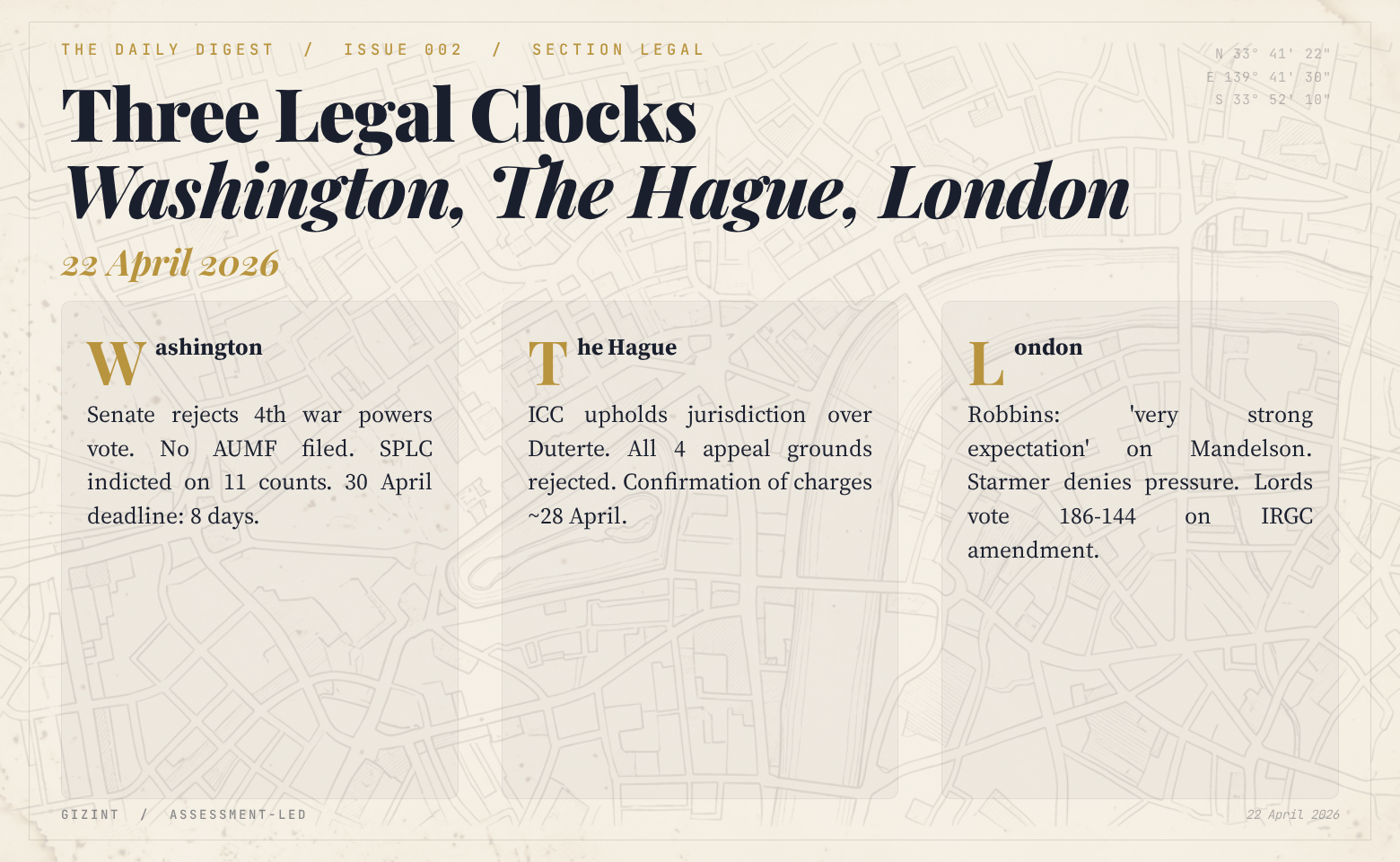
In Washington, the Senate rejected a Democratic war powers resolution on Iran along party lines, the fourth such rejection this year, according to Time. Roger Wicker, Republican chair of the Armed Services Committee, has not scheduled hearings before the 30 April deadline. Four votes down, no hearings scheduled, the statutory deadline eight days away. Senator Lisa Murkowski's draft authorisation for the use of military force has not been filed. There is no bill number. Separately, the Department of Justice unsealed an 11-count indictment of the Southern Poverty Law Center yesterday, alleging the organisation paid "at least $3 million to eight individuals" whom the indictment alleges were associated with far-right groups between 2014 and 2023. Acting Attorney General Todd Blanche said the SPLC was "manufacturing the extremism it purports to oppose." Interim SPLC chief executive Bryan Fair called the allegations "false." No plea has been entered. The allegations are unproven.
At The Hague, the International Criminal Court's Appeals Chamber today upheld jurisdiction over Rodrigo Duterte, rejecting all four grounds of his appeal. The ruling closes the "withdraw to escape" strategy as a matter of law: a state cannot evade prosecution for crimes alleged during its Rome Statute membership by leaving the statute afterwards. The decision on confirmation of charges is expected around 28 April.
And in London, the Prime Minister had a long day. Sir Olly Robbins, the former Foreign Office permanent secretary, told the Foreign Affairs Committee on Tuesday that Downing Street had a "very, very strong expectation" that Peter Mandelson be cleared for the Washington ambassadorship, and that UK Security Vetting's concerns had been overruled. At Prime Minister's Questions today, Sir Keir Starmer said "no pressure existed whatsoever in relation to this case." The government has opened a leak inquiry into how the Guardian obtained details of the vetting file. The Liberal Democrats have reported Starmer to his own ethics adviser. Bloomberg called him a "lame duck." The House of Lords voted 186 to 144 on 17 April to attach an IRGC designation amendment to the Crime and Policing Bill; the Commons considers it this week. The Ministry of Defence has not issued a ministerial statement on Iran since 8 April.

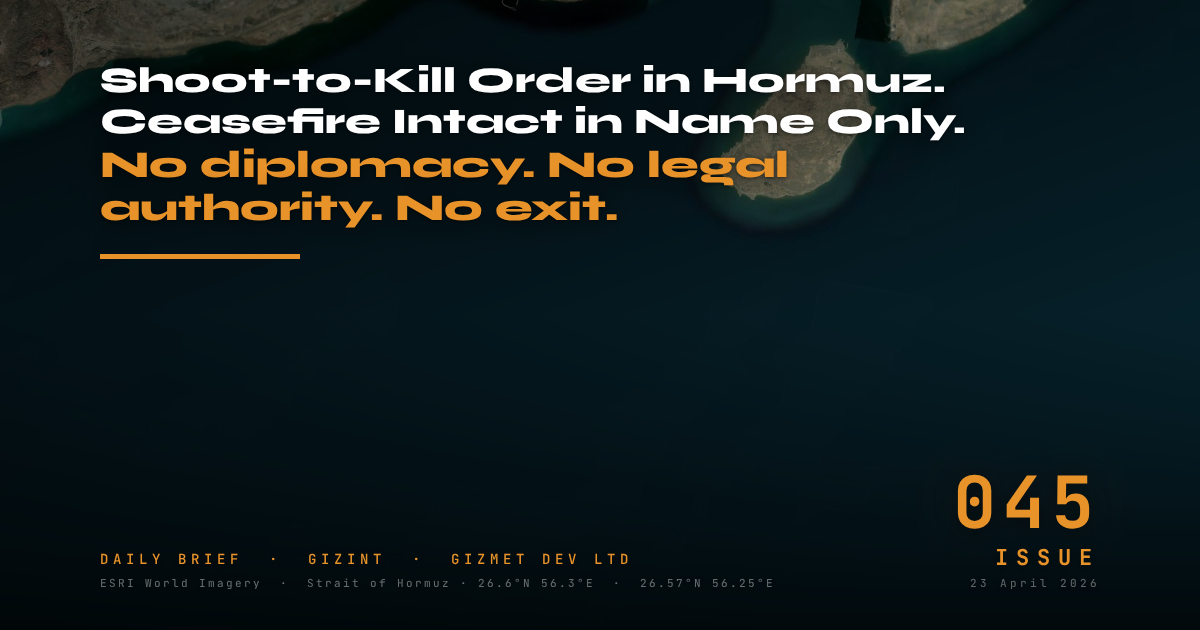
According to the Washington Post's reporting on a closed-door House Armed Services Committee briefing, US officials told legislators Iran has emplaced 20 or more sea mines in and around the Strait of Hormuz. Separate reporting suggests fewer than 10 have actually been laid.
The gap between 20 and 10 matters less than the fact that any are in the water at all. Even if the United States and Iran signed a comprehensive deal tomorrow, the Strait of Hormuz does not fully reopen this calendar year. Not because of the politics. Because of physical objects in the water that nobody knows the precise location of. The firms that repair submarine communication cables have already suspended operations in the strait indefinitely. Tasnim, Iran's semi-official news agency, today published a detailed map of Gulf submarine cable systems. Cables cut now would not be repaired. The strait has a physical expiry date, and diplomacy cannot move it. A ceasefire on paper is a different object from a ceasefire on the sea floor.
What to watch: Thursday's Washington talks on Lebanon are the last bridge before the 26 April expiry. If they produce nothing, a second front opens 48 hours before the Federal Reserve, European Central Bank, and War Powers deadlines all land in the same window on 29-30 April. Watch whether Iran seizes a tanker, not a container ship: that is the trigger that turns Brent's intraday $100 into a structural price. And watch the Commons vote on the IRGC proscription amendment this week, which could rewrite Britain's legal relationship with Iran's state apparatus regardless of anything the Foreign Office says.
The full analytical picture, including the Popular Mobilisation Forces crossing into Iran at Shalamcheh, the GCHQ director's CYBERUK remarks on China as a "peer competitor" in cyberspace, and the Sadara Chemical debt cliff on 15 June, is in today's Daily Brief.
GIZINT has no corporate sponsors and no donors.
That's not a limitation. It's the point.
Corporate reporters need steady paycheques from people who get to lean on the reporting. We chose a different model: you. $7 a month keeps it that way.
Every subscription is a vote for reporting that doesn't have to embellish the truth.
The full Daily Brief: Read today's.
The Digest: $7/month.
GIZINT Daily Digest. For informational purposes only. No editorial line. No advocacy. Assessment only. Errors: corrections@gizmet.dev