








GIZINT - Daily Digest - Issue 007
The UAE quit OPEC during a war. Lebanon's ceasefire is being broken at six times the UN review threshold. Gold is being sold while oil rises.

Right, let's get to it.
It's the 28th of April. Here's what you need to know.
The United Arab Emirates quit OPEC during an active war. The Lebanon ceasefire is being broken at roughly six times the rate that historically triggers a UN review of the mandate. And gold is being sold while oil rises, which is the kind of trading pattern that usually shows up before a margin call.

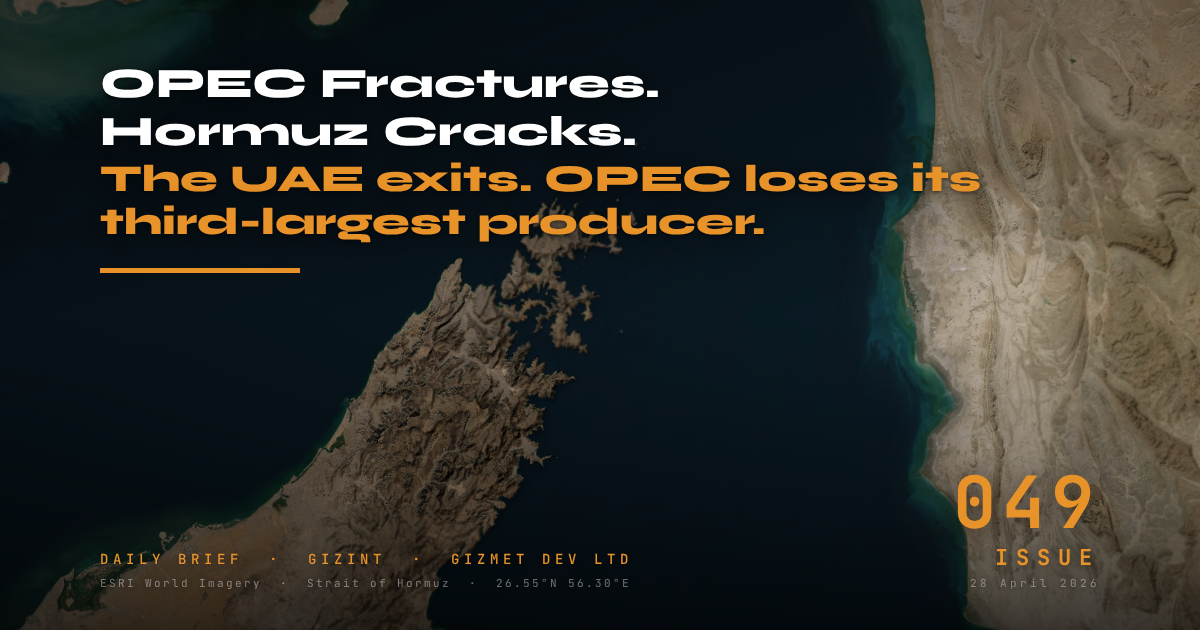
The United Arab Emirates announced its departure from OPEC effective 1 May. No member state has ever left during an active supply crisis. Indonesia left in peacetime in 2008 and again in 2016. Qatar left in 2019. The UAE timed its exit hours before the Gulf Cooperation Council emergency summit in Jeddah and did not consult Riyadh.
The summit produced no formal communique. Saudi Press Agency issued a single paragraph. Qatar's Emir posted online about a "unified Gulf stance" and the need to "intensify coordination." Before the summit, Qatar's foreign ministry spokesman Majed al-Ansari told Al Jazeera the bloc would not accept "a frozen conflict that ends up being thawed every time there is a political reason." Doha is publicly warning against a ceasefire-only outcome, which is the framework currently on the table in Washington.
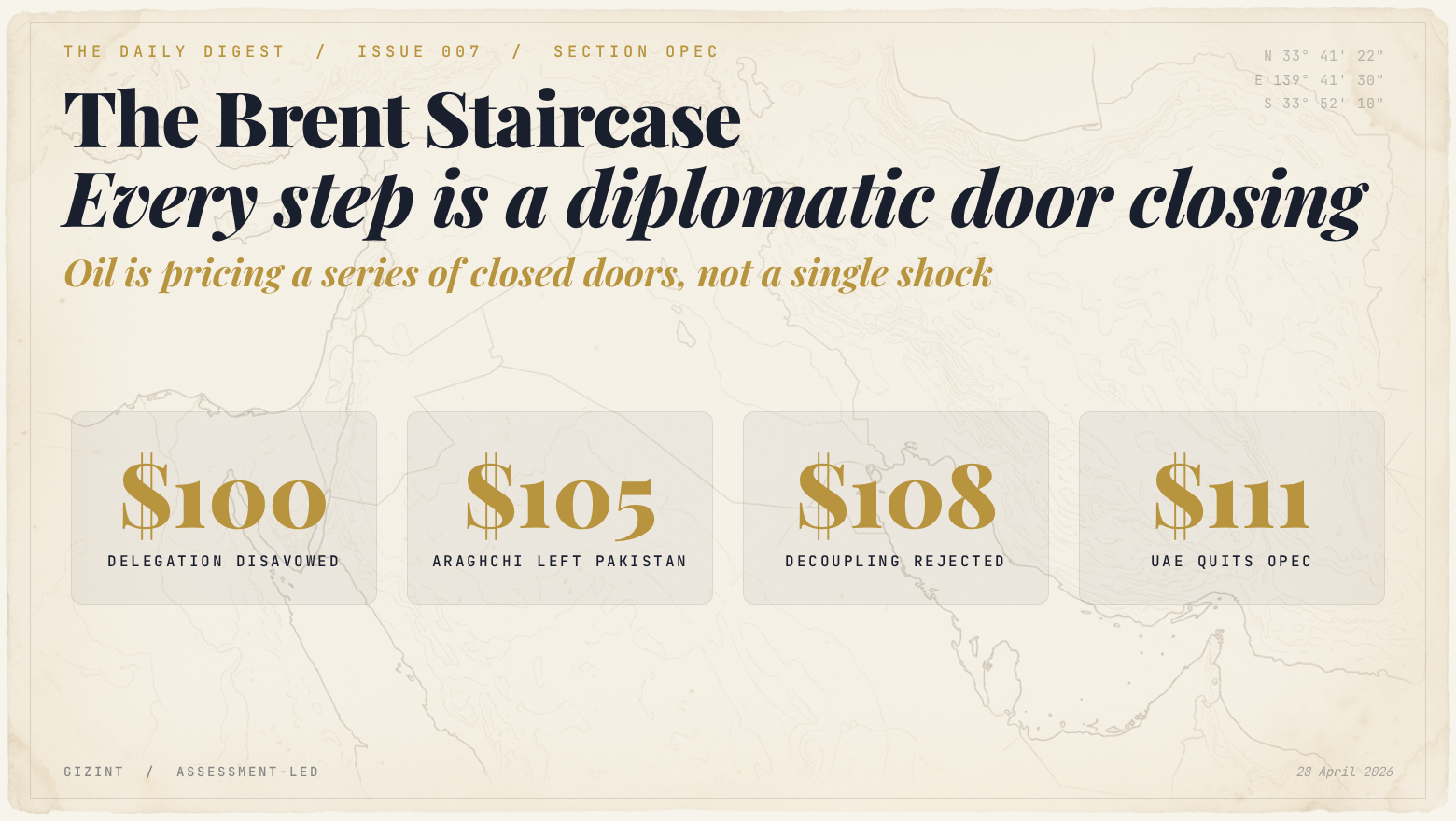
Brent hit $111.16 on Tuesday, up from $108 on Monday and $105 at Friday's close. The price is climbing in steps now, not spikes. $100 the day Iran's diplomatic delegation got disavowed. $105 the day Araghchi left Pakistan before the American envoys arrived. $108 when the proposal to decouple Hormuz from the nuclear file was rejected. $111 when the UAE walked. Each step is one diplomatic door closing.
The UAE's exit looks less like a commercial complaint than a security one. Abu Dhabi has absorbed more than 550 missiles and 2,200 drones since 28 February. OPEC offered no production flexibility and no security coordination. The bilateral alternative is already on the ground: Israel deployed an Iron Dome battery to UAE territory earlier in the war (Axios reported 26 April). The UAE is replacing collective Gulf institutions with point-to-point arrangements with whoever shows up with hardware.
Iraq's foreign ministry put out a statement saying it has "no intention" of leaving OPEC. That sentence is doing more work than it looks like. In March, the Gulf states went silent for 22 days, then issued a public statement, then took unilateral action within 48 hours. The same shape is repeating. The next OPEC+ monitoring meeting is on 3 May, the first one without the UAE in the room.
If a second Gulf state signals before that meeting, the cartel's pricing mechanism stops functioning during the largest supply shock in its history.